Put your Ashes disappointment to one side. For a cricket fan steeped in the history of the game, there can be no more exciting place to stay than the Dorset Square Hotel in central London. This is cricketing nirvana, with the boutique establishment sitting at the site of the original Lord’s ground, built by Yorkshireman Thomas Lord back in 1787 just as the great game was putting down roots.
Lord’s Old Ground
In the gardens opposite the hotel, on the wall of a green hut, a plaque – unveiled in 2006 by former England captain Andrew Strauss – commemorates the Lord’s Old Ground (as it is now referred to), which stood here for 23 years at the heart of English cricket before a dispute over rent forced the game’s headquarters to move, eventually to its present home in St John’s Wood.
Across the road and inside the hotel, the immense cricketing heritage of this area is joyfully celebrated in every nook and cranny. In a corner of the reception the old master himself, W.G. Grace, prepares to take guard in a famous photograph which hangs above an orange and black armchair featuring a playful design of two bats and a ball. Then, on the wall to the left of the front desk, is a selection of old bats in cabinets, the newspaper cuttings wrapped around them displaying photographs and accounts of famous matches.
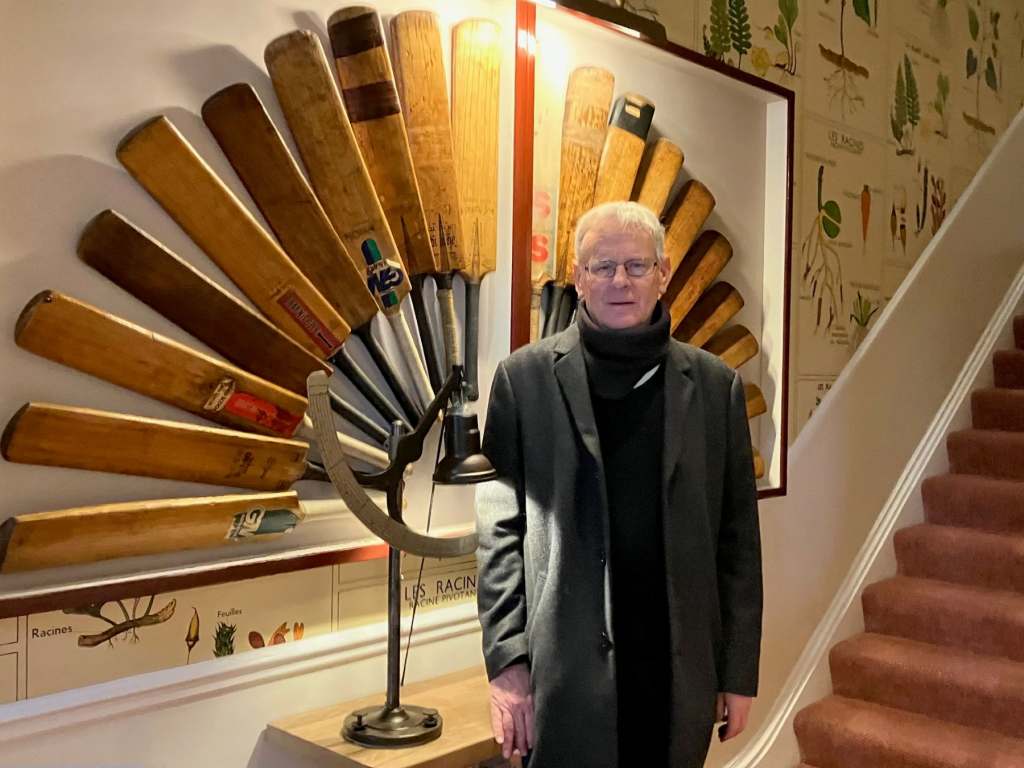
The Dorset Square staff had a competition recently to guess how many bats are displayed around the hotel – the correct answer being 89! In most of the 38 rooms imitation red cricket balls take the place of conventional wardrobe door handles: the elegant drawing room has a selection of 19th century ‘Spy’ cartoons featuring the foremost cricketing characters of the day: and on the wall in The Potting Shed, the hotel’s restaurant and bar, there is a mocked up scoreboard, displaying the score 349-0 with old metal numbers, surrounded by a host of ancient brown bats and stumps.
Firmdale Group
This former Regency townhouse is just a three-minute walk from Baker Street underground, and right on the cusp of fashionable Marylebone High Street with its independent shops, bars, restaurants and galleries. It became a hotel as recently as 1985, the first in the luxury boutique Firmdale group, founded by husband-and-wife team Tim and Kit Kemp. Firmdale comprises eleven hotels as well as nine restaurants across London and New York – The Soho Hotel and Ham Yard perhaps the best known of the capital’s establishments.
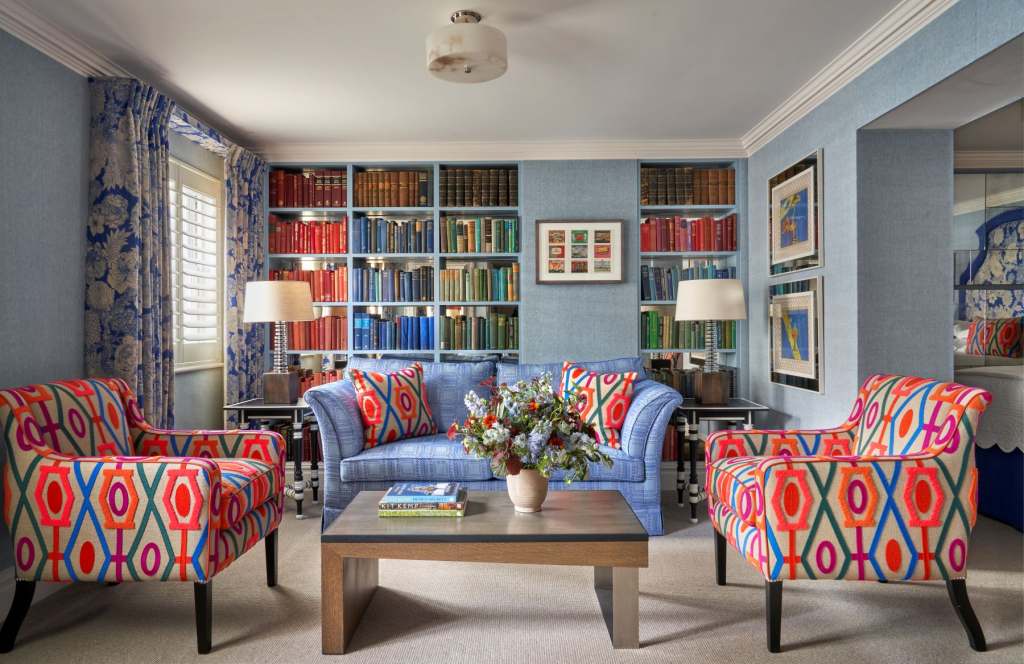
Kit Kemp is the design director and Dorset Square is characteristic of her inimitable bold style, all the furniture decked out in warm, bright colours with striking patterns. It all makes for a welcoming atmospheric, which is complemented by all the staff who bring a generous, informal style to their excellent service.
Deluxe Room at Dorset Square Hotel
Our recently refurbished Deluxe room on the first floor had a splendid view out over Dorset Square Gardens, and at night the Christmas lights and the tree outside the hotel made for a pretty window picture. We had a very comfortable Queen-sized bed (with enormous colorful headboard), and – always important – good reading lights on either side.
The stylish granite and marble bathroom was equipped with a decent-sized bath, a necessary soothing luxury after a hard afternoon pounding the city streets. There was a nice touch in the shape of a tailor’s ladies dummy which made for an excellent coat and hat stand, and four paintings of notable London houses drew you back to Georgian and early Victorian times when this place was in its pomp as a private residence.
The Potting Shed Dorset Square Hotel
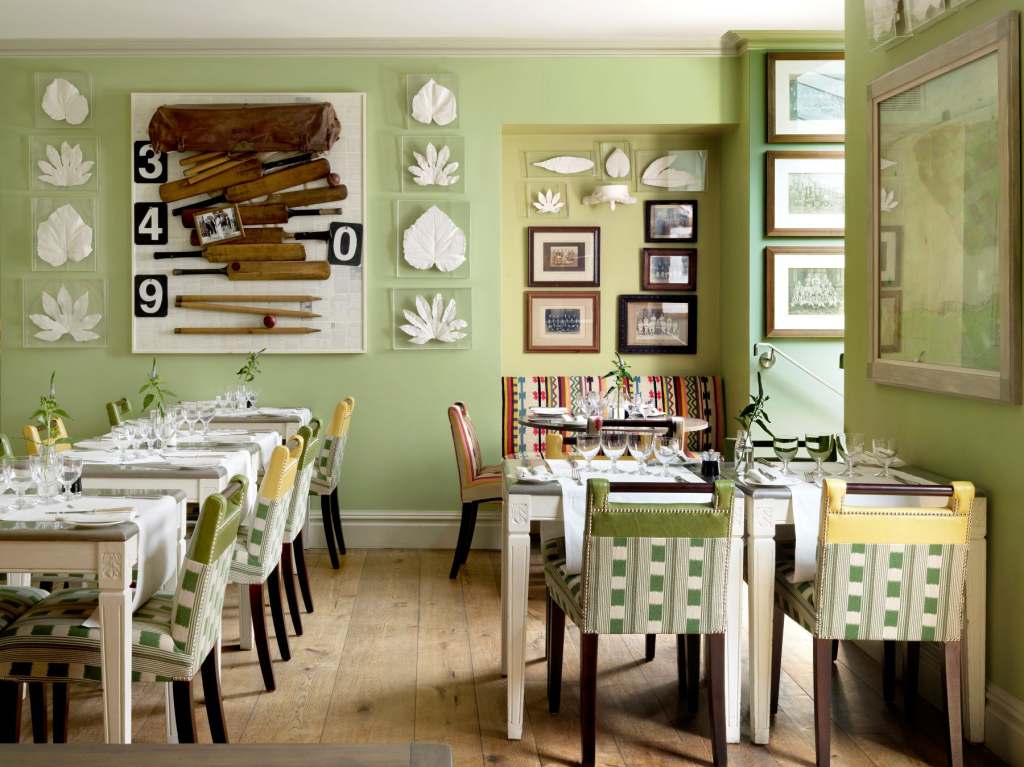
For dinner we took the stairs down to The Potting Shed restaurant and bar in the basement, passing further cricketing memorabilia by way of signed shirts from the Essex Eagles one-day side. Inside the restaurant, in addition to the aforementioned 349-0 ‘scoreboard’ and numerous other old sporting photographs (football as well as cricket), there was an extraordinary art installation covering the entire wall next to our table.
Created by the artist Martha Freud (the great great granddaughter of Sigmund), it features 198 small lights sat in porcelain cups, designed to fade on and off in batches of six to 12, all the while spelling out the names of well-known cricketing personalities and famous sayings.
It was a mesmerising and enjoyably distracting backdrop to our eating, as you would put aside your knife and fork and watch the lights come up and gradually spell out a quote you might just know.
The Potting Shed is a bright, airy, cozy environment with an impressive skylight, grey oak floors and colorful upholstered banquette seating. Our menu was seasonal British/Mediterranean, and on a cold day cauliflower soup, followed by chicken, mushroom and tarragon pie, with tarte tatin as desert, went down very nicely.
The hotel prides itself on its cocktails and, of course, alongside the classics there are the cricketing themed drinks – ‘Silly Midwicket’ (gin and grapefruit based), ‘Body Liner’ (gin, lime and guava) and ‘LBW’ (vodka and lime).
Of course, it’s not all cricket. There is pleasure in viewing the vibrant wallpaper in the hotel corridors, scenes from gardens and forests apparently inspired by a 1950s French botanical school photograph.
Lee Miller at Tate Britain

It was time to explore. When in the capital, we like if possible to combine a hotel stay with a visit to a major art or theatrical event. This time it was a trip across town to Tate Britain on Millbank, where there was an exhibition of the work of the trailblazing American photographer and photojournalist Lee Miller.
Many readers may have learned about Miller from the 2023 biopic ‘Lee’, with Kate Winslet succeeding splendidly in the central role. However, that movie concentrated on Lee Miller’s famous wartime work, and, as we navigated our way through eleven rooms of her material, we realised there was so much more to her life than those six years.
Firstly, she was a high-profile model. Tall and slim, with cropped hair, she embodied the androgynous beauty ideals of the 1920s, and appeared on the covers of British and American Vogue. Her wanderlust took her to Paris by the end of the decade, where she determined to forge a career behind, rather in front of, the camera.
She quickly forced her way into influential artistic circles, and apprenticed herself to two of the great photographers of the day, Man Ray and George Hoyningen-Huene. Much of Room 2 of the exhibition, ‘Dreaming of Eros’, is full of the creative collaborations of Lee and Man Ray (they were lovers too) – highly charged, erotic, experimental works.
Always a rebel against convention, it was inevitable that Lee would join the Surrealist movement in the 1930s. Then, with an Egyptian businessman for a husband, she moved to Cairo and embarked on expeditions across the Middle East, recording ancient landscapes and ruins alongside industrial modernity.
Inevitably, perhaps, her wartime portfolio is the most arresting of her magnificently varied body of work. With a propaganda hat on, her stark photographs of Britons bravely enduring the Blitz will have helped to convince her American audience that their island cousins merited their help. ‘You Will Not Lunch in Charlotte Street Today’, a brooding depiction of the aftermath of a bombing raid, is characteristic of her work for Vogue in this period.
Ultimately though Lee longed to be in the field, in the midst of the action, and after much lobbying she got her way and joined the troops after D-Day. Alongside photographs of badly burnt soldiers and destroyed towns, the most famous photograph of them all, of her taking a bath in Hitler’s abandoned flat in Munich, is here, as are her horrific shots of piled up bodies in the concentration camp of Buchenwald.
Just as affecting in a very different way is Lee’s 1944 photograph of two young refugees leaving Luxembourg in the back of a cart, their tired, resigned expressions summing up the misery of a continent.
Back at Dorset Square Hotel, a cup of tea in the warm glow of the lovely Drawing Room with its high ceilings and Regency windows came as a welcome antidote to the grim truths of the Miller photographs. Then it was time to pack our bags for home, comfort and culture having been satisfactorily realised.
Dorset Square Hotel
Dorset Square Hotel, NW1
For more information on the Dorset Square Hotel London, click here.
