


Mark Bibby Jackson visits Blazny, Montceau-Les-Mines and Le Creusot, as he follows the trail of industrial heritage in Creusot Montceau, Burgundy.
I think it’s fair to say that attitudes towards mining have changed with time. What was once perceived as a filthy business is now regarded as part of our cultural heritage. Perhaps this is most noticeable in the Nord-Pas de Calais Mining Basin which received UNESCO recognition in 2012, but it also applies to other parts of France including a small area of Burgundy. A region more noted for its wine.
Visiting the Museum of the Mine in Blazny it is impossible not to detect the scent of pride which has far outlasted that of the coal dust.
Museum of the Mine, Blazny
The museum charts the history of mining in this part of Burgundy through the past two centuries, although mining in the region can be traced back to the 16th century.

As late as the start of the 19th century the area was predominantly farmland, with a small community in Blazny. Then Jean-Francois Chagot became owner of a foundry and crystal works at Le Creusot as well as the mines in 1818.
Over the years the family sold off parts of its industrial empire to focus on the mine. In 1833, Jules Chagot, son of Jean-Francois, founded the Blazny Mining Co. At its peak the mine had 200 shafts and was spread across eight levels. At the end of World War I some 13,000 people worked here.
Although a statue of Jules Chagot stands near its entrance, the museum is not about mine owners but about those who worked in them. In fact, the museum was opened in the 1970s long before the mine closed in 2000, by the workers, who still run it.
There are more than 600 objects including an impressive array of lamps, including a Davey Lamp, which you can see on a guided tour held in English upon pre-arrangement. The shaft is still functional, although you cannot visit it.
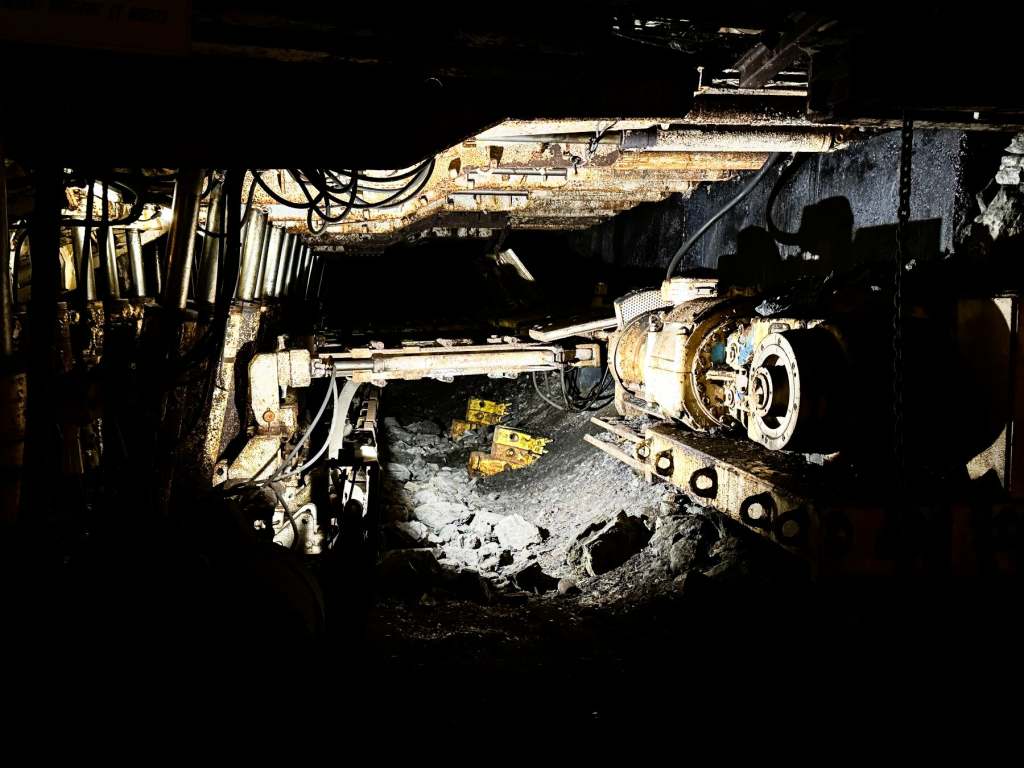
The most impressive part of the museum is the gallery created by the miners to represent what life was like working down the mines. Unlike some mines I have visited, you do not have to descend down a shaft to reach the gallery, as this is a reconstruction rather than the real thing, but it is most convincing. Walking along the gallery you see all the different machinery used in the mines.
There are also some interesting photographs including that of Radeau, who was the last horse to work down the mines. A certain Monsieur Honoré sold his car to save the Radeau from the butcher’s. Horses were not popular with all as they were treated better than the men.
A Tour of Industrial Heritage in Montceau
As the mines developed, there was a distinct shortage in labour force, if not horses. Consequently, men were brought to work here from Poland and Italy as well as other parts of France.
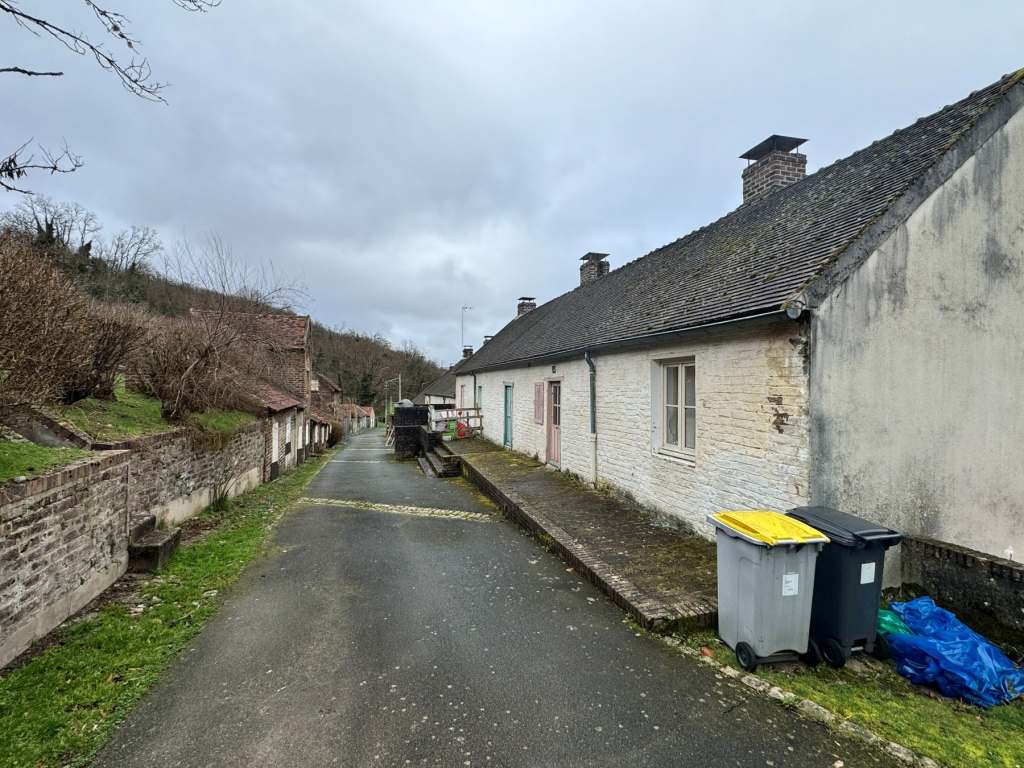
Apart from the wages part of the attraction was the quality of housing provided. Apparently, the health of the workers was held in high regard, as that allowed them to work more efficiently, so the miners’ cottages had small gardens.
Some of the cottages still survive, with perhaps the most impressive standing in the neighbouring town of Le Creusot – the Combe des Mineurs, which was built by Manby and Wilson, two British engineers, based on similar miners’ cottages in Wales.
Like so many former mining communities, the landscape has been transformed since the closure of the mines. Two large landscaped parks – Maugrand and Saint-Louis – have been created from the former mines. The parkland includes lakes created from the quarries and pits, as well as Infinite Circle, a very attractive wooden sculpture by Marc de Roover, a Belgian artist.
Le Creusot
Neighbouring Le Creusot started to develop in the 18th century when first mines were created in 1769 and started to flourish when the Royal Foundry was established in 178. The crystal glassworks factory opened in 1787, and was dedicated to Marie-Antoinnette as an industrial palace. Timing could not have been much worse as the queen was to get her just desserts during the French Revolution of 1789.
The foundry was bought by Manby and Wilson in 1826, at the time the Chagot family were focusing on mining. The glass furnaces were located in two conical buildings according to the English-style currently in vogue then. The Royal Foundry was then closed down before being bought by Adolphe and Eugene Schneider in 1837. The Schneider family diversified into heavy manufacturing such as sheet metal for ships and armaments.
Château de La Verrerie
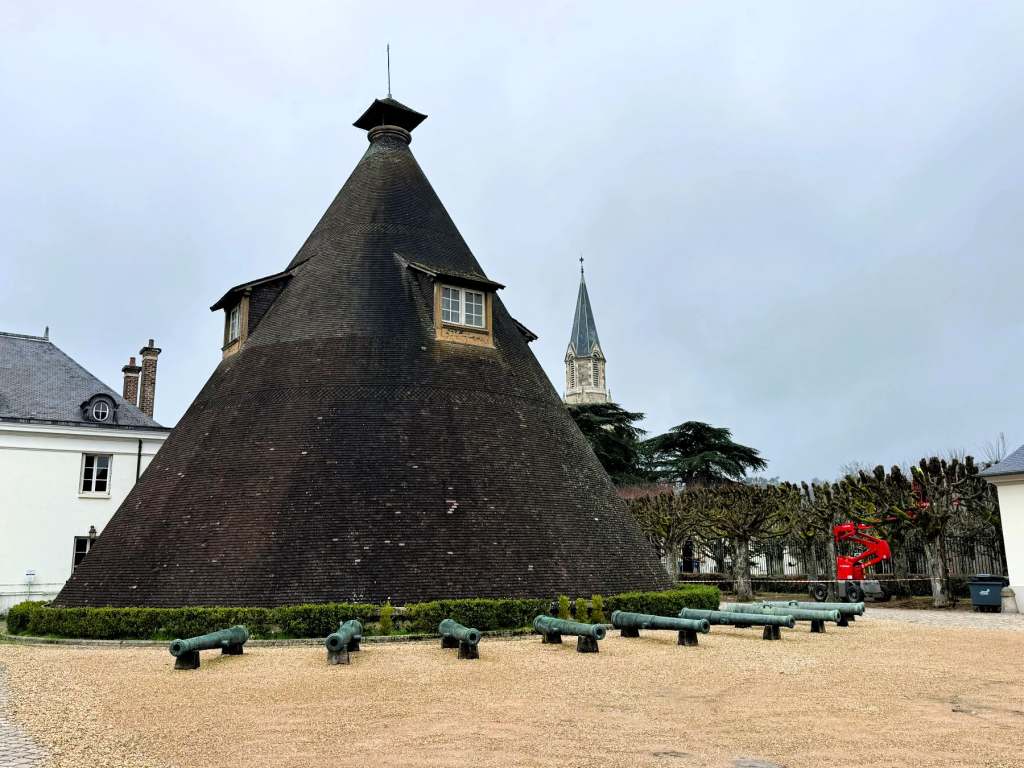
Renamed the Château de La Verrerie, the foundry was completely transformed into a place to entertain clients, and politicians between 1905 and 1911, in the style of an 18th century chateau.
In some ways this is an early example of how a former industrial space can be converted into a cultural or social space.
Château de La Verrerie leant heavily on its royal tradition, with images of the ill-fated Marie Antoinette appearing on crests around the property, as well as allusions to both her Hapsburg dynasty, and the armaments from which the Schneider family made much of their money.
One of the conical towers was converted into a small theatre, while the other became a chapel. Around the chateau the most ornate gardens were created as well as parkland in the English romantic style. The guests must have been impressed as the contracts continued to flow, as war beckoned.
Museum of Man and Industry
Now Château de Verrerie houses the Museum of Man and Industry. This has sections on the history of the Schneider family and that of the foundry-cum-chateau, as well as a selection of crystal ware.
There is also a Pavilion of Industry which has an exhibition on the industrial history Le Creusot, although sadly it was closed during my visit. The little theatre still remains – and is a wonderful space which somewhat disappointingly is used for meetings and corporate events rather for performances, although you can visit backstage as well as understage, a fascinating experience.
The parkland, once private reserve to the Schneiders has now been opened to the public and includes a small petting farm.
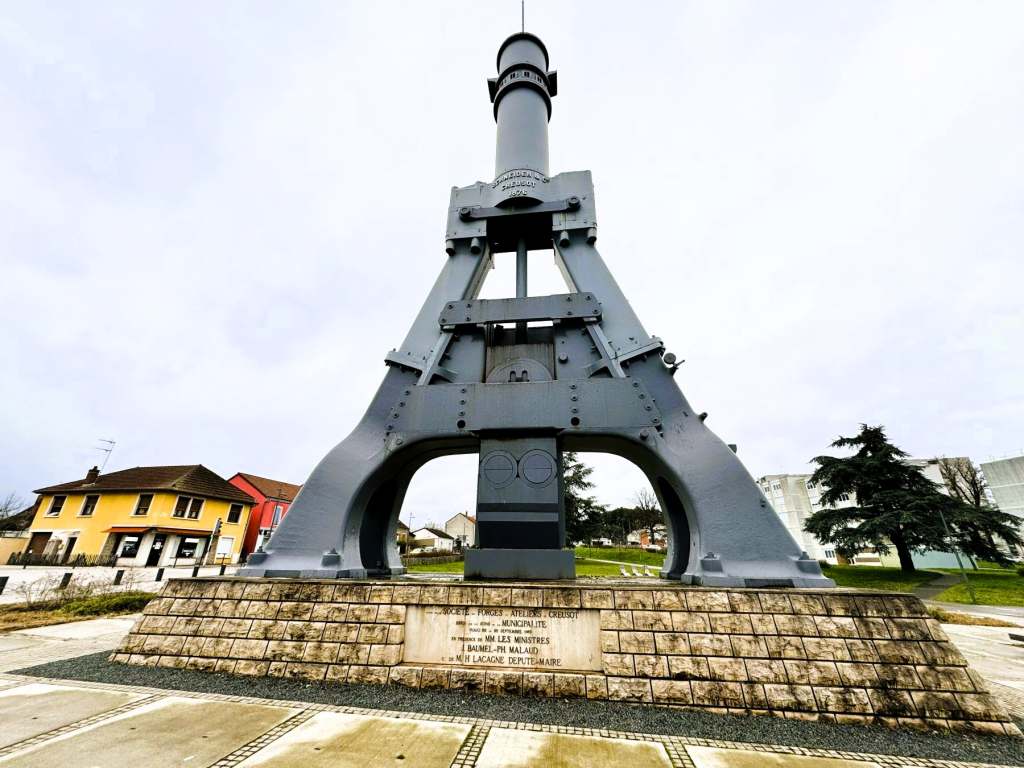
Perhaps the most famous machinery in the Royal Foundry was the steam hammer, which when built in 1876 was the largest in the world. Apparently, you could hear it from miles around as it pummelled sheet steel for ships. Now it stands on the entrance to Le Creusot proudly proclaiming that this city was built on industry. It is the symbol of the industrial heritage you can visit in this little part of Burgundy.
Things to Do in Creusot Montceau
To discover more about the things you can do in Creusot Montceau, visit the local tourism website which is a mine of information.
Where to Stay and Eat in Creusot Montceau
Mark stayed at La Belle Epoque, a lovely hotel right in the heart of Le Creusot, which served a great breakfast. He ate at the Restaurant du Château, an amazing restaurant in the village of Saint-Sermin-du-Bois just outside of Le Creusot, which specialises in fresh and seasonal produce.
Mark’s Road-trip through France
Mark travelled through France in February 2026 on his own, taking the ferry from Dover to Calais and then driving through Pas-de-Calais to Chartres, on to the Dordogne Valley, across to Burgundy, and then up through Burgundy back to Calais. He took the DFDS ferry using their excellent priority boarding and premium lounge service.