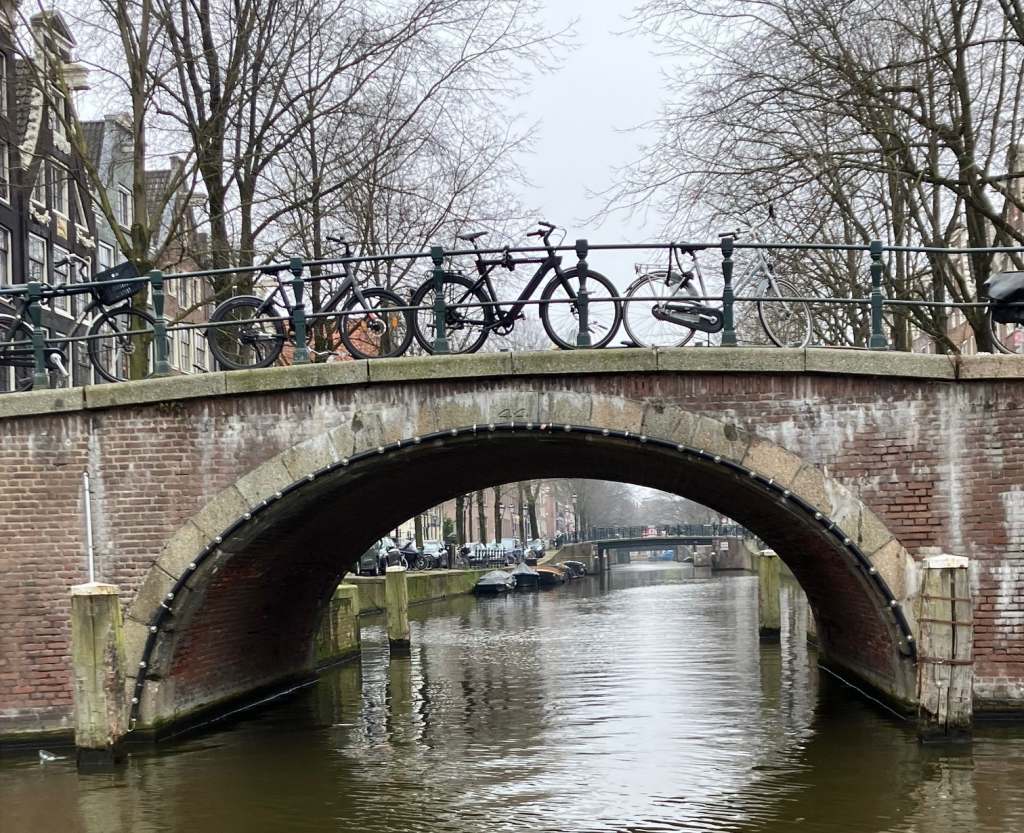
In Amsterdam, there’s nothing quite like messing about in boats to get the measure of the place. So, on a cold, grey, but mercifully dry, winter’s morning, we took to the water for a fresh introduction to the sights, sounds and past glories of this fine city.
We would cruise on an eco-friendly, electric powered canal boat with our friendly skipper Stephen, or ‘Captain Nemo’ as he is otherwise known in these parts, at the helm. Captains on his KINboat company have to be as much historian as navigator, and Stephen fitted the bill splendidly.
Amsterdam Canal Trip
Starting at a berth just opposite Anne Frank House, he guided us along the main concentric canals of Prinsengracht, Keizersgracht and Herengracht, all the while pointing out fascinating details and telling stories about the attractive canal side houses which sprang up in the city’s ‘Golden Age’ (17th century).
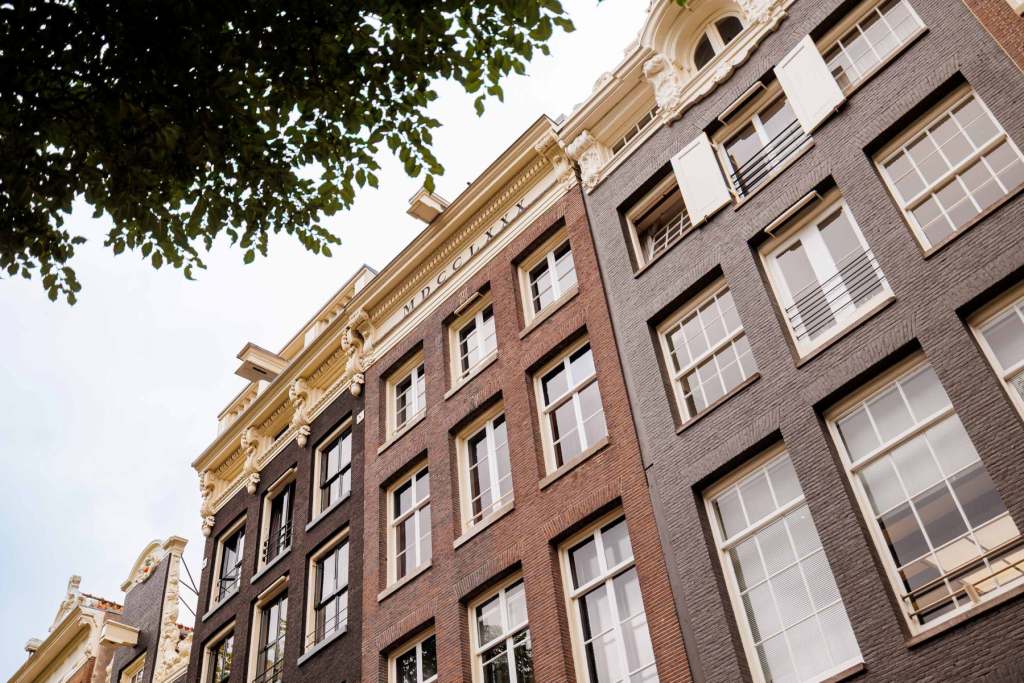
In that period no house numbers existed, so the wealthy merchants identified their fine, slim, tall properties by means of decorative stone tablets placed high up on the building, often depicting the owner’s trade, or a scene of personal significance. Once Stephen had pointed out the fine carving of a roebuck, it developed into a game to find the next one; a coat (reflective of the then thriving cloth trade), a sailing ship, a flask and two goblets, a bison, a fox and an elephant.
Stephen had some tales to tell, too, about the occupation of the city in World War 2. As the great church of Westerkerk came into view, he reminded us that the country’s Nazi ruler, Arthur Seyss-Inquart, ordered that the bells of the city’s churches be melted down for the German war effort. But, said Stephen, the great bell of the Westerkerk was saved because Seyss-Inquart, an art lover, was enamoured of Rembrandt, whose pauper’s tomb is buried at the church.
The Toren Amsterdam by The Pavilions
Finally docking after our hour-long trip, it was just a three-minute walk to our hotel The Toren, Amsterdam by The Pavilions, spread over two 17th century houses by the side of the Keizersgracht canal. This attractive establishment, comprising 40 rooms, is part of The Pavilions Hotels & Resorts Group, a collection of boutique luxury hotels around the world.
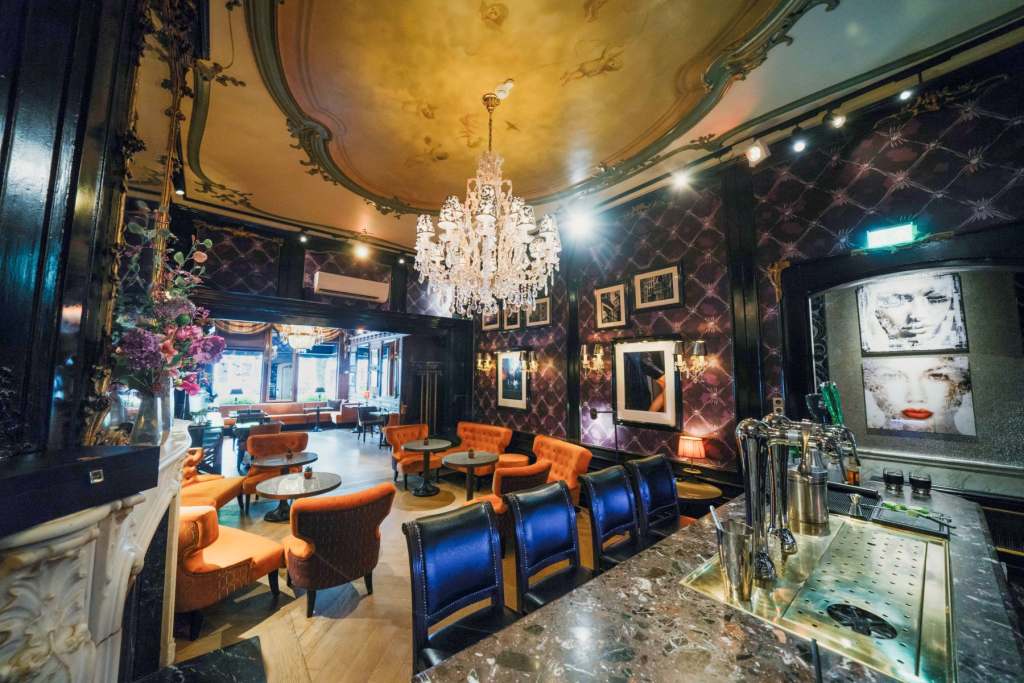
Before it became a hotel in 1968 The Toren enjoyed a fascinating history as private houses. Early in the 19th century the property was owned by the Bienfait family, descendants of French Huguenots who had fled religious persecution. Later in the century it was home to Abraham Kuiper, founder of the Dutch Anti-Revolutionary Party, who became Prime Minister in 1901. Then during World War 2 it became a safe haven for twenty people, most of them Jews, who escaped the Nazi round-up; remarkably all of them survived the war, unlike Anne Frank and her family who were hiding out around the corner in Prinsengracht.
The architectural grandeur of the Golden Age survives on the exterior of The Toren, and inside too the dark, decorative wood-panelling, painted ceilings and stucco moulding are redolent of a prosperous past. Red, black and purple tones predominate, while antique mirrors, chandeliers and wall hangings feature in the main public rooms and corridors. All in all, there is a cosy, relaxed atmosphere about the place.
After receiving a warm welcome at reception (the staff at The Toren are unfailingly friendly and helpful) we made our way to our room on the first floor. The highlights of our Deluxe, garden facing room were a supremely comfortable king-sized bed and, a real luxury, an enormous whirlpool bath. A spacious walk-in shower and excellent reading lights by the side of the bed enhanced the experience.
Our room also boasted a unique feature, a beautiful stained glass window high up in the top left hand corner of the room. At the heart of it appeared to be a sunflower motif, and amongst the exquisite yellow, green, and light and dark blue panels there appeared to be a number of figures engaged in prayer. The window is an adornment whose history no-one in the hotel is quite sure about, but this churchlike splash of colour added mystery to the surroundings.
We enjoyed breakfast in the informal setting of the bar lounge, a perfectly satisfactory menu of fruit, granola, cold meats, toast, pancakes and eggs. The hotel has no restaurant, but does provide evening meals courtesy of an arrangement with the Black and Blue steakhouse around the corner – and there are vegetarian options available too.
Dining in Amsterdam
In fact, Amsterdam is fast making up ground on other European capitals in the culinary stakes. The proof was in three terrific evening meals we enjoyed during our stay; one Italian, one Indonesian and one French, all within a few minutes’ walk.
The first was at atmospheric Momenti on nearby Herenstraat, where we enjoyed a superb starter, a Sicilian sweet-sour caponata with fresh burrata and toasted almonds, followed by an equally delicious homemade tagliolini with lamb ragu.
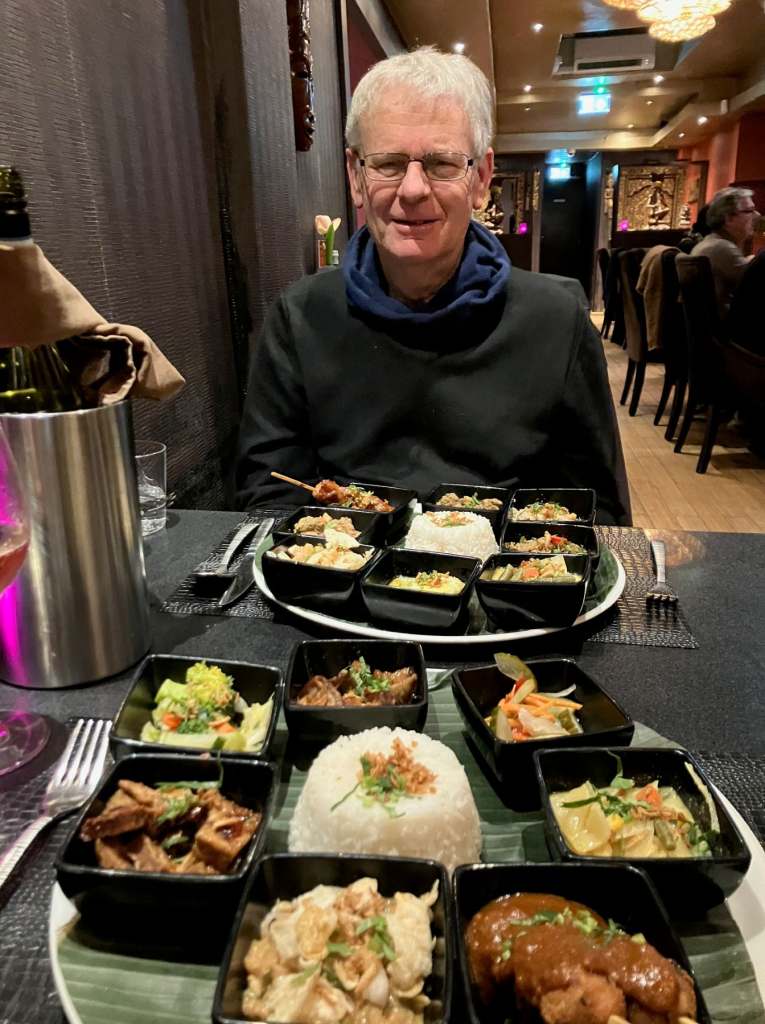
At buzzy Long Pura restaurant on Rozengracht, we ate our way through a delicious Chef’s Ricetable, featuring a mix of fish and meat in coconut and spicy sauces. Then on the final night came perhaps the piece de la resistance, dinner at the Belhamel French restaurant on Brouwersgracht.
The canal side restaurant’s Art Nouveau features evoke the romantic atmosphere of fin-de-siècle Paris, and it’s clearly doing everything right as the place was packed out on a Wednesday night in the heart of winter. The food was exquisite; a starter of creamy savoy cabbage soup with slow-cooked pork belly, followed by Tournedos Rossini accompanied by green asparagus, potato rosti and black truffle gravy.
Walking around Amsterdam
Rich meals require walking off, and Amsterdam is the quintessential walking city; if you can avoid the hordes of cyclists who zip around every corner and over every bridge. The aforementioned Anne Frank House, just on our doorstep, was an obvious first destination.
Anne Frank’s House
Surprisingly neither of us had been there, despite previous visits to the city. The story of 13-year-old Anne, who took refuge in the Secret Annex to her father’s office/ warehouse as the Nazis began their hunt to round up the city’s Jews, is known all over the world through the legacy of the intimate diary she kept during her two years of confinement.
‘It’s more like being on holiday in some strange pension,’ Anne wrote optimistically just five days into her incarceration. ‘The Annex is an ideal place to hide in. It may be damp and lopsided but there’s probably not a more comfortable hiding place in all of Amsterdam. No, in all of Holland’.
Step beyond the bookcase which hides the door to the Annex, just as Anne and her family did on that fateful day in July 1942, and you are transported back to those tension-filled days. It was stripped of all its furniture long ago, yet the museum here is a superbly evocative recreation of what life was like for those eight individuals; Anne’s bedroom, with its pictures of movie stars, perhaps the most poignant.
The betrayal of the hideout would ultimately lead to death in the concentration camps for all but one of the Annex’s residents; Anne’s father Otto. His recorded interviews many years later are a sad but vital feature of the display.
Resistance at the Verzetsmuseum
The Nazis rounded up around 70-80,000 Jews in Amsterdam and dispatched them to the death camps. But there was a vigorous resistance movement in the Netherlands, and we travelled across town to the Verzetsmuseum to learn all about it.
This was an exemplary museum with audio, video and interactive displays, and packed with vivid personal stories of the resistance through the eyes of resisters, forgers, collaborators, German soldiers and ordinary Amsterdammers.
Of all the stories, the one that lingers longest in the memory is that of nine-year-old Settela Steinbach, a Sinti girl rounded up along with her family and taken to the Westerbork transit camp before being transported to Auschwitz. She is seen briefly on film, stood at door of a packed train car as she is about to go on her last journey. Her face, bewildered and fearful, is utterly haunting.
Van Gogh Museum
Given the magnificence of Dutch Art in the Golden Age and beyond it would have felt negligent not to have observed some of it at close quarters. So rather than the granddaddy of them, the Rijksmuseum, or the equally splendid Stedelijk Museum, we opted for a visit to the Van Gogh Museum. Not all of the tortured genius’s work is held here, but there is a good deal of what was bequeathed – along with their letters – by his close brother Theo. One of the Sunflowers set is here, as is the yellow-suffused The Bedroom from his time in Arles, and perhaps best of all, Wheatfield with Crows from his manic final days.
The famous – or infamous – coffee (cannabis) shops are still here, and the whiff of marijuana catches the nostrils from time to time. We opted instead for your regular coffee, often accompanied by savoury pancakes which go down well here. We also spent half an hour in the enticing Amsterdam Cheese Museum and shop on Prinsengracht, enjoying free samples of Gouda, Edam, Leyden and Limburger and receiving an education in the country’s cheesemaking history.
The Catboat
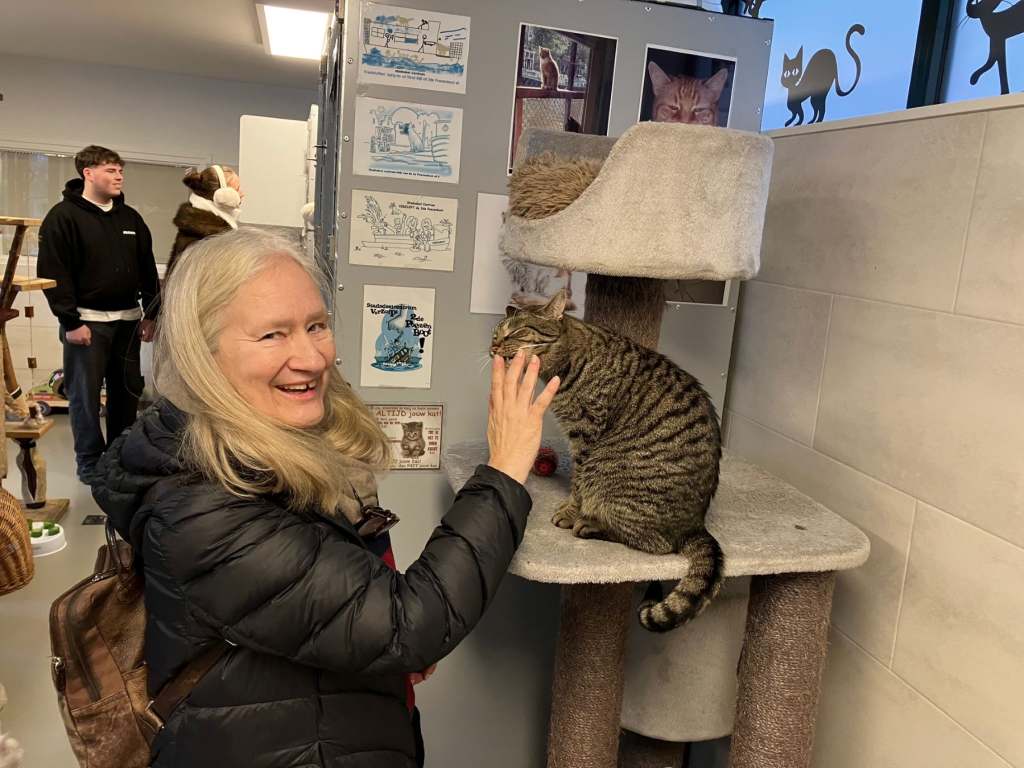
With two cats of our own it was perhaps inevitable we would make an enthusiastic beeline for one of the city’s most unusual yet hugely popular tourist venues – De Poezenboot, or The Catboat, surely the world’s only cat shelter where the animals live on a houseboat on the canal.
We were lucky to get on board – the very last visitors of the day. The cat boat originates from the 1960s, after Henriette van Weelde, known locally as the ‘Cat Lady’, ran out of space for all her stray cats and a boat by the canal was the solution to help house them all.
The goal for today’s dedicated group of volunteers is to find homes for the stray and unwanted cats if possible; if not, to look after them in a congenial environment of cushions, baskets, beds, climbing frames and scratching posts. They can venture outside on the boat, although there is a fence to make sure they never fall in the water.
Some were in (comfortable) cages but most were wandering happily around, fairly oblivious to visitors but happy to be stroked and fussed over if necessary. One or two are likely never to leave because of emotional problems or disability – including Bear, a lovely, friendly Turkish angora who was totally blind.
The cat boat is the most therapeutic of environments; a good place to conclude our various expeditions around the city. We would catch our Eurostar train the following morning with another stack of fond memories from this most welcoming of European cities.
