Bodensee? Bet you’ve never heard of it. And neither had I until I stepped off a train from Munich to find myself on lovely Lindau Island and gazing out over Lake Constance.
For Bodensee is the German name for the lake, the third largest in Europe, which, with an area of 152 square miles, makes Windermere look like a mere puddle.
These days the name has come to encompass those parts of the four countries which surround this inland sea on the northern edge of the snow-covered Alps.
Although, to be accurate, there are only three – Germany, Austria and Switzerland. But the tiny principality of Liechtenstein is a mere stone’s throw away, so that gets lumped in too.
Four Countries in a Day, Or Not
You could, if for some odd reason you wished, “do” Bodensee with a sort of cruise ship passenger’s mentality and happily tick off another four countries visited in just one day.
“Oh yes, we had a hearty breakfast in Germany, a light lunch in Austria, delicious dinner in some other place called Lichtenstein and then a nightcap surrounded by cuckoo clocks in Switzerland. All very nice, of course, but I can’t remember much about any of it now.
“Anyway, we’re going somewhere else, tomorrow. France, I think. Then again it might be Belgium? Or are they both the same place?”
But, why on earth would you want to.
Because, let’s be honest, who actually enjoys traipsing along behind a guide carrying an umbrella or a little flag who gives a running commentary through your earpiece, most of which you will, of course, instantly forget?
Far better to linger and spend a few relaxing days taking a network of trains, buses and ferries to explore Europe’s hidden gem.
Especially as for around £50 you can buy a three-day travel pass giving unlimited journeys.
Bodensee, Germany
The lake itself is some 40 miles long and five miles wide, with 125 miles of shoreline. And the warming influence of the water, which gathers heat during summer before releasing it in winter, gives the region its own pleasant all-year-round micro-climate.
So even in the coldest winters, the water has only frozen over once in the last 200 years.
But it’s not just the awe-inspiring natural scenery that makes Bodensee so beguiling. There are so many interesting places to visit and fascinating things to do.
Lindau Island
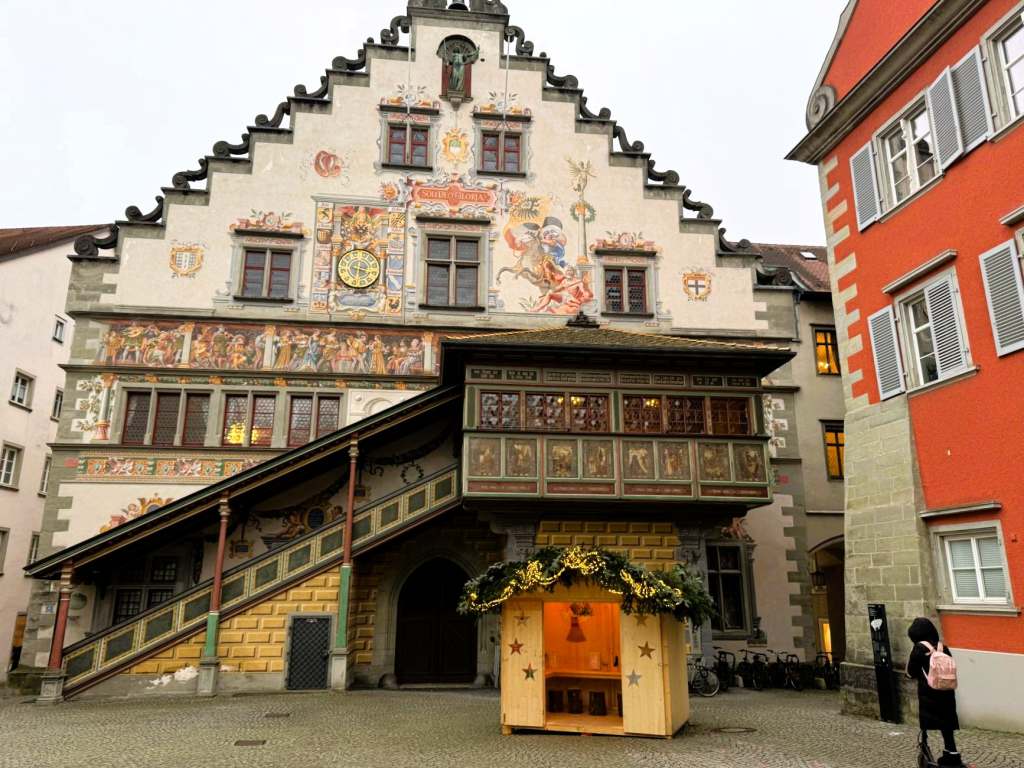
Take Lindau Island, where I get off my train, walk out of the station and find myself by the harbour of what is arguably the most charming town in all Bodensee.
Towering over the bay is a 20m high square 12th century tower called the Mangturn, which was once part of the medieval fortifications before being turned into the local lighthouse.
These days it’s just a picturesque tourist attraction. Clamber up the 91 steps to the top and you’ll end up a little out of breath but with a magnificent bird’s eye view across the lake to the Austrian mountains.
Once back down to earth, guide Kristen Azouz gives me a whistlestop tour through the cobbled streets, and past the even taller Thieves Tower, where once they would lock away the local miscreants.
There’s a wonderfully-decorated Gothic old town hall, the 1,000-year-old St Peter’s Church and some classy-looking shops lining the wide pedestrianised boulevard called Maximilian Street.
I’d love to linger longer, explore more and enjoy a beer or two in one of the cosy bars, but I’ve a date for dinner in a different country. So, I clamber on another train and 10 minutes later hop off in the Austrian town of Bregenz.
Bregenz, Austria
You can take a cable car from here to the top of Mount Pfander. I’m here in December, though, and choose to explore the charming old town instead before watching the beautiful sunset over the lake.
Then I wend my way through a maze of colourful Christmas market stalls from the Hotel Messmer before tucking into a hearty dinner at the Gasthaus Kornmesser.
Go there in summer you’ll catch the Bregenzer Festspiele, when every night for a month up to 7,000 opera fans cram on to the world’s largest floating stage which juts out spectacularly into the lake.
Summer 2026 is its 80th anniversary, with Verdi’s La Traviata being performed between July 22 and August 23. There’s also an annual jazz festival in June
St Gallen, Switzerland
The following morning, I take another train and 25 minutes later am in Switzerland at St Gallen, a World Heritage site with its Baroque cathedral, vibrant cultural life and regular festivals.
It’s raining heavily when I arrive, which is perhaps not surprising. For with 151 days of rain or snow every year, St Gallen is wetter than Manchester. Somewhat more picturesque, though, lying at the foot of the Appenzell Alps.
Konstanz Back in Germany
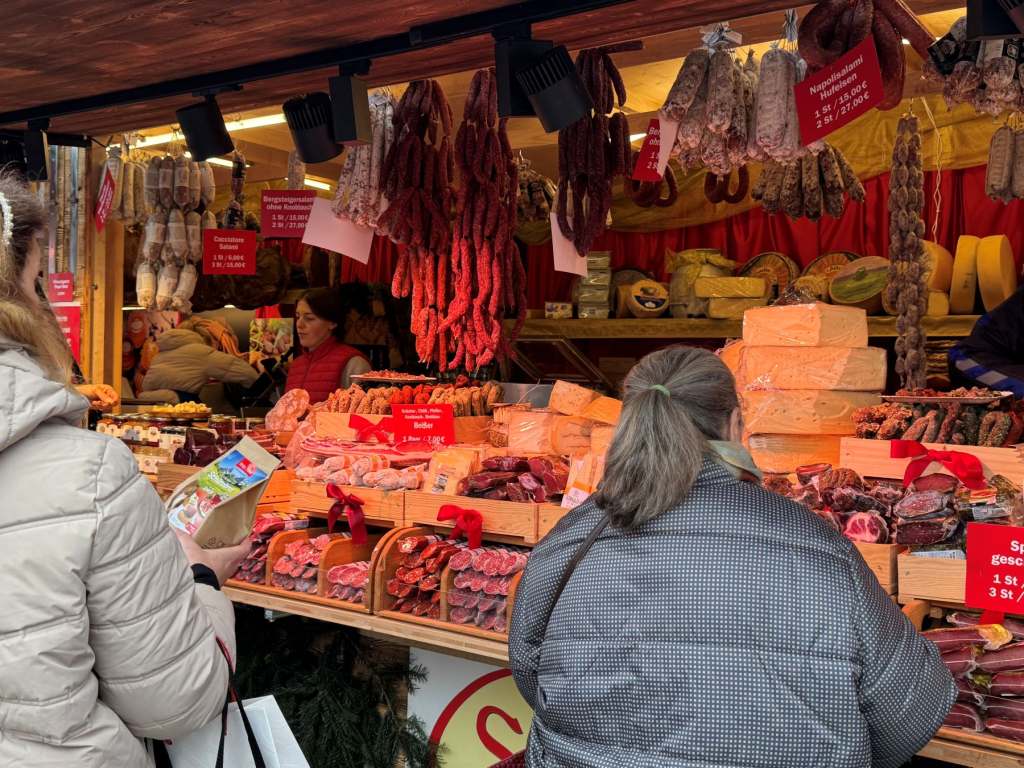
Forty-five minutes away on an afternoon train is the German town of Constance, or Konstanz as the local spell it, the largest town around the lake and the one which shares its name.
The medieval Niederburg district is a fascinating maze of narrow, twisting cobbled streets crammed with little restaurants and wine bars leading down to the harbour with its controversial 30-foot high revolving Imperia statue.
Positioned at the end of the pier, sculptor Peter Lenk’s work shows a woman gripping two men – one, rather bizarrely, a naked 15thcentury Pope – in her hands.
A short bus ride out of the town and then a 10-minute walk takes me to Mainau Island, or Flower Island, where thanks to the almost year-round subtropical eco-climate, banana and palm trees grow.
There’s also a stunning baroque palace built by Germany’s ferocious Teutonic knights, and during summer more than a million tulips, rhododendrons, roses and dahlias bloom here.
In winter, though, it is transformed into a magical fairytale wonderland, with hundreds of gaily-coloured illuminated tableaux and displays.
Friedrichshafen and Zeppelin
Ferries from Constance criss-cross the lake in all directions and after a night in the welcoming Hotel Constantia I take a 50-minute catamaran trip to Friedrichshafen.
This little German town is best known as the home of the Zeppelin, the mighty flying machines which struck fear in the hearts of our great grandparents during the first world war.
During summer you can take Zeppelin sightseeing flights, which must be a spectacular and truly unforgettable experience as you gaze down at Bodensee from 1,000 feet.
But, alas, they don’t operate during winter so instead I take a trip round the harbourside Zeppelin Museum, which is almost as good.
There’s a huge replica of the Hindenburg airship, which, at 803ft long with a 135ft diameter, was the largest aircraft ever built and almost four times the length of a Boeing 747 Jumbo Jet
With its top speed of 87mph, the Hindenburg revolutionised travel during the 1930s, meaning you could fly to America in just two days, or half the time it took to sail across the Atlantic on the Queen Mary liner.
Of course, it wasn’t cheap; a one-way ticket cost the equivalent of £5,000 in today’s money. But it was certainly luxurious, with individual cabins, showers, a restaurant, bar and bizarrely even, despite the seven million cubic feet of highly explosive hydrogen just overheard, a smoking salon.
Sadly, the era of airship travel came to a tragic end when the Hindenburg crashed and burst into flames while landing at New Jersey in 1937, killing 36 of the 97 crew and passengers on board.
But don’t worry about suffering the same fate on one of the modern Zeppelin flights from Friedrichshafen. These days airships use the much-safer non-flammable helium.
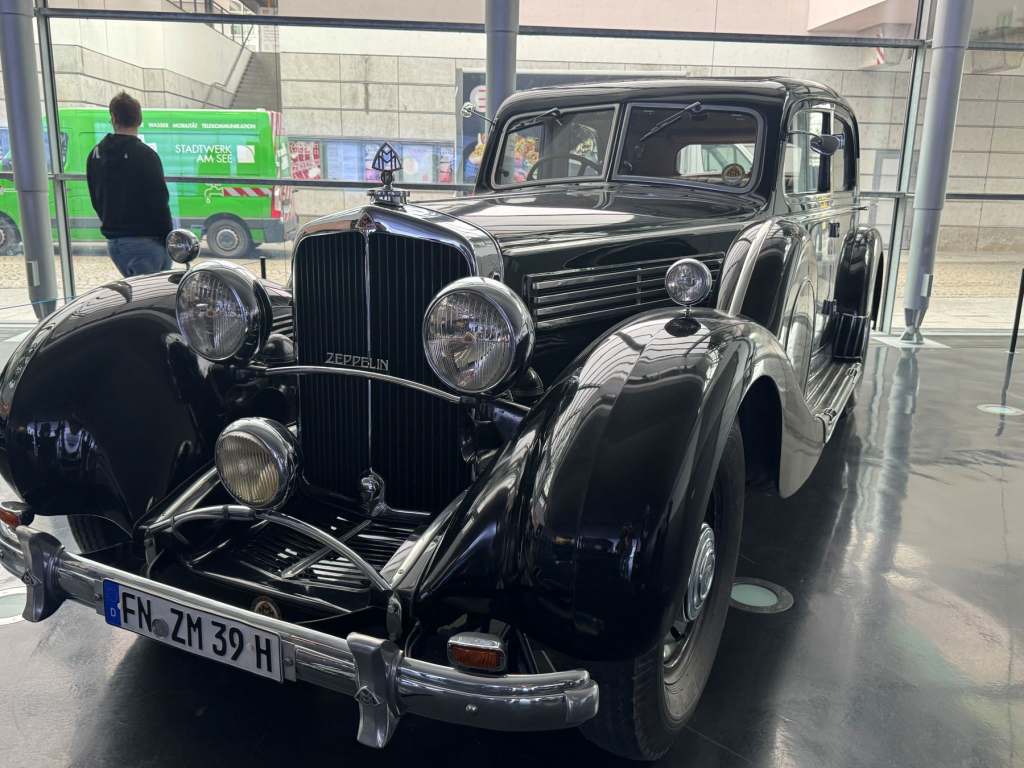
By the way, the museum also features a Zeppelin car. Built in Stuttgart by Maybach during the 1930s, this three-and-a-half ton monster with an eight-litre engine could reach more than 100mph.
Sadly, Friedrichshafen is to be end of my Bodensee tour. A delicious dinner at my four-star SEE Hotel and then the following morning it’s a train back to Lindau Island to catch my connection to Munich.
Waiting on the station platform, I rather hope it might be cancelled so I can stay another day. But with typical Teutonic efficiency, the train arrives bang on time.
For more details of the Bodensee are: what to see, what to do and where to stay – check out the local website.
