I am not usually too interested in museums, and especially not when the sun is shining outside, but at the Cité des Climats et Vins de Bourgogne in Beaune, I found myself genuinely piqued.
It did help that the subject was about wine, which is a topic close to my heart, but also (major confession), something which, despite writing about it for a couple of decades, I still find a bit Greek to me. As I emerge an hour later having been expertly tutored by my guide Lea Phelippeau, I declare myself an expert. Well, less a novice at any rate.
Cité des Climats et vins de Bourgogne
Probably the first thing to realise is that climats has nothing to do with climate; it derives for the Greek for slope (I did say it was all Greek), and refers to the individual parcels of land. There are some 3,000 in Burgundy. The landscape is protected by Unesco, and stretches for 60 kilometres and includes 40 villages.
The second thing is that in Burgundy there are only two main grapes; chardonnay for white and pinot noir for red. These constitute more than 90% of all Burgundy wine, the rest being aligoté and a little gamay.
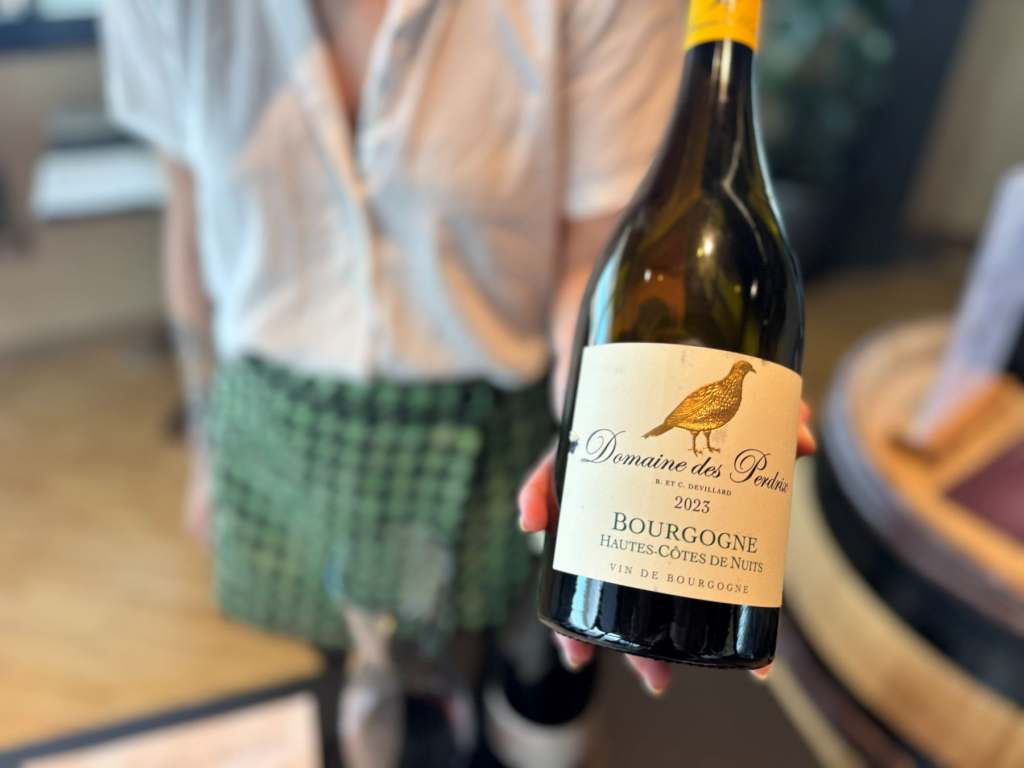
The final lesson is that Burgundy wine is graded, with the Grand Cru at the top, followed by Premier Cru, and then village wine (where all the wine is from the same village), and regional wine, where the wine can come from anywhere in Burgundy (Bourgogne). So, both grand cru and premier cru wines can only come from the same climat. Only 33 climats are grand cru, or roughly 1% of the total, and none have been added since the last world war, according to Lea.
That is not to say nothing has changed in wine production in Burgundy over time. Almost inevitably it has been affected by climate change in recent years. Harvests are earlier and the wines are becoming stronger, due to increased sunlight and temperatures. They are also looking at more robust varieties of pinot noir and chardonnay, but at least as yet have no plans for any wholesale changes.
Several Wine Tastings in Beaune
And this is hardly surprising as wine in big business in Beaune. My guide on the town tour, Alexia Papin, explains, I think without exaggeration, “There are more wine shops than clothes shops here.”
My first tasting is while still in the Cité des Climats et vins de Bourgogne, at its fifth floor restaurant. Here I sample both white and red while eating some local cheese. I soon realise I will have to deposit my car at the hotel for the duration of my stay.
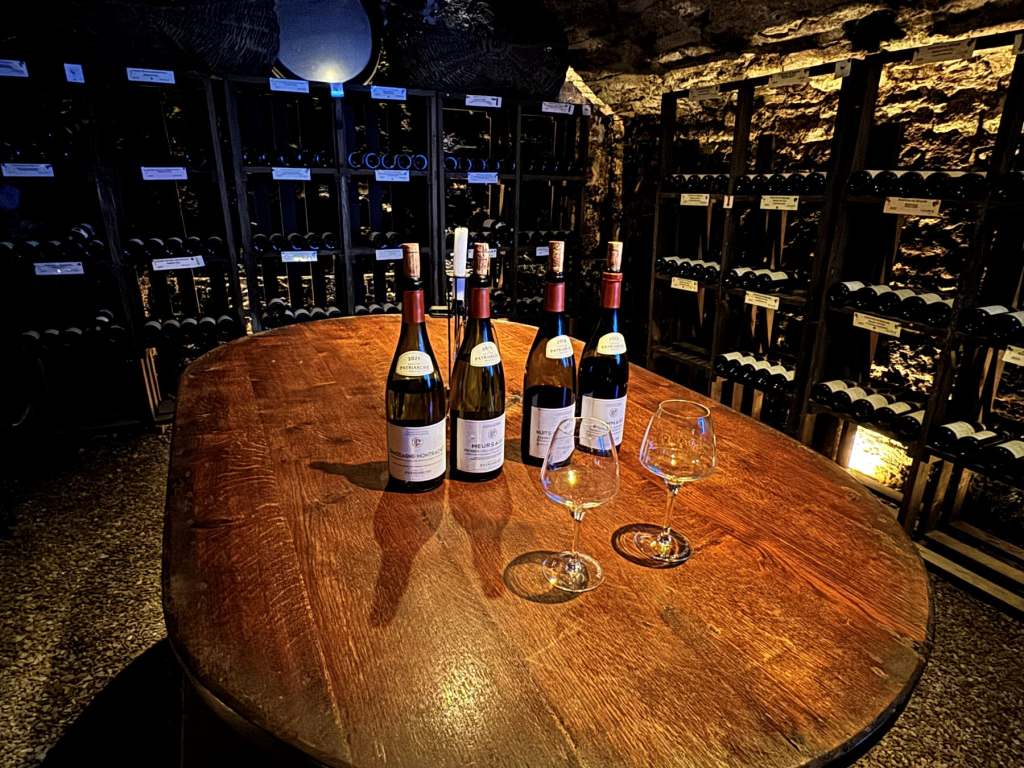
My second wine tasting is at Maison Patriache, car safely parked. The company was founded in 1780, but really took off in 1796, when it acquired the land and cellars of a former convent. Prior to the French Revolution, much of the wine was produced by the monasteries and priories. When Napoleon came to power he closed the monasteries. Enterprising wine merchants realised the opportunity, purchasing the cellars, and presumably the wine.
Maison Patriache has the largest cellars in Beaune. Former owner Andre Boisseaux purchased neighbouring cellars as they became available. So, on a tour of the winery, you walk from the 17th century priory through the neighbouring properties in a subterranean labyrinth, surrounded by more than two million bottles of wine.
You can taste the wine in the former kitchen of the convent, or in your own private cellar, as I did. I tried one village wine as well as three premier cru. On other tours you can try a grand cru as well. You are quite literally drinking your way through history.
Beaune Town Tour
It is impossible to separate the wine from culture in Beaune for every historical building appears to have a link to wine. My Beaune town tour starts at the city’s Notre Dame, which is a 12th century church with a wooden statue of the Virgin and Child from around that period. Needless to say, they produced their own wine.
I continue my tour around the town, which is glorious in the first Spring sun after the recent floods. People sit outside in the main square, enjoying a cup of coffee or perhaps a glass of wine; when in Beaune … The city also has wonderfully preserved medieval walls which you can stroll around.
A Visit to the Hospital
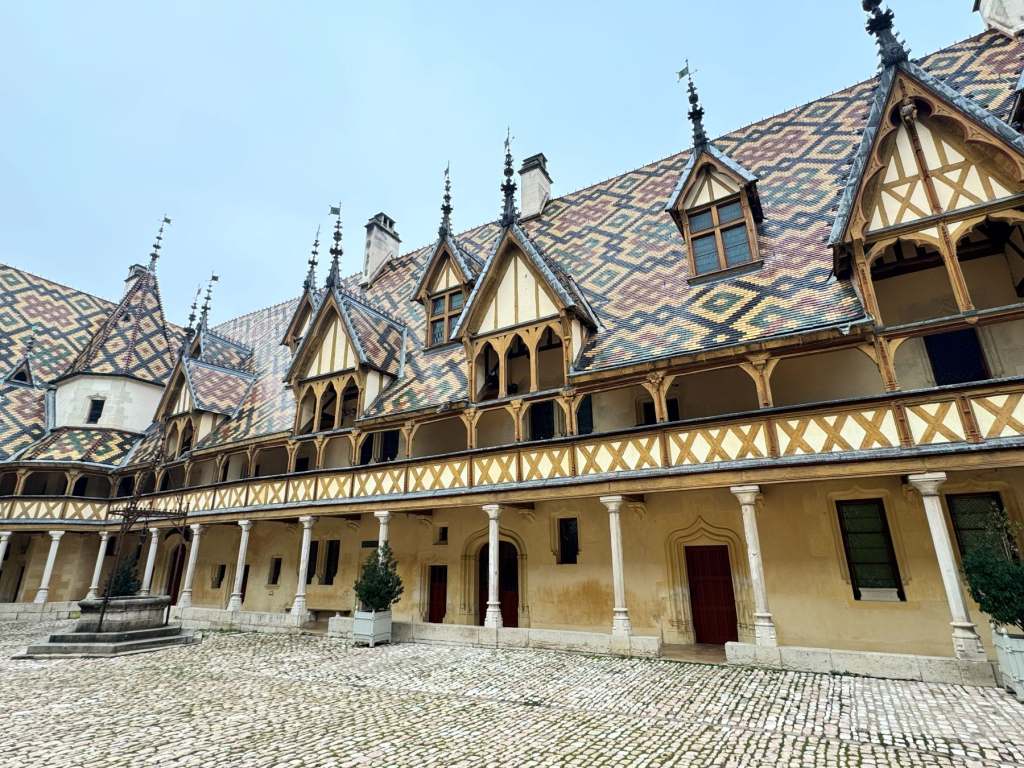
Probably the most famous building in Beaune is the Hôtel-Dieu des Hospices de Beaune, or God’s hotel, a hospital created for the poor in 1443 by Nicolas Rolin, Chancellor to the Duke of Burgundy, and his wife Guigone de Salins. The hospital still treated the poor up to 1971, and was a home for the elderly for some years after that.
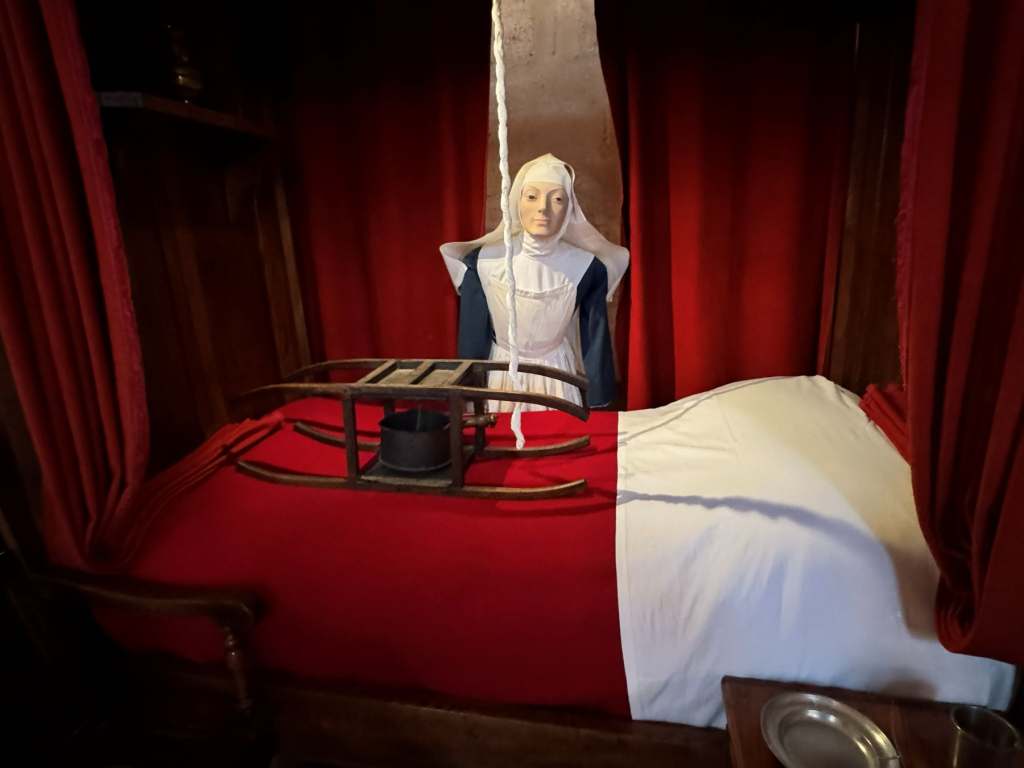
On my second day I arrive on the dot of nine as it opens and have the ‘palace to the poor’ all to myself. Rolin had made a tidy sum out of the 100 Years War, and the hospital was in part his pay back for his good fortune. No doubt Trump plans to do the same after all his wars are concluded, though I imagine the hotel of God would be named hotel of Trump. The halls where the sick and infirm were treated look quite magnificent now, but the hospital’s main feature is the glazed coloured tiles on the roof of the courtyard. Apparently, these were relatively commonplace at the time; the slate tiles on the front roof were more expensive.
It is also famed for a polyptych of The Last Judgment by Rogier van der Weyden. A reproduction hangs in the former hospital ward where the original stood. It is now preserved in the hospital’s museum, which I also visit.
Each November, the hospital auctions off a barrel of wine (naturally it has its own vineyard). The proceeds go towards maintaining the building and to running the still existing hospitals in the group. Apparently, it is a spectacular occasion held in the market opposite the hospital, and draws much attention. Dominic West recently was one of the celebrity auctioneers.
Cutting the Mustard
Not everything in Beaune is about wine. Being so close to Dijon, it is unsurprising to discover they also produce their own mustard. The Moutarderie Fallot is the only mustard factory in Beaune which still uses stones to grind the grain. They claim the slowness of the process makes for a more interesting flavour.
Founded in 1840, the factory adopted the Fallot name in 1928. They have two tours, one where you visit the factory, and the other of the museum where you can make your own mustard, and take it home with you. There is also a shop where you can taste the different varieties of mustard.
Final Wine Tasting in Beaune
My final wine tasting is at Bouchard Aine & Fils, which was founded in 1750. What distinguishes this from the other wine tours is the emphasis on the five senses.
Music accompanies the start of the tour, which is then followed by sessions on the colour, smell and taste of the wine. It is as if I am going on an advanced course after my opening session in the Cité des Climats et Vins. The final sense is that of texture, although I must admit to not having been totally persuaded on that. Although if you drink too much wine your throat might feel rough in the morning.
I tasted some more premier cru, including an excellent Pommard, which I understand is best paired well with strong meat and cheese. And therein lies the rub as regards wine tasting. I really would have liked to try the wine paired with appropriate food, albeit in bite size bits.
Food in Beaune
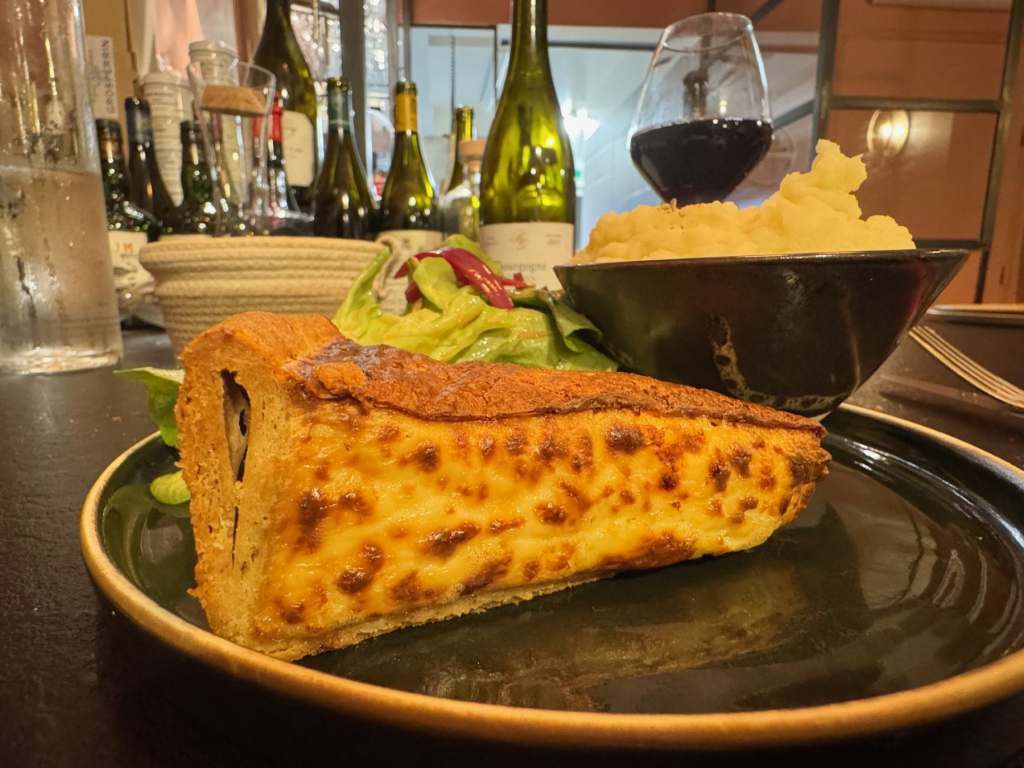
Fortunately, there is no shortage of wonderful restaurants in Beaune.
On my first night I visited Soul Kitchen. Sitting at the bar I was able to chat with owner Matthieu about the restaurant’s philosophy, between courses. He explains they source only from within Burgundy. A board on the wall lists all their suppliers, although it states it is “informal, unfaithful, incomplete and lunatic”.
There was nothing lunatic about the food. I start with a carrot salad which Matthieu paired with a chardonnay. We follow with a quiche that is so light it’s more like a soufflé. It’s quite wonderful and was paired with a Cote d’or.
The following day I lunch at Loiseau des Vignes, which is part of the Oisseaux Group. Here I start with an eggs mornay. The sauce is made with a mature Comte cheese which gives it admirable fortitude. This I follow with a rock salmon with potatoes. I lunch with Anke Fatet from the local tourism office. She reckons that around 80% of tourism in Beaune is related to wine. Frankly, I was struggling to work out what the other 20% was; certainly not clothes shopping.
A Farewell Feast
Having wined and dined pretty much constantly for the past 24 hours, I spend the rest of the afternoon walking around the city walls, and then returning to my room at the excellent Hotel de la Poste for a quick nap.
By the time I emerge Beaune is full of life, with people enjoying their aperitifs before the 7pm curfew before restaurants can open is lifted. I join them for a kir in the main square.
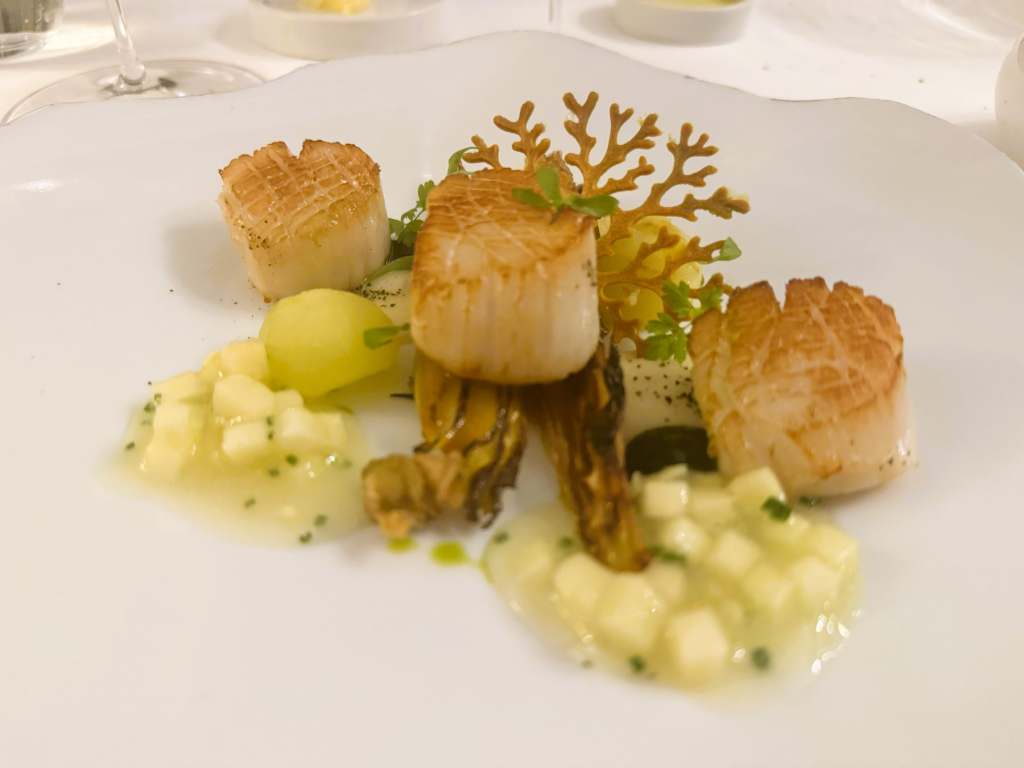
My final feast is at Le Clos du Cèdre. As this has a Michelin 1-star, I am expecting a rather formal occasion and worry I might be underdressed. I need not have feared. Although the building is beautiful, there is an informality to Le Clos du Cèdre I find most welcoming.
I have another kir, which is far superior to the one in the square, while studying the menu, and tasting the amuse bouche.
Le Clos du Cèdre specialises in its bread, which is baked in their kitchen. Several varieties are presented before me, of which the brioche is perhaps the best. My starter is a magnificent cauliflower velouté which is followed by Jerusalem artichoke which comes with the brioche. Vegetarian cuisine in France has certainly improved.
By the time my main arrives, scallops served with chicory and a ginger and apple sauce, the flavours have started to dance with each other. There is also a great juxtaposition of different textures. It is all very delicate.
And thus, my brief stay in Beaune comes to a conclusion, drinking a cold infusion to help my digestion, and sampling the petit fours, of which the purple macaroon is magnificent. I emerge from my whistlestop lesson on the wines of Beaune, if not with flying colours, then at least still standing. The only thing is, I feel I might need a refresher course sometime soon.
Where to Stay in Beaune
We recommend the four-star Hôtel de la Poste, 3 Bd Georges Clemenceau in Beaune – tel +33 3 80 22 08 11. Just outside the city walls it is recently restored and very comfortable, with the most excellent bar.
More Things to Do in Beaune Burgundy
To discover anything else about this amazing town, visit the Burgundy tourism website.
Mark’s Road-trip through France
Mark travelled through France in February 2026 on his own, taking the ferry from Dover to Calais and then driving through Pas-de-Calais to Chartres, on to the Dordogne Valley, across to Burgundy, and then up through Burgundy back to Calais. He took the DFDS ferry using their excellent priority boarding and premium lounge service.
