


Roger Hermiston and Eileen Wise stay at Bertrand’s Townhouse, London, a new hotel with a literary history.
Bertrand Russell was one of the most famous intellectuals of the 20th century, a dazzling philosopher, mathematician, social critic and political activist. He wrote thousands of essays and letters and over 70 books, and was awarded the Nobel Prize for Literature.
But ‘Bertie’, as he was known to his friends, lived in no ivory tower. The public came to know and respect him as one of television’s earliest and brightest performers, a familiar figure in the studio, tall and lean with thick, unruly white hair, and always with a pipe in his mouth.
Now he has lent his name and his formidable legacy to a brand new hotel, set (where else) in the heart of Bloomsbury, North London’s literary and academic heartland. Bertrand’s Townhouse, which opened just before Christmas, is a 43-bedroomed luxury boutique establishment spanning three beautifully restored Georgian houses in Bedford Place, just off Russell Square.
Bloomsbury London
The setting is perfect for those, like us, who enjoy their cultural fix. The British Museum is just yards away, the Charles Dickens Museum is but a short walk, and if you’re looking for an excellent arthouse cinema the Curzon Bloomsbury is in the nearby modernist Brunswick Centre.
As you walk around the grand streets and leafy squares the blue plaques inform you of the area’s unique literary and scientific status. On our walk to the London Review Bookshop we discovered that Russell himself lived not on the site of the hotel that now bears his name, but in neighbouring Bury Place (from 1911-1916). Dickens, Virginia Woolf, crime writer Dorothy L Sayers and briefly Charles Darwin were all residents here.
So its branding as a literary hotel makes perfect sense for Bertrand’s Townhouse. But while style and a sense of history is one thing, a comfortable room and surroundings, with good service, are another. Fortunately Bertrand’s has these too, in good measure, the staff displaying a real sense of enthusiasm as befits a brand new establishment keen to make its mark.
Staying at Bertrand’s Townhouse, London
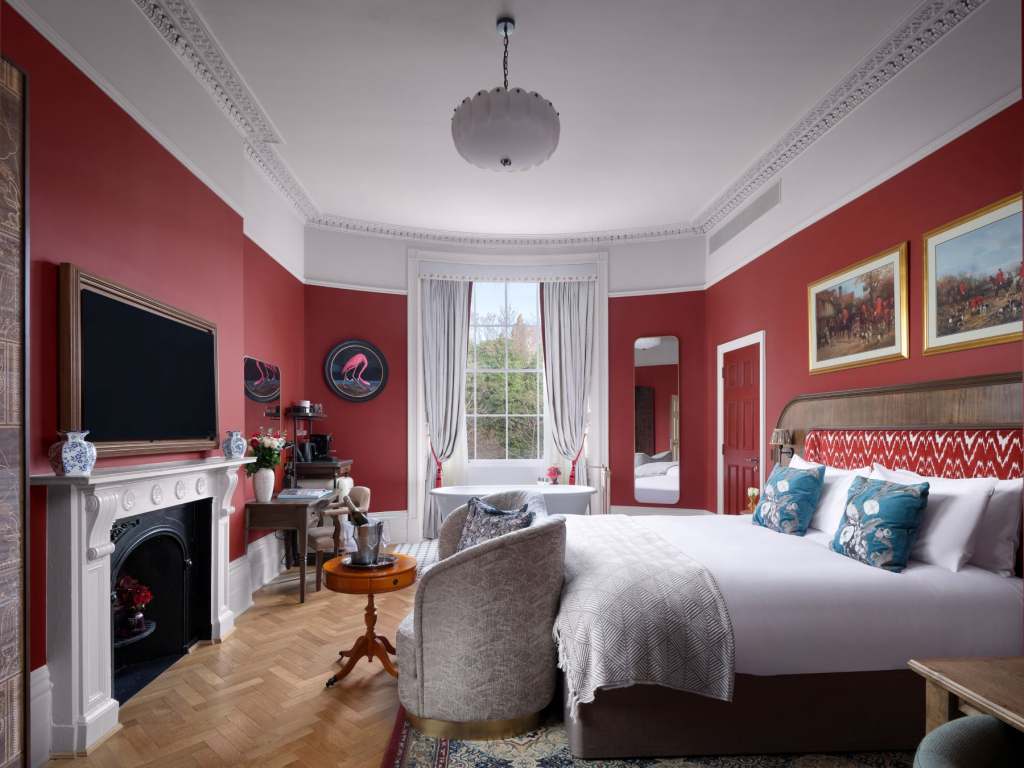

The artwork in the hotel is second to none, a mixture of classical and modern; above our bed hung a couple of intriguing Cubist works. Amid the room’s rich burgundy walls, the ornate Robert Adam-style fireplace stood out, while a comfortable sofa with pretty cushions provided a good reading spot.
Ottie’s Salon
Once lured from the comfort of your room, all roads lead to Ottie’s Salon, named thus after the famous society hostess Lady Ottoline Morrell, who entertained the Bloomsbury ‘set’ in her Bedford Square mansion and seems to have had affairs with a number of them.
Which brings us to one of Russell’s famous quotes (like Churchill, there are so many of them): ‘It’s easy to fall in love. The hard part is finding someone to catch you’. Morrell seems to have caught him for a good number of years, even though they never married.
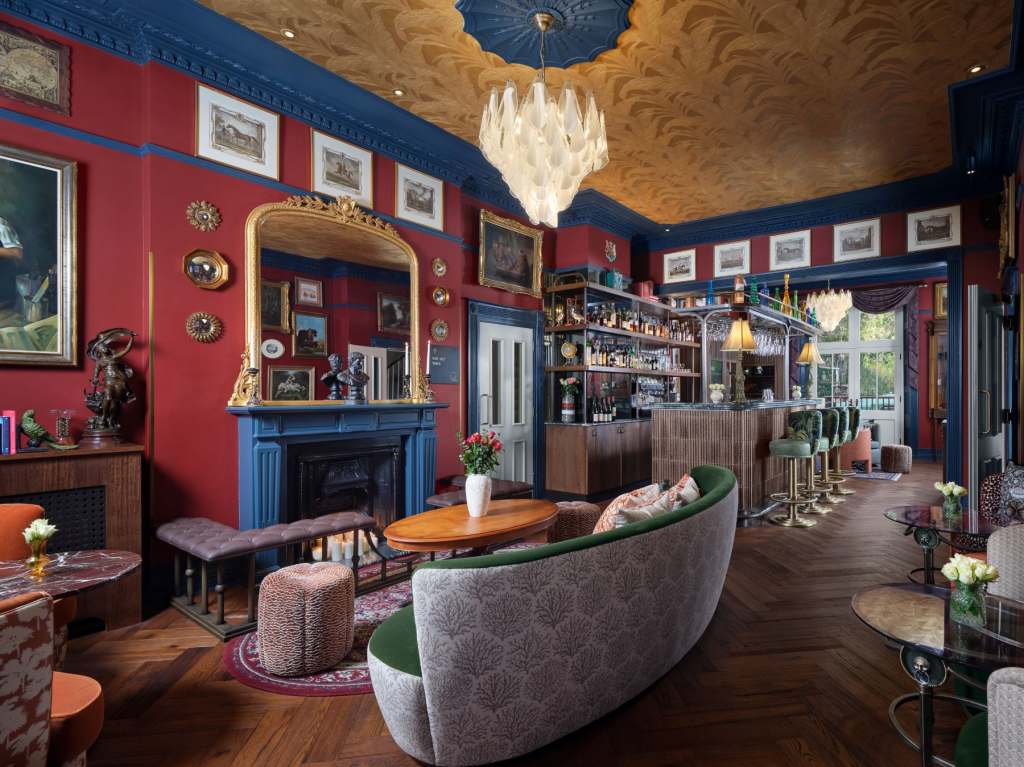
Ottie’s Salon is an atmospheric bar, lounge and breakfast room/restaurant all rolled into one. During the day guests find it a relaxing place to do some work with a cup of coffee; at night, it can reverberate to the sound of jazz music.
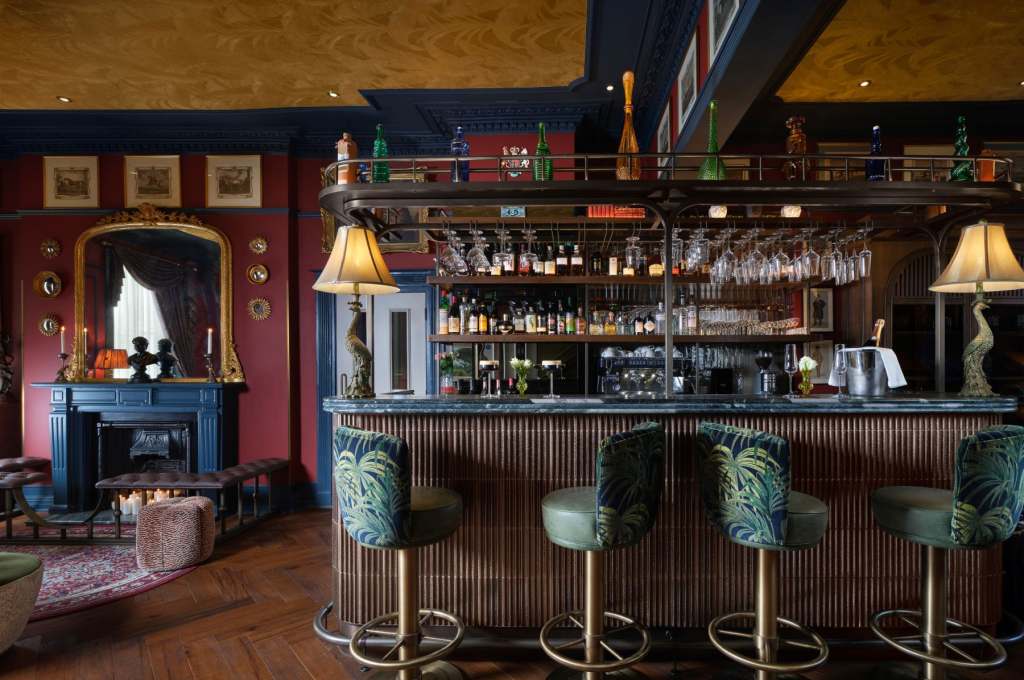

Against the rust-coloured walls the artwork and curios are striking; classical 18th and 19th century landscapes and portraits tend to dominate the front of the room, while more abstract and surreal paintings and prints are at the rear. Especially notable is a lovely work near the window by the popular American artist Norman Rockwell, Painting the Little House, depicting a young boy brush in hand, his expression one of intense concentration, while his pet dog, feet on the desk, looks on.
We had a healthy, hearty breakfast on the table underneath this painting, and were back for an evening meal. Now Ottie’s Salon is not a full-out restaurant but instead provides snacks and small plates. However, we enjoyed a very tasty wild mushroom ravioli which, with a chocolate tart and washed down with a couple of glasses of white wine, made us replete.
In the corner of Ottie’s is a cigar lounge containing a large humidor, and a terrace outside on which to smoke them. In fact ‘Bertie’ was more of a pipe smoker – which can’t have done him much harm, as he lived to the ripe old age of 97.
Turner and Constable: Rivals and Originals exhibition at Tate Britain

Leaving our literary surrounds in search of yet more culture, we were lucky to have tickets to one of the events of the year, the ‘Turner and Constable – Rivals and Originals’ exhibition at Tate Britain.
It was a great experience as the gallery had managed to bring together over 170 paintings and drawings, including a rare showing of Turner’s magnificent 1835 The Burning of the Houses of Lords and Commons, and an appearance of Constable’s superb The White Horse (1819).
Born within a year of each other in the late 18th century, the two great landscape artists came from very different backgrounds – Turner raised in the gritty city, son of a barber and wigmaker, Constable in the countryside, son of a wealthy Suffolk merchant.
Critics of the time compared their work to a clash of ‘fire and water’. To gaze at the Turner paintings here was to admire a variety of work, from early classical scenes from his travels, his blazing sunsets, to the later quite different atmospheric and experimental paintings, pre-abstract or impressionistic.
But we gravitated more to our county’s great painter, his ‘rural realism’ with its sublime depiction of nature and the countryside in its true hues. Constable has been criticised, perhaps retrospectively, for not capturing the agricultural hardship of his times, but Flailing Turnip Heads, East Bergholt certainly does that, with its detailed depiction of back breaking labour by a group of man and boys.
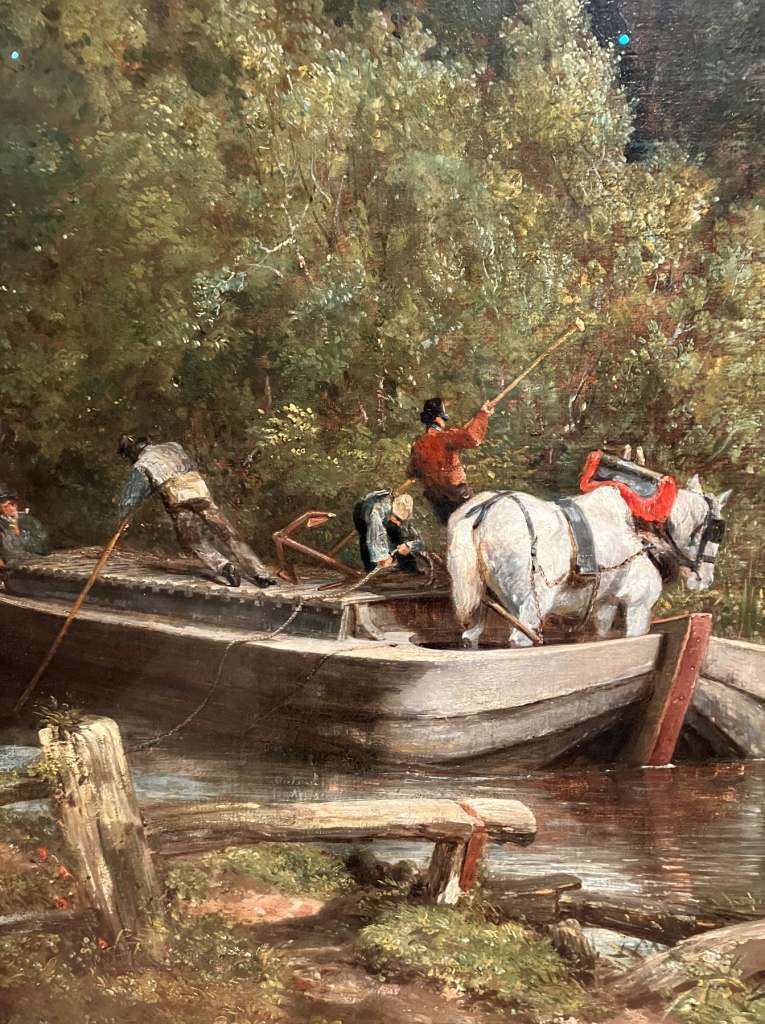
Constable’s later obsession with the sky is best seen in his brilliant Salisbury Cathedral (1823). And a darkening sky features prominently in The Leaping Horse, where the eye is drawn to Dedham Church on the right. Christianity was the central part of Constable’s world view, and to fit the church into this painting he deliberately distorted the landscape – perhaps the first time he had done so.
I’m Sorry Prime Minister
Back in Bloomsbury Way, just around the corner from Bertrand’s, we had an excellent lunch at the lively Vietnamese restaurant Café East Pho. Charismatic owner Michelle and her eager staff served us up delicious starters of mango salad, spring rolls filled with pork and salt and pepper soft shell crab, followed by Pho Kho Dac Biet Cay – spicy moist noodles with chicken soup.
But there was one more cultural experience to undertake – a matinee performance of the play I’m Sorry Prime Minister at the Apollo Theatre. This new comedy by Jonathan Lynn is an updating of the fondly remembered TV series Yes, Prime Minister, and stars Griff Rhys Jones as former PM Jim Hacker, and Clive Francis as the erstwhile mandarin Sir Humphry.
Set in the future, the plot centres around the politically incorrect, ageing Hacker’s likely ‘cancelling’ as Master of a famous university college (which bears his name), and Sir Humphrey’s attempt to come to his rescue – just like old times.
It’s always dangerous to re-engage with such a classic. But Jones and Francis spar in lively fashion, the majority of the jokes work, and the play is surprisingly thought-provoking, and opinionated, on issues of wokeness and free speech.
We reflected on a stimulating couple of days as we boarded the train at Liverpool Street, back to Constable country.
Bertrand’s Townhouse
Click here for more information on or to book Bertrand’s Townhouse.