


Forget the crowds of Ranthambore. In the heart of Madhya Pradesh, a little-known sanctuary offers tigers, 30,000-year-old cave paintings, and the kind of stillness that busy lives rarely afford.
The jeep had stopped. Our guide raised his hand — the universal signal for silence — and pointed toward a stand of teak trees perhaps forty metres ahead. I squinted through the morning haze, seeing nothing but dappled light on dry leaves.
Then she moved.
A tigress, unhurried and utterly indifferent to our presence, crossed from shadow into sunlight. She paused briefly to drink from a stream, the morning light catching the water droplets on her whiskers, before disappearing into the sal forest. The entire encounter lasted perhaps ninety seconds. We sat in stunned silence for considerably longer.
This was Ratapani Tiger Reserve — a place I’d never heard of until three months earlier, and one that most visitors to India will never find on their itineraries. That, as I was beginning to understand, is precisely the point.
Where the Famous Parks End and Something Different Begins
India’s tiger tourism has become, let’s be honest, something of an industry. Ranthambore, Bandhavgarh, Kanha — these are magnificent reserves, but they’ve also become destinations where jeeps queue for sightings, lodges book out months ahead, and the experience can feel rather more like a production than an encounter with wilderness.
I’d done that circuit in my thirties. Two decades later, approaching travel with rather different priorities — fewer crowds, deeper experiences, actual rest — I found myself drawn to somewhere quieter.
Ratapani sits roughly 60 kilometres southeast of Bhopal, Madhya Pradesh’s lake-studded capital. Upgraded to tiger reserve status only recently — making it the state’s 8th and India’s 57th — it covers 825 square kilometres of the Vindhya foothills. The landscape is dry deciduous forest, dominated by some of India’s finest teak, interspersed with rocky outcrops, seasonal streams, and two significant reservoirs.
What makes it unusual is what sits within its boundaries: the UNESCO World Heritage site of Bhimbetka, rock shelters containing paintings that predate the pyramids by millennia. Wildlife and ancient human history share the same forest here — a combination I’ve not encountered elsewhere.
Getting There and Settling In
The logistics are refreshingly simple. Bhopal’s Raja Bhoj Airport receives daily flights from Delhi, Mumbai, and several other Indian cities. From there, the drive to the reserve’s edge takes roughly an hour — long enough to watch the urban sprawl give way to agricultural land, then to forest.
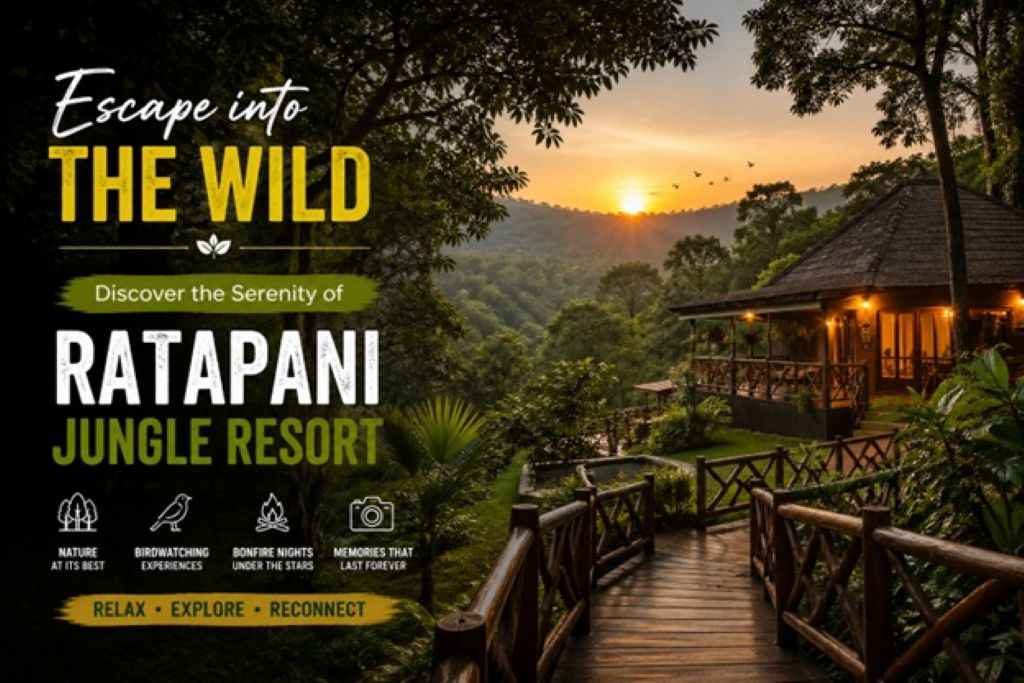
I’d arranged to stay at Madhuban Eco Retreat, a resort in Ratapani that sits on twenty acres at the sanctuary’s edge. The property belongs to the Somaiya Group — better known for their educational institutions — and approaches hospitality with a particular philosophy: vegetarian food, no alcohol, minimal ecological footprint, maximum forest immersion.
I’ll admit I had reservations about the no-alcohol policy. A sundowner after a dusty safari has become something of a ritual for me. But sitting on my cottage verandah that first evening, watching the tree line shift from green to gold to silhouette against an absurdly pink sky, I found I didn’t miss it at all. The forest provides its own intoxication.
What Lives Here — And What You Might See
Beyond the headline act — the Bengal tiger — Ratapani hosts an impressive supporting cast. Leopards are present, though as elsewhere, they’re more often sensed than seen. Sloth bears are relatively common, particularly around the rocky escarpments where they dig for termites. Striped hyenas patrol the reserve’s edges. Indian wild dogs, increasingly rare across the subcontinent, maintain a presence here.
The ungulate population — chital, sambar, nilgai, chinkara — is healthy enough to sustain the predators. On my first morning drive, we counted over forty chital in a single meadow, their spotted coats catching the low sun.
For birders, and I count myself as an increasingly enthusiastic amateur, the reserve offers over 150 recorded species. The Indian paradise flycatcher — Madhya Pradesh’s state bird, with its absurd white tail streamers — was a particular highlight. I also ticked off golden orioles, Indian grey hornbills, and several raptors whose identities remain, embarrassingly, uncertain.
What struck me most, though, was the absence of other visitors. On two full days of safari, we encountered exactly one other vehicle. The silence, broken only by bird calls and the occasional langur alarm, felt like luxury of the rarest kind.
Walking Through 30,000 Years of Human History
The Bhimbetka Rock Shelters deserve their UNESCO status. Scattered across a sandstone ridge within the reserve, these 750-odd caves and overhangs contain paintings that span from the Mesolithic period to the medieval age — a continuous record of human expression that makes European cave art seem almost recent.
I spent a morning here with a local guide who knew the site intimately. The oldest paintings — simple figures in red ochre, depicting hunting scenes and large animals including what appears to be a rhinoceros — date back at least 30,000 years. Layer upon layer, generation after generation added their own marks. Horses appear around 2000 BCE, suggesting contact with Central Asian cultures. Buddhist imagery emerges later still.
What moved me most was the recognition that these shelters weren’t museums to the artists — they were homes. Families lived here, raised children here, died here. The paintings weren’t art for art’s sake but records of daily life, spiritual beliefs, and accumulated knowledge passed across hundreds of generations.
Walking back to the vehicle, I found myself looking at the surrounding forest differently. The same teak trees, the same rocky outcrops, the same resident wildlife would have surrounded those ancient artists. The tigers’ ancestors hunted here when humans were still learning to paint.
A Queen’s Fort Lost to the Forest
For those with energy and inclination, Ratapani holds another treasure: Ginnourgarh Fort, a 15th-century Gond citadel perched on a hilltop deep within the reserve. Reaching it requires a proper trek — roughly two kilometres uphill through dense forest — but the reward is considerable.
This was the stronghold of Rani Kamlapati, a Gond queen whose story intertwines with the founding of modern Bhopal. After her husband was poisoned by a treacherous nephew, she fled here with her son. The alliance she formed with an Afghan warlord — sealed, legend has it, by tying a rakhi on his wrist — eventually led to Bhopal’s establishment as a princely state.
The fort itself is largely ruined, but impressive nonetheless. Palace walls, elaborate water harvesting structures, gatehouses bearing Persian inscriptions — all slowly returning to the forest. During World War II, the area was used as a prisoner of war camp for Italian soldiers, adding yet another layer to its improbable history.
The trek isn’t suitable for everyone. The terrain is uneven, wildlife (including leopards and bears) is present, and a guide is essential. But for those who can manage it, the combination of exercise, history, and wilderness feels genuinely adventurous — not the manufactured adventure of most tourism, but something real.
The Case for Slow Safari
Madhuban Eco Retreat also runs educational programmes for schools — immersive nature courses that teach children about ecosystems, wildlife, and sustainability. I mention this because it speaks to something larger about this place: it’s not trying to maximise visitor throughput or deliver Instagram moments. The approach is slower, more considered.
I found this suited me perfectly. Past forty, I’ve lost patience with rushed itineraries. The appeal of sitting quietly in a forest hide, watching nothing much happen for an hour until suddenly everything happens, has grown considerably. Ratapani rewards this kind of patience.
The resident naturalist at Madhuban, Shibajee Mitra — a herpetologist by training — led a night walk around the property one evening. Armed with torches, we discovered an entirely different forest: a wolf spider carrying her egg sac, a sleeping kingfisher, a family of civets hunting at the tree line. It was one of those experiences that reminds you how much we miss by restricting ourselves to daylight hours.
Practical Matters for the Mature Traveller
The best time to visit Ratapani is October through March, when temperatures are comfortable and the deciduous trees drop their leaves, improving visibility. April through June is scorching; the monsoon months (July-September) see restricted access and leeches.
Safari options include morning and evening drives, as well as the occasional night safari. Vehicles are generally open jeeps — pack layers for early mornings, which can be surprisingly cold in winter.
The Ginnourgarh trek requires reasonable fitness; those with mobility issues might find it challenging. Bhimbetka, by contrast, is accessible via well-maintained paths.
Bhopal itself is worth a day or two. The old city’s narrow lanes, Mughal-era mosques, and surprisingly good street food make it more interesting than its reputation suggests. Rani Kamlapati’s palace still stands by the Upper Lake — a connection to the queen whose forest stronghold I’d just visited.
Why This Matters Now
I’ve been thinking, since returning, about what made Ratapani feel so different from other wildlife experiences. Part of it is simply the absence of crowds — that increasingly rare luxury. Part of it is the layering of human and natural history, the sense that you’re moving through a landscape with genuine depth.
But mostly, I think, it’s the stillness. In an age of constant connectivity, relentless scheduling, and the pressure to optimise every moment, Ratapani offers something radical: the chance to simply be present in a wild place, without agenda.
The tigress I saw that first morning didn’t care about my presence. She was living her life, unhurried and complete, exactly as her kind have done in these forests for thousands of years. For ninety seconds, I was permitted to witness it. That felt like enough. That felt like everything.