


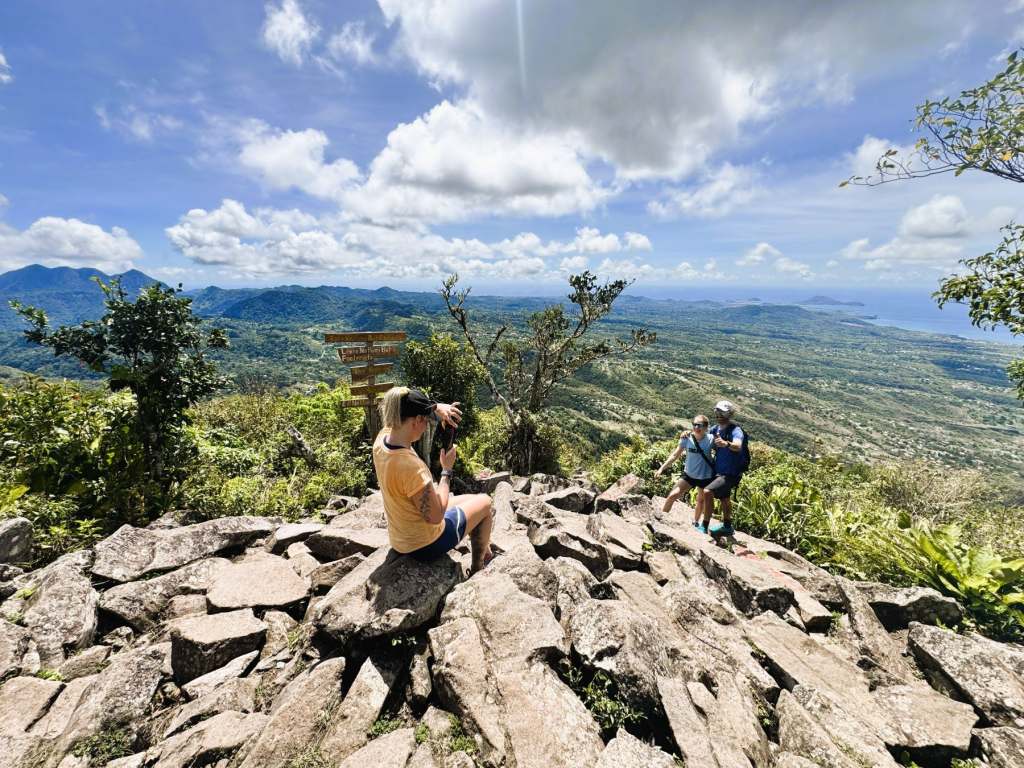
I am halfway up my ascent of the Gros Piton Saint Lucia when I reach my moment of truth. My guide Trannie looks at me and asks if I want to continue to the summit, I can tell by the look on his face he thinks perhaps we ought to turn back.
The view here of Petit Piton, the smaller yet harder to climb neighbour of the mountain I am ascending is amazing. I can make out Martinique in the distance. It is tempting to stay here like the French Canadian woman opposite me, before retracing my steps. I take in the view once more and make my decision.
Fond Doux Ecolodge
It is two days since I checked into Fond Doux ecolodge near Soufrière on the west coast of Saint Lucia. Two days in which I have lazed around on my small terrace, taken occasional dips in my plunge pool and marvelled at all the nature surrounding me.
It is almost 30 years since I first stayed in an ecolodge in Costa Rica and the same period since I first saw hummingbirds. Now, I have the two combined as the tiny birds flap away in the foliage, largely cocoa trees, beside my terrace. A bullfinch is even brave enough to join me nibbling away on my baseball cap as I languish beside my neglected novel.
Quite why it should choose my cap when there is so much more appetising fare to feast on, beats me.
Literally meaning ‘sweet valley’ in the local Saint Lucian Creole language, Fond Doux is a 250-year-old still functioning cocoa plantation, set in 135 acres of fruit trees.
On my second day I am taken on a tour of the plantation where my guide explains about all the trees, including mango, papaya, banyan, cinnamon and of course cocoa, as well as the various buildings, one of which was transported here from the capital Castries.
Upcycling, Local and Eco Tourism
Part of what makes Fond Doux so special is the way the ecolodge reuses, or upcycles, existing structures rather than introducing new buildings out of keeping with its context. This means the rooms are both individually designed and woven into nature.
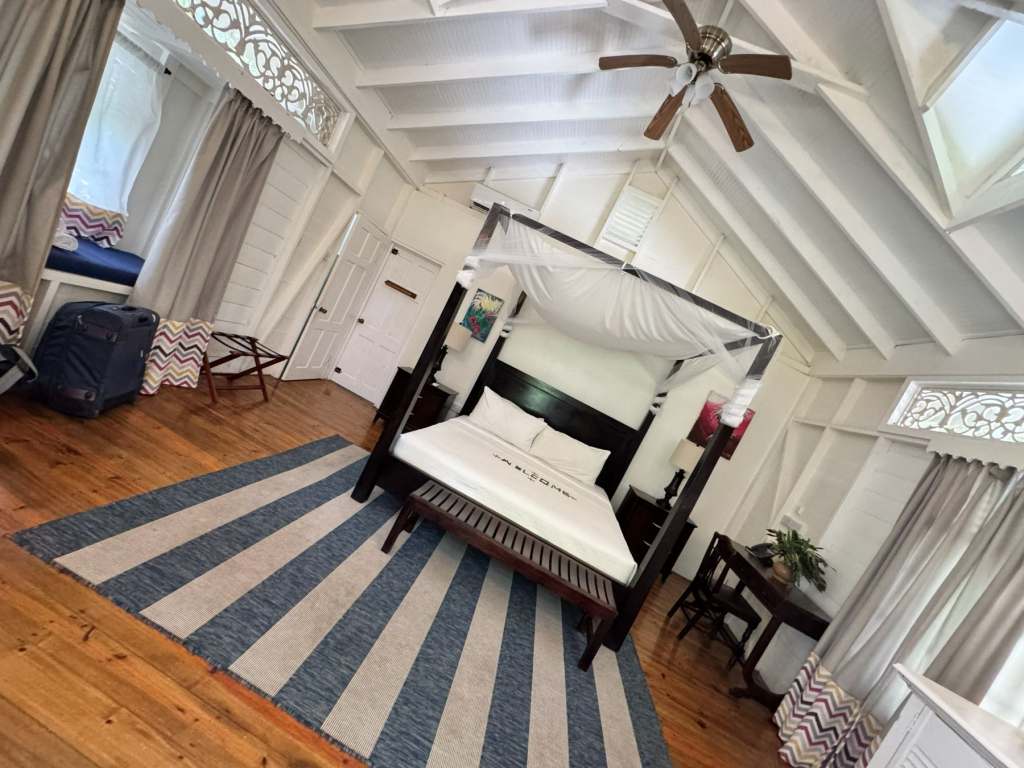
My Cashew Cottage is a wonderful wooden structure, with a four-poster bed, and outside bathroom as well as plunge pool and terrace. It is totally secluded from the outside world, my only neighbours the amazing birdlife and occasional gecko.
On my first night I dine at Fond Doux’s only restaurant. All the food is locally produced where possible, with the fruit and vegetables grown on the plantation. I have seldom eaten more healthily taking salad and fruit each meal. The staff are also local, and extremely accommodating.
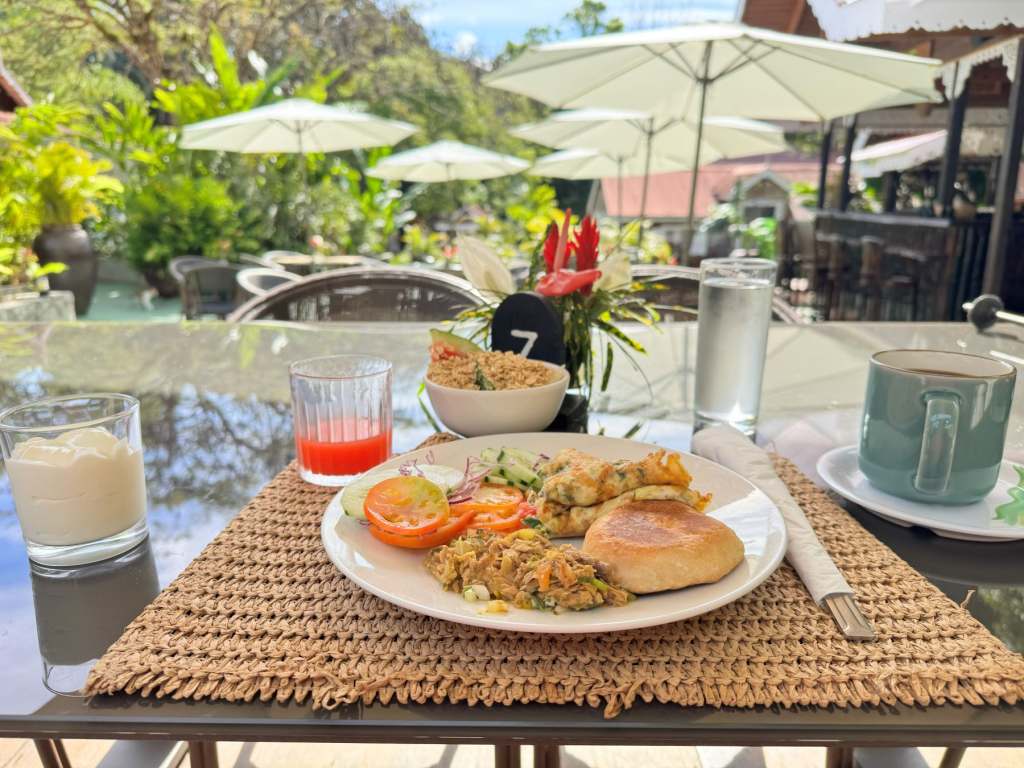
If anything, breakfast the following day is even better with fresh juice, fruit and the most wonderful omelettes accompanying local dishes such as the saltfish.
Exploring History at Fond Doux
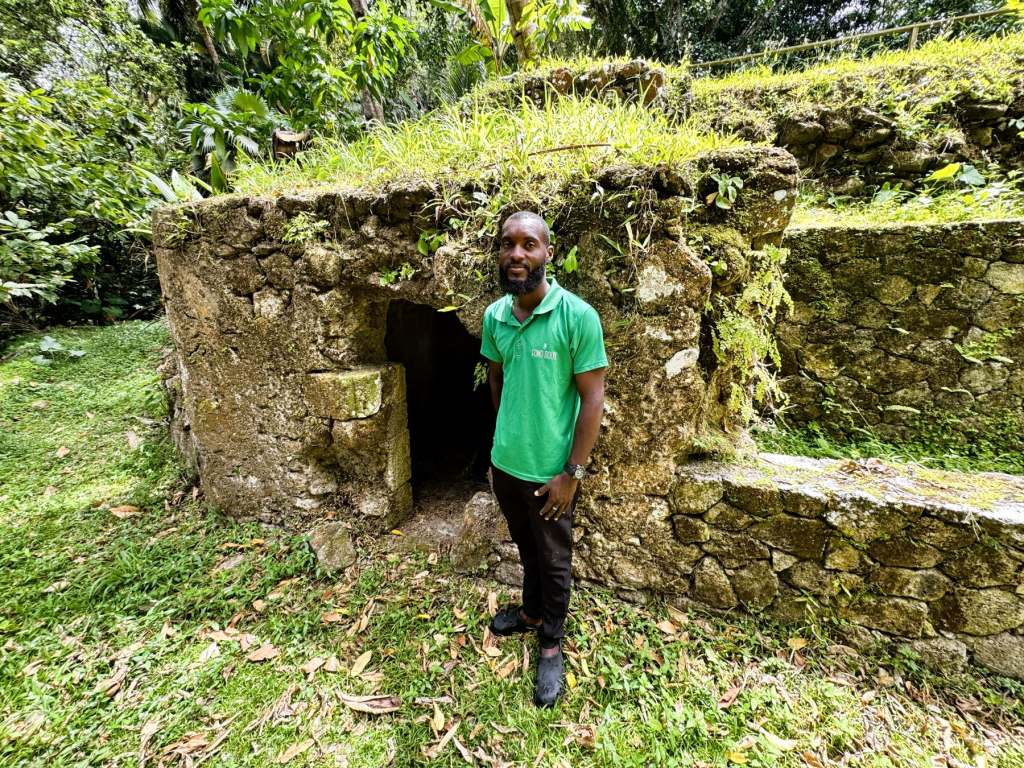
Fond Doux has several guided tours to explore the past and present. First my guide Shyne Pascal takes me across the road to Fond Doux Historical Park, which has information on the history of slavery on the island and the many people who were slaughtered often in the most horrific manner in one of the most shameful periods of British history.
Not that it was just the British who were guilty. Fond Doux was established by the French. Next to the information centre is the Bastille which was built in the 1780s. Here slave prisoners were held in barbaric conditions, next to it is a solitary confinement cell where they were kept in the sun beneath a grill in a manner similar to the Tiger Cages on Vietnam’s Phu Quoc island.
Making Chocolate
After this, Shyne takes me on another tour to discover all about chocolate production. First, we wander around the plantation and open up one of the cocoa pods to reveal ‘Jungle M&Ms’ the cocoa beans that are dried and ground to make chocolate, and which you can suck.
Then Shyne shows us the trays where the cocoa beans are dried. These are still the original ones. Then he jumps into an iron cauldron and mixes the cocoa beans with the juice from a young cocoa pod with his feet, which apparently helps to preserve and polish the beans.

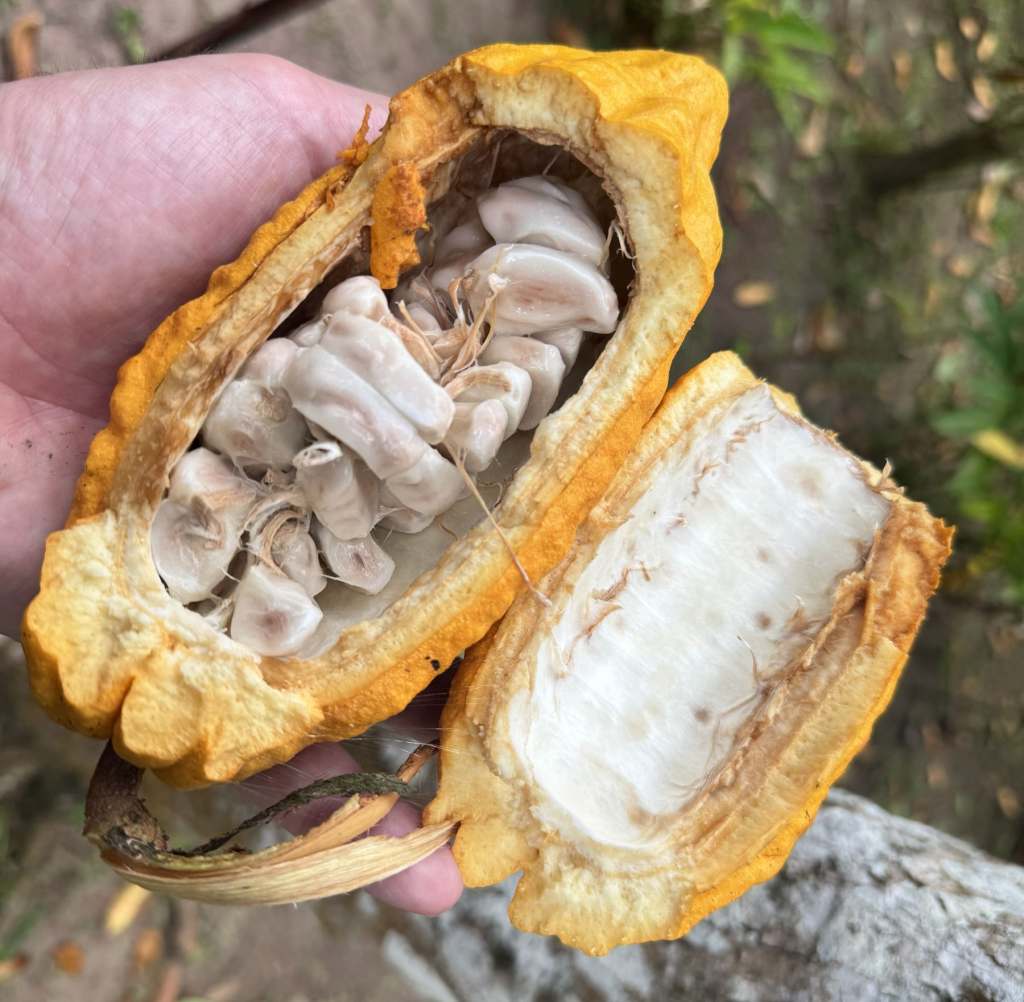
It is then that Shyne hands the baton over to Cornelia who takes us through the rest of the chocolate making process in her chocolate laboratory, at the end of which I emerge with a bar of Fond Doux chocolate.
Explaining I am to trek up Gros Piton, I ask the staff about trails around the plantation. They suggest I take the Petit Piton View Trail. Clearly marked, this weaves its way around the trees before the Petit Piton appears in a small clearing in front of me. The view is brilliant. I view this short 45-minute trek as a training hike for the following day, one which I pass with flying colours, sufficient to allow me to rest in confidence for the rest of the day on my terrace admiring the flitting hummingbirds.
Hiking the Gros Piton Saint Lucia
It is not long into my hike I realise how misplaced my confidence was. Gros Piton Summit is some 2,619 metres above sea level, but we start the four-mile hike in the small community of Fond Gens Libre (Valley of the Free People) some 2,000 feet below.
I meet Trannie at the reception area. Born and raised there he explains how it was one of the first settlements of freed black people on the island, following their emancipation in the 1730s. Some 120 people live here, many making a living from the trail as guides.
The trail is managed by the Soufrière Foundation, who also operate the nearby sulphur springs I visited on my previous visit to Saint Lucia.

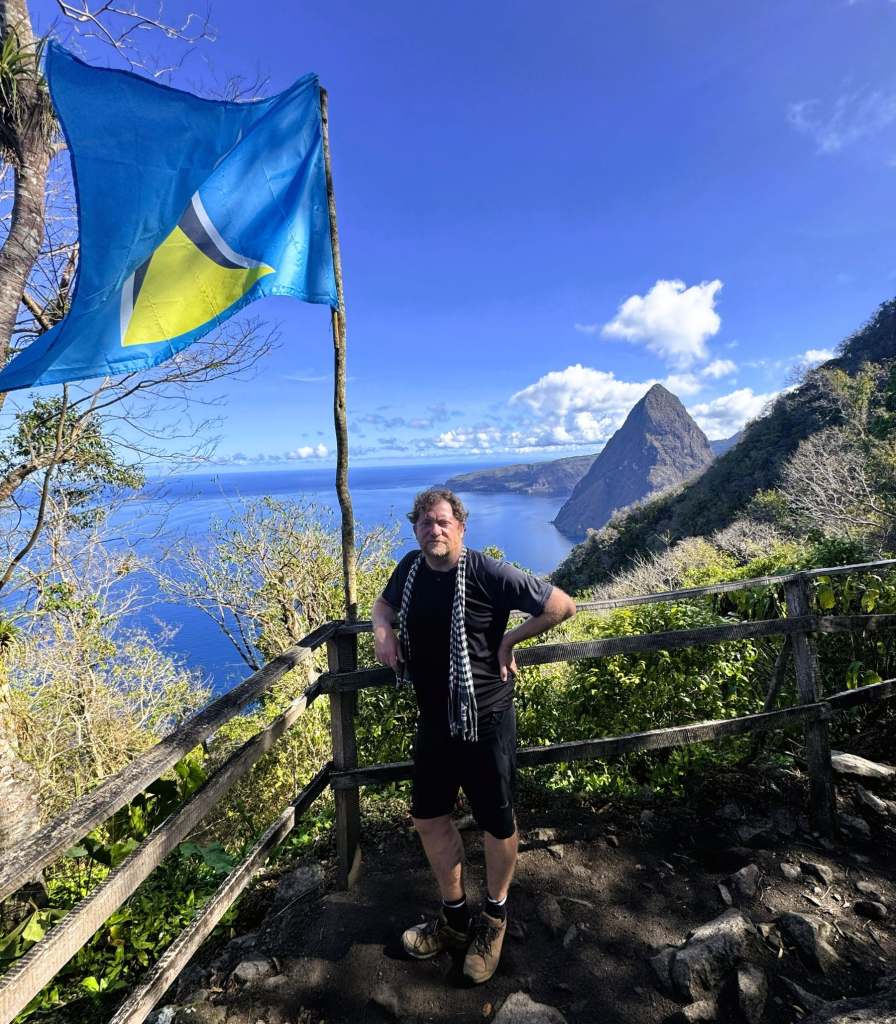
After a brief induction talk, where the route is explained and the staff ensure I have sufficient water and am equipped for the hike, we set off. It will start off moderate but the last half will be hard, I am informed.
At first, I find the trail relatively comfortable. I have to scramble over some rocks but generally the path is even and at a gradual incline.
We pass a cave where runaway slaves (brigands) from the sugar plantations used to hide before their emancipation. Nearby there is a small inviting path down to the beach. Soon, we pause at the quarter-way marker (that is a quarter of the way up) where we are fortunate enough to have great views to Saint Vincent island some 27 miles away.
Saint Lucia is a beautiful, green island, but it is also very hilly. “We don’t know what is flat here,” says Trannie, as we continue. Soon I am to discover what he means as the ascent steepens, and is made more difficult as I stumble spraining my ankle.
Before long I am on all fours as I scramble up what Trannie dubs Rock City. It is shortly after that I face my moment of truth.
What Goes Up Must Go Down
The sensible option is to head back down the mountain, but I have never been one noted for much common sense. My ankle throbbing, I march on, reassuring myself I will turn around at the three-quarter mark.

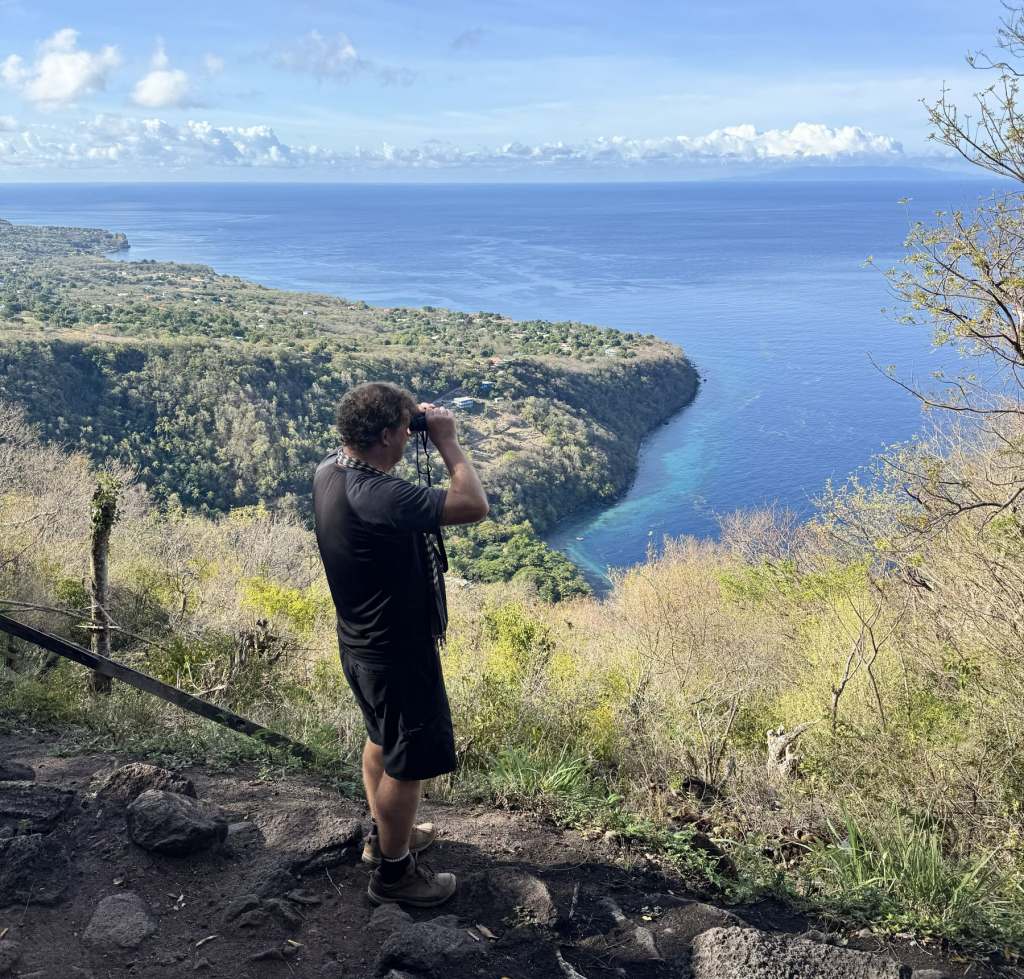
But there I chat with some Canadian hikers who somehow persuade me to continue. After all I am still feeling pretty fine and my legs feel good, with no onset of wobbliness, the consequence of fatigue.
Before long I am being passed by allcomers, like a Reliant Robin on a motorway. The path as promised grows increasingly steep. I am on all fours more than I am upright. But still I carry on, managing my water carefully, and sucking on fruit Fond Doux have provided me for breakfast.
Near the top, the Canadian hikers pass me on their descent. Only a hundred metres to go they say. My long-term chronic back condition kicks in giving me a sharp jolt to accompany my throbbing ankle.
Only a few more metres. I can see the sun breaking through the canopy and realise I am almost there.
Although not quite heavenly, the view from the summit is spectacular. We can see Mount Gimme, the highest point on the island, emerging from the rainforest, and further south the tip of Saint Lucia.
All the hikers who passed me have congregated here swapping phones to take pictures as everything seems fine in the world. Until I remember the words Trannie had cautioned me earlier, “what goes up must go down”. This is no Hollywood movie where the actors escape near death on the edge of a cliff before we cut to the next scene where they are enjoying a beer back at their eco-lodge. I still have to descend some 2,000 metres.
Fortunately, the trek down is not as difficult as it could be. Trannie only half-jokingly I suspect says he has never known anyone take longer to hike Gros Piton than me, but most importantly I make it there and back in five and a bit hours (most people take four), safely.
At the bottom I am interviewed by the Soufrière Foundation for their website, but not until I have one final Piton, a bottle of the local beer of the same name. I might be the slowest to climb Gros Piton but I am a match for anyone in the speed I down my beer.
“What was the best part of climbing Gros Piton,” my eponymous interviewer Lovely Saint-Aime Joseph asks me. “The beer at the bottom,” I respond like Trannie before me only partially in jest.

Gros Piton Hike Saint Lucia
Gros Piton Hike Difficulty : Moderate at the start but it soon becomes very difficult. If you find the hike hard at the start then it is suggested you stop at halfway point enjoy the view of Petit Piton and walk back down again.
Gros Piton Hike Entrance Fee: It costs $90 for the entrance fee and guide. All the proceeds go to the non-profit Soufriere Foundation.
Gros Piton Distance: It is about 4 miles walk, but the real problem is the steepness as it is 2,000-foot ascent.
Fond Doux
For more details on this quite amazing eco-resort click here.
Flight to Saint Lucia from Gatwick
Mark flew to Saint Lucia with BA from Gatwick. He used Holiday Extras, the market leader in UK airport parking, hotels, lounges and transfers – and in 2025 its customers saved an average of £200 per trip by booking their airport parking in advance. Booking an airport hotel with parking means you can enjoy more holiday with less hassle – and can actually cost less than booking airport parking alone. Plus with Flextras, if you need to cancel or amend you can without charge. One night in a double room at Hilton with nine days Maple Meet & Greet parking at Gatwick Airport South Terminal is available for £265 based on arrival on 8 June 2026. For more information and to book, HolidayExtras.com or call 0800 316 5678.
*All costs supplied are the cheapest available rates for the product specified and therefore availability may be limited at this price. Prices are correct as at 05/05/2026.