When I tell friends that I’ll be taking some sea air the instant I get to The Hague, they react with mild surprise. Such is the association of those two words with international law and so forth, that a coastline, they say, doesn’t exactly spring to mind.
But the entire western edge of the Netherlands is coastal, and of that 280 miles, a glorious seven of them belong to The Hague. The city has two main beaches, Scheveningen and Kijkduin, which are 20 and 30 minutes from Den Haag Centraal station respectively, after an easy trundle on a tram (if landborne, you alight from the Eurostar train at Rotterdam for the change).
Another attracting and typically Dutch aspect of the place is the high density of art galleries, museums and houses of culture. They stand out or are hidden all over the city and in one curious example, the old US Embassy, art has even colonised a former place of diplomacy.
The Beach in The Hague
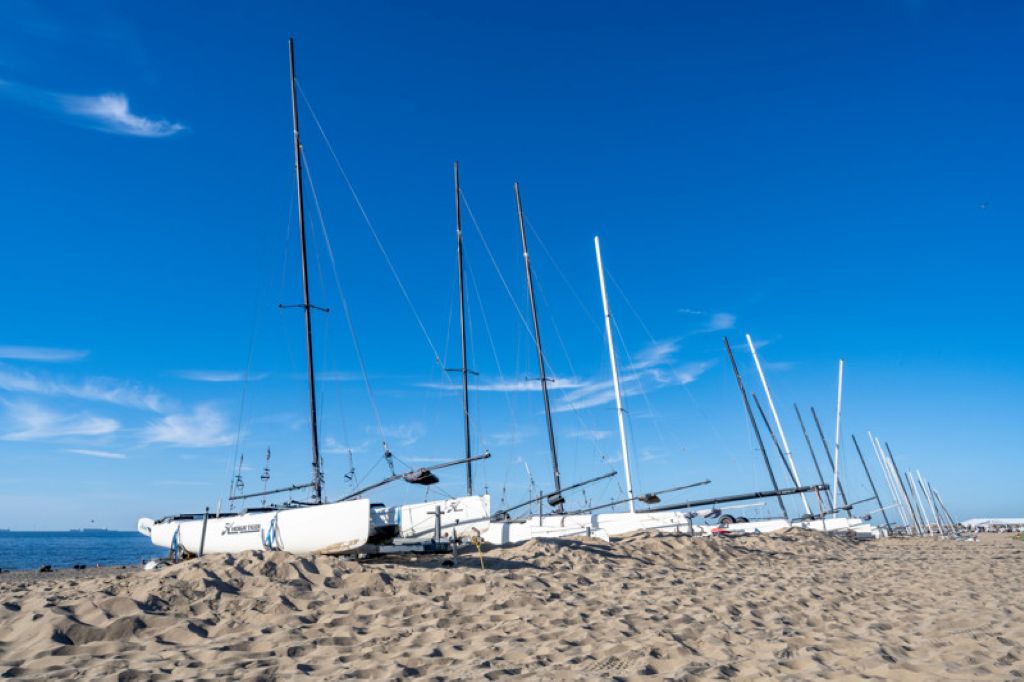
But first it is to the coastal resort of Scheveningen, which I’m rather impatient for after too many consecutive days in London. It’s a cool late-afternoon three weeks into March but the sky is clear and vibrant and walking up Scheveningen promenade, the lovely vision of pinkish sand beneath a mellowing sun to my left, I feel thawing within.
The resort has all the usual trappings: a Funland, big wheel, pier and lighthouse, and no shortage of beach-side bars and restaurants, but nothing tacky, and the deep three-mile long stretch of sand seems to overpower everything. My destination is Museum Beelden aan Zee, which is said to be the only art gallery in the Netherlands to exhibit sculpture alone.
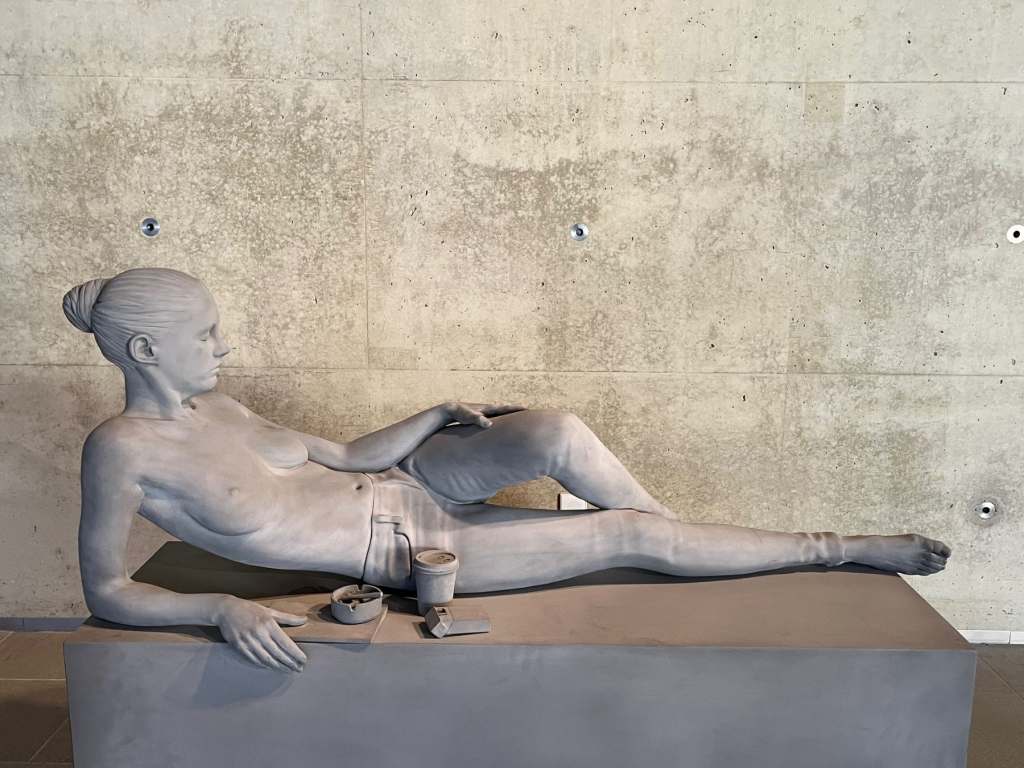
Visit before October 24, and you can see the exhibition Reclining Figures, which gathers differing examples of one of the oldest subjects in sculpture, with works by Henry Moore, Charlotte van Pallandt and Hans Op de Beeck. The uncanny creations of Scheveningen-born artist Magali Reus are also showing. Reus transforms eclectic everyday objects and junk into intricate sculptures. Things like hooks, sardine cans and beakers are liberated from their function to cause unexpected memory jolts and associations that can delight and disturb.
Museum Beelden aan Zee itself is like an art work, a little inland and partly built into a small hill. The display rooms are of elegant, brutalist design and the flat roof and terraces are dotted with figurative works leaning towards the surrealist and modernist. With that shifting coastal light, and quick switch between interior and exterior, Beelden aan Zee has to top any Hague gallery itinerary.
Back on the promenade, the sun is heavy and the bars are now bustling. I choose Hart Beach Restaurant, a recommendation, which has a surfing bent and is all driftwood and plants and “sit wherever, man”. Everyone looks pleased with their burrito, jerk chicken or tempura plate. I have two amaretto sours and chips and get grilled about my home town by an adjoining table of twenty somethings.
They are also exasperated by a common mistake, which is ‘Holland’ being used interchangeably with the ‘Netherlands’ by outsiders, an obvious no-no around the Dutch. In short, the Netherlands contains 12 provinces, two of which are North and South Holland. The Hague is the capital of the latter and the seat of government for the whole country, and it sits 56 miles south-west of Amsterdam which is in North Holland. Amsterdam is the Netherlands’ capital, but not that of North Holland – that job goes to Haarlem. I remark that such arrangements are more straightforward in the UK.
The Kunstmuseum
The next morning it’s tram 17 from the pretty town centre to the same area but I jump off at Statenplein, about a mile before the seaside. The skies are again jubilant but soon I’ll be back in the clutches of the “Great Wen” (from whence I escaped) for at date with London Calling, a painting show at the Kunstmuseum. It’s a clever exhibition that expresses the recovery of the Blitz-shattered capital through painting of the human form.
At the heart of this story is the School Of London, a loose-knit group of celebrated rascals that included Francis Bacon, Lucian Freud and RB Kitaj, all present here, alongside other familiars like David Hockney, Paula Rego and Frank Auerbach. But its the more obscure names that really draw me.
One is Denzil Forrester, whose attendance at reggae clubs in the 1980s, with their constant the threat of police raids and violence, led to works that are like mosaics of discord. In the clubs, Forrester would limit sketching time to the length of the record playing to get source material. The painted result is loud and fractured, and the eye darts all over the canvas rather than go in on it.
Another is Leon Kossoff, a contemporary of Frank Auerbach, and a painter firmly rooted in London’s East End. Kossoff obsessively returned to the same subjects – such as the Nicholas Hawksmoor-designed Christ Church in Spitalfields – and models. I love the mayhem of his Children’s Swimming Pool, Autumn Afternoon, 1971, an inner London scene, as I recall such places myself. In all, the curation is impressive.
The Old US Embassy
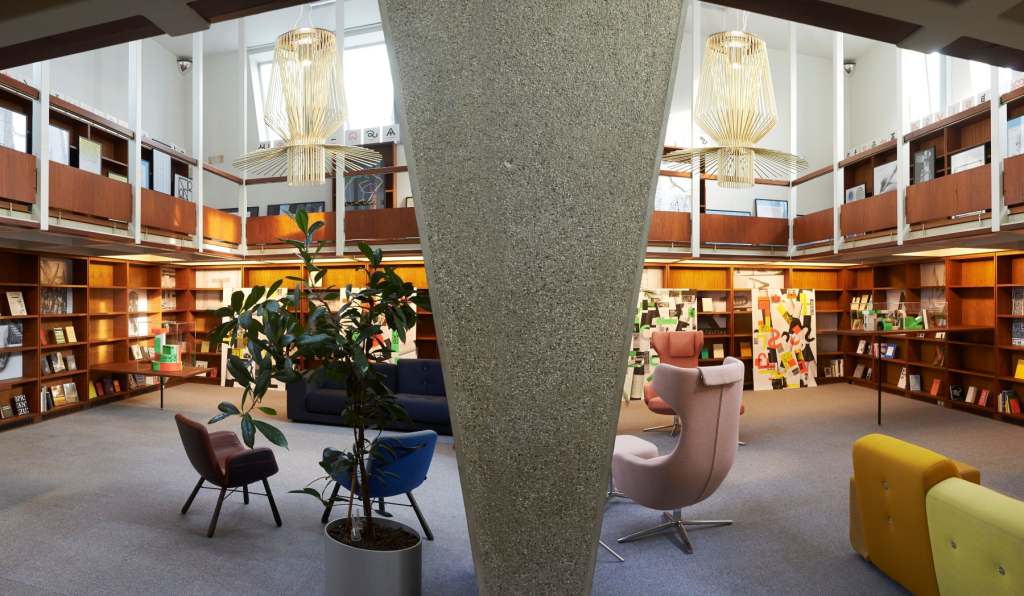
It’s back to Den Haag central for my next engagement, an architectural marvel very near my base, Hotel Indigo. The former US embassy, now in use by art organisation Den Haag West, was originally designed by Bauhaus architect Marcel Breuer and opened in 1959.
Here’s the back story: just after 1945, President Truman started a building project, the FBO (Foreign Building Operations), to establish American embassies abroad, with libraries, exhibition rooms and auditoria. It was a way of creating attractive modern centres for the spread of American history and culture in keeping with a particular city – a moment coinciding with the birth of the United Nations and NATO, and worry of communism. Before the project, American diplomats abroad simply rented space.
Breuer, a refugee to the US from Nazi Germany and close friend of Bauhaus founder Walter Gropius, was chosen for The Hague embassy, as the movement’s vision of form following function, “unhindered by untrue facades and cheating”, seemed in step with the robustness of Dutch building. The Hague is also America’s oldest diplomatic post, dating back to 1782, perhaps another factor in such esteemed, cutting edge design.
You can take a tour of the interior and admire the familiar mid-century slotting together of wood, glass and various types of stone and ceramic, even if the slickness has faded a little, and the place is touchingly shabby.
The embassy closed in 2017 after the slow-drip of concern around the security of such monumental buildings, that stretched back to anti-Vietnam riots of the 60s. Resolve against turning them into bunkers stood for a few more decades, until US embassies in Kenya and Tanzania were attacked in the late 90s, but it took 9/11 for steel doors, a reduction of glass, and 30-metre distancing to be reluctantly applied. Most of the central rooms are a little cell-like, and a day’s work here might’ve felt long. It seems only the bosses had offices with the beaker-shaped windows looking out onto the leafy, 16th-century Lange Voorout square.
And yet, the building’s star power and weight of history are overwhelming. Excellent as the Den Haag West is – exhibitions on Kathy Acker and James Baldwin are currently showing – the organisation seems adrift within a place that’s in transition, something their irreverent staff would freely admit to. I loved its liminal feel, almost like an art squat, and feel privileged to have seen the interior intact, give or take.
Panorama Mesdag
A light stir of summer is all about, and afterwards, as I walk past the town’s main square, Plein, the cafe tables are busy. In the middle of the square stands the figure they have to thank for it all, William of Orange (or “the Silent” if you prefer, due to his reserved nature in matters political), the man who led the revolt against the Spanish which led to Dutch independence. The Grote Markt, the central bar area, is even livelier that evening, with a sea of people sitting out in 3C temperatures.
Finally, the following day, it’s back to Scheveningen, but not to the coast. This time I see old wooden fishing boats all along the beach, donkeys pulling carts and heavily frocked women sitting beneath parasols. There are also cavalry exercises because The Hague is a garrison town. I’m in the middle of the city at Panorama Mesdag, standing in a small pavilion, within a museum, that is surrounded by vast cylindrical painting of Scheveningen in the 1870s when it was a fishing village.
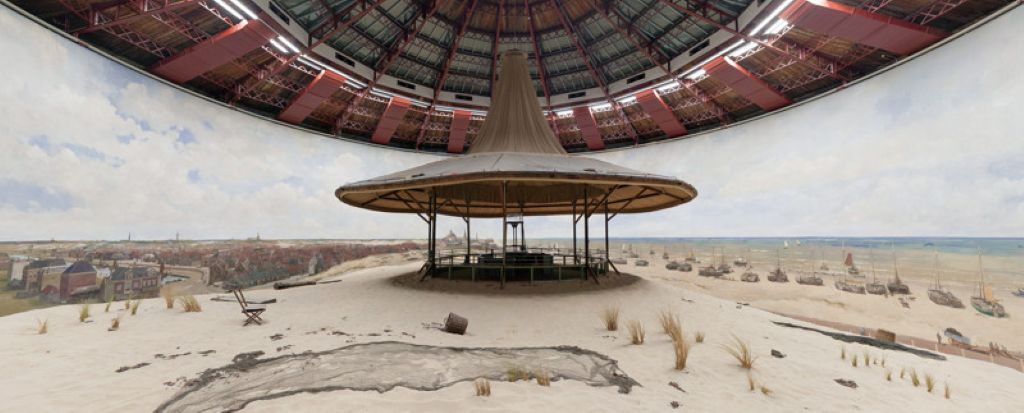
It’s a stunning achievement, like 19th-century CGI; a 1660 square metre canvas that’s 14.5 metres high and 114 metres in circumference, giving the viewer the impression of being on top of a dune with the bright horizon all around. Because the top and bottom edges of the panorama cannot be seen, the illusion of infinity is achieved and of time standing still.
The project was overseen by Hendrik Willem Mesdag and his wife Sientje. Mesdag was a would-be banker with a gift for painting, best enjoyed in his grand, turbulent seascapes. The panorama has stood in the same purpose-built museum since opening to the public in 1881 and is recognised as the greatest of its kind in the world. But it’s another, temporary exhibition, also at Panorama Mesdag, that brings out the deeper message of the panorama.
Drift: Dune To Dogger Bank explores the fragile dune landscape of the North Sea, largely inspired by Mesdag’s desire to protect the Seinpostduin, the highest dune in the coastal area, which is staged as the visitor viewing point for the panorama. As the exhibition states, “For the artists involved, the sea is not a backdrop and the dune not a possession but a living reality with which we must engage”’ and that “humans are not owners of nature, but a tiny part of it”.
Strange maps and paintings, sculptures of bizarre part-human creatures, textile work, photography and hard, uncomfortable facts, make up show involving the artists Tim Knol, Valerie van Leersum, Folkert de Jong, Anke Roder and more. Mesdag would’ve been with them all the way.
Where I Stayed in The Hague
The Hotel Indigo is a relaxed and upbeat and elegant place on Noordeinde 33, and worth every star of its four. The hotel is near the old US embassy in The Hague and Escher Museum (which I sadly missed), and is directly opposite the Royal Palace Noordeinde, a residence of the Dutch royal family.
During the last world war, when the building was still the Dutch Central Bank, the royals would at times take refuge in the basement which still features the bank’s 25-tonne door to the vault, and there is a secret tunnel joining the vault and palace. At one time the nation’s gold reserves, 7,000 gold bars, were stored here. Today, the basement is a 1920s-themed speakeasy cocktail bar. The hotel is also a few minutes from the tram going directly to the beach.
