


There’s eco-tourism…and then there’s real eco-tourism. After our busy, rewarding spell in the Central Valley area, we were set to enjoy a truly authentic nature experience at Selva Bananito Lodge, which nestles in the Talamanca mountains on Costa Rica’s Caribbean coast.
After a three-hour drive from Cartago, we bade a fond farewell to our guide Roberto and driver James just outside the village of Bananito Norte, and our new host Sofia transported us in her 4×4 on the bumpy last leg to the lodge.
Selva Bananito Lodge Costa Rica’s Caribbean Coast
Selva Bananito (in English, ‘Little Banana Jungle’) has eleven suites and cabins built on Caribbean-style stilts in the forest, and is the heart of a 1,450-hectare private biological reserve, owned and run by the pioneering Stein family, Sofia and her sister Karin and brother Jurgen.

Their story is a unique and inspiring one. Their father Rudi, an expatriate German who had been farming in Colombia since the 1950s, bought this large tract of land on the upper Bananito River in 1974, intending to exploit its timber resources. But in the 1980s his children, (perhaps unusually for that time) steeped in environmental conservation, pleaded with him to stop his destructive logging and instead protect the pristine forest and all that lived in it.
To his great credit the father agreed, and the idea of a lodge to bring in some income was born. It would be the purest form of eco-tourism; conservation always first and foremost, with sustainable accommodation to help fund it.
Selva Bananito Lodge, which opened in late 1994, was largely constructed from waste or salvaged wood. It has no mains electricity. The rooms have small, solar-powered lights; power outlets are available (along with WiFi) in ‘El Rancho’, the central hub which contains the restaurant, bar and library area. Hot water is provided by a few solar heaters, and the septic system uses a special water-lily purification system. The (mainly vegetarian) meals are served communally in ‘El Rancho’, in the evenings by candlelight.
The atmosphere at the lodge has been termed ‘luxurious rustic ambience’ and that seems a good description. The values of environmental protection, conservation and sustainability are there for all to see, but they are not relentlessly pummelled into you. What the Steins want you to do is enjoy their natural paradise, and that is what we set out to do.
Birdwatching and Horseriding in Selva Bananito Costa Rica’s Caribbean Coast
Courtesy of our superb guide Alan we had a terrific couple of hours birdwatching (Selva Bananito is also on a major migratory route). Alan was thrilled to find us not one, but two toucans, the yellow-throated and the keel-billed varieties. Such magnificent, colourful birds, as were the Cinnamon Flycatcher, the Pale-Billed Woodpecker, Baltimore Oriele, the Golden-hooded Tanager and the Collared Trogon, to name but a few. Costa Rica is home to over 900 bird species; more than double found in USA and Canada combined.

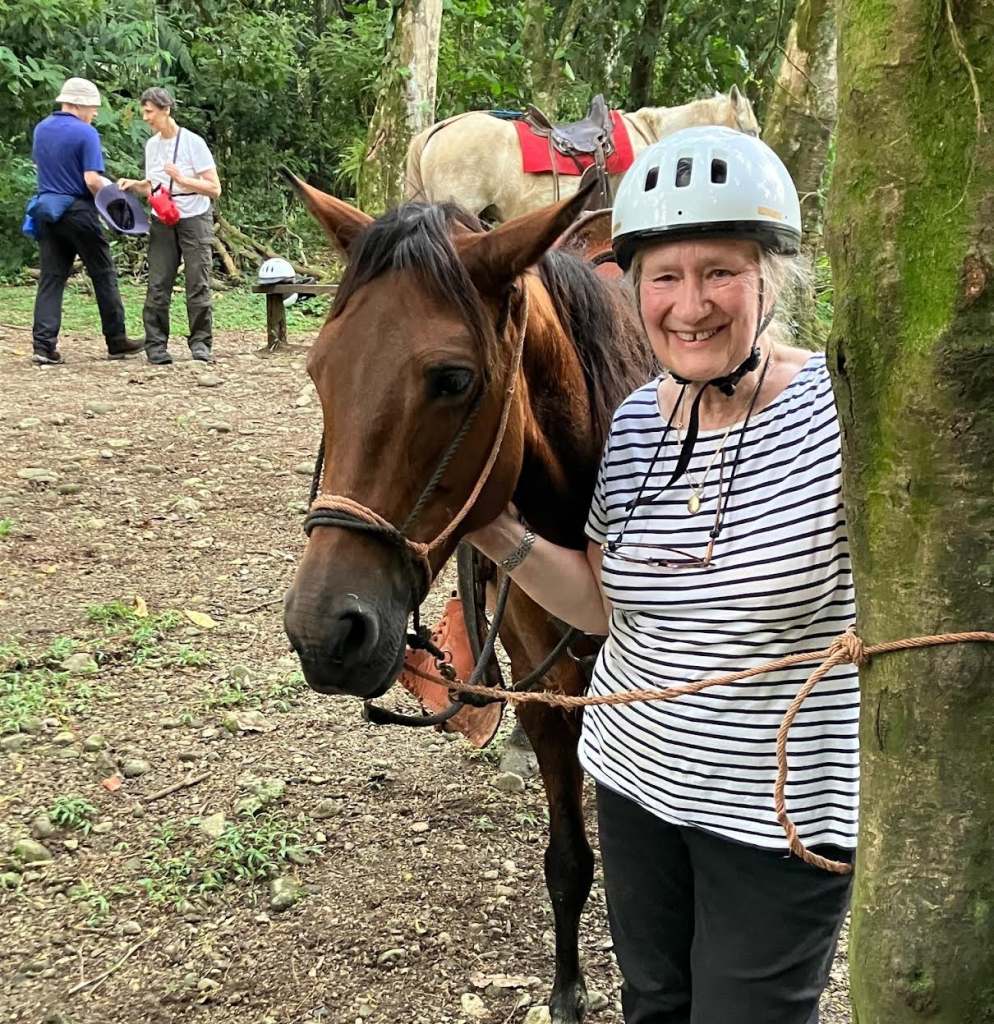
Selva Bananito lodge tries at all times to employ locals, and the Limon Province is home to the indigenous Bribri people. One of their number, Jerry, a farmer’s son, is a guide here, and possesses a remarkable knowledge of insects, birds and trees. He took us first on a nature trail, and then in the afternoon he was our guide when we joined forces with a German family for a horse-riding experience.
‘We don’t have an army, but we have an army of ants’, Jerry quipped as we watched in wonder as thousands of these astonishingly hardworking insects ferried leaves on their backs to their hideaways. Amongst the varied fauna, we spotted beautiful red and green coloured frogs, and a yellow eyelash palm pit-viper, on what turned out to be a gruelling, but satisfying, four-hour trek through primary and secondary forests.
Horse riding with Jerry was a tougher proposition than it had been at Queveri Farm in the Orosi Valley earlier on our trip. Once again the animals were steady, Roger’s grey gelding Centenario restraining his leadership instincts to fall in obediently behind Jerry’s mount. It was just that this time the terrain was trickier, not just green pastures, secondary forest and thick jungle, but some scary descents down steep banks and into streams.
Back safe and sound, we rested on one of the hammocks on our broad veranda before hunkering down for the night on a bed advisedly covered with mosquito nets. After a good night’s sleep we awoke to the familiar sound of the oropendolas and, after a hearty breakfast, awaited our car to take us to Cahuita on the Caribbean coast.
Cahuita on the Costa Rica’s Caribbean Coast
We would be now plunged into the warm, relaxed embrace of an Afro-Caribbean Creole culture. A good many of the inhabitants of the charming village of Cahuita and the other towns along the Caribbean coast are descendants of Jamaican workers who came to Costa Rica in the late 19th century to help build the Jungle Train railway, which carved through 100 miles of forest from the capital San Jose to the port of Limon, in aid of the ‘banana boom’.
Those Jamaicans joined the indigenous Bribris and Spanish-heritage Latinos to make up a diverse population mix on this coast, later supplemented by a growing community of North American, and some European, expats.
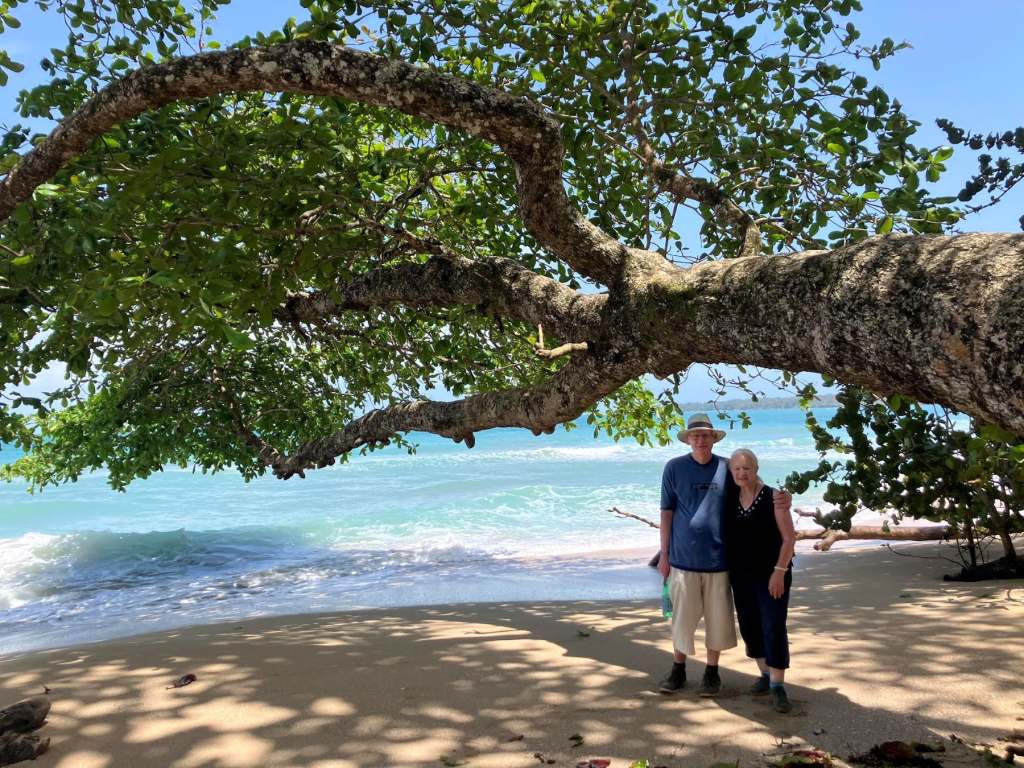
Cahuita is a pleasant, laidback place, with well-looked streets and a smattering of welcoming restaurants and bars. But its greatest draw is its national park, one of the smallest but loveliest in Costa Rica, which runs alongside the white-sanded beach.
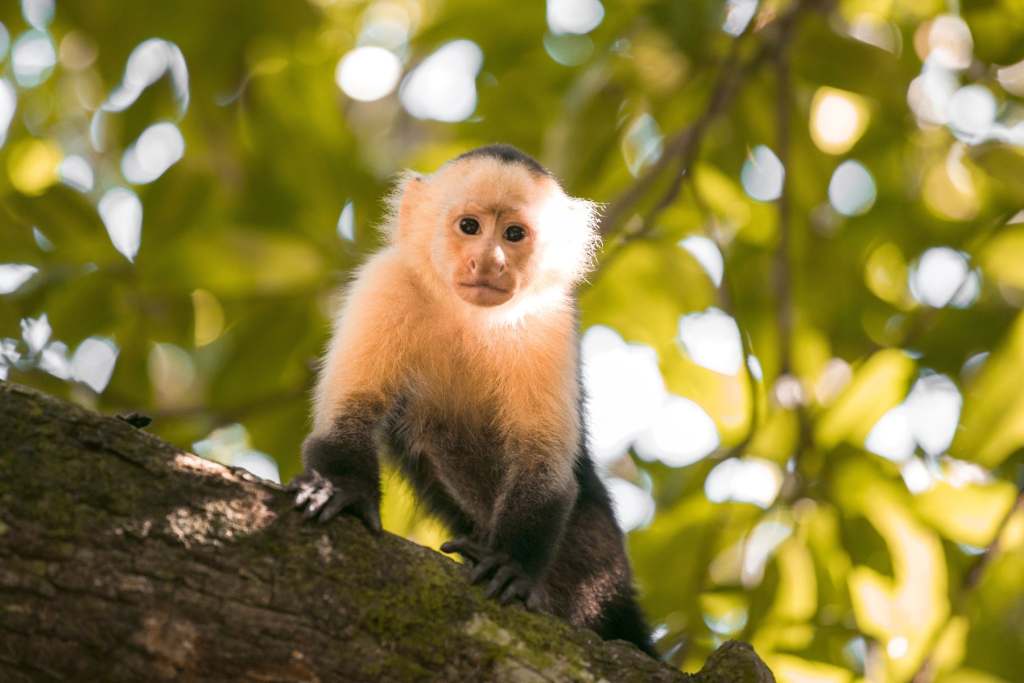
We took a late morning walk, the massive canopy of trees bathing us in lovely, dappled sunlight, and with our experienced guide Justo set out to find all the wildlife we possibly could. There were some successful early encounters, a cheeky white-faced capuchin monkey leaping about in bushes by the side of the path, a racoon almost comically fast asleep on the branch of a coconut tree, and a green iguana slithering its way on the canopy above us. Such are the riches of this small Latin American country which boasts a staggering six per cent of the whole world’s biodiversity.
On the Trail of a Sloth
But like everyone else who comes here, we were keen to get up close and personal with the nation’s most iconic creature, for this is prime territory for the two-fingered sloth.
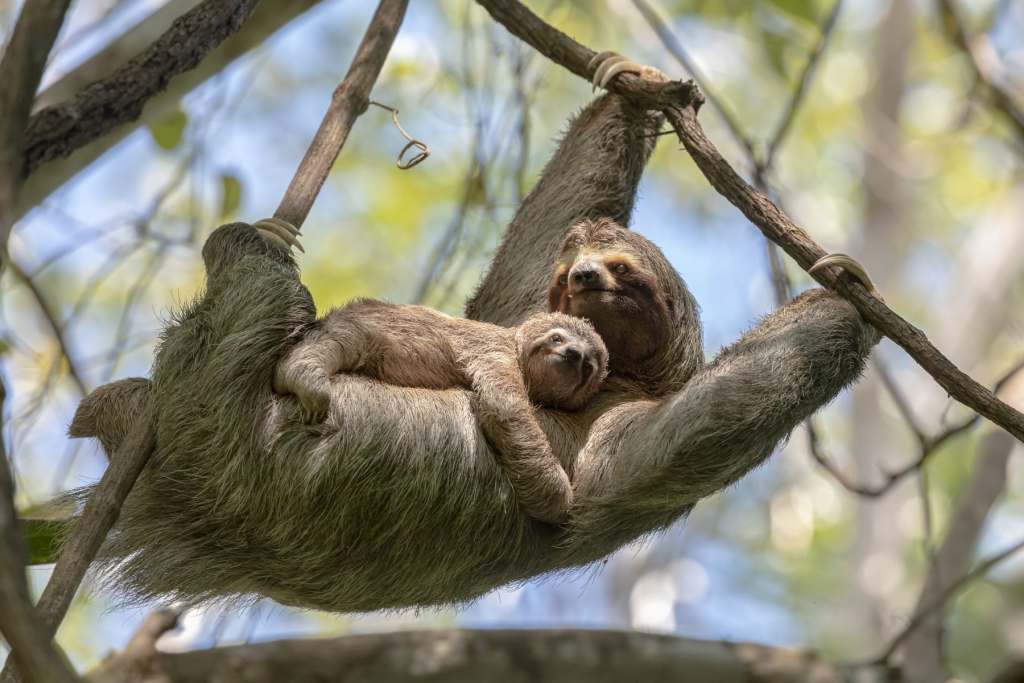
We had a few early tantalising glimpses: a hairy backside in the almond tree at the beginning of the trail, the fingers wrapped around the branch of a coconut tree. Then finally, just as we turned back from the Rio Perezoso to head home, we struck gold.
Justo had been training his scope towards the upper branches of a cecropia tree. ‘Come quickly, look, look,’ he urged us. Peering into the lense rewarded us with the most amazing of sights, a mother sloth pulling herself upwards on her powerful arms to nibble on a succulent leaf, while her baby, wrapping its legs around her fur to cling on, does likewise on the branch below.
To witness these curious looking upside down creatures in the wild, with their big brown eyes, black noses and seemingly gentle smiles, was more than we could have hoped for. It was a great start to a few days of the ‘pura vida’ (literally the ‘pure life’ – the Costa Rican catchword for their laidback style of living) on the Caribbean coast.
Aguas Claras
We were staying four kilometres outside the town of Puerto Viejo at Aguas Claras, an elegant, ecologically-minded, luxury boutique hotel comprising rooms and bungalows in an extraordinarily, lush, wildlife-filled jungle garden. Macaws screeched at dawn, howler monkeys hopped among the palm trees, and little agoutis (guinea pig like creatures) ambled along the winding pathways.
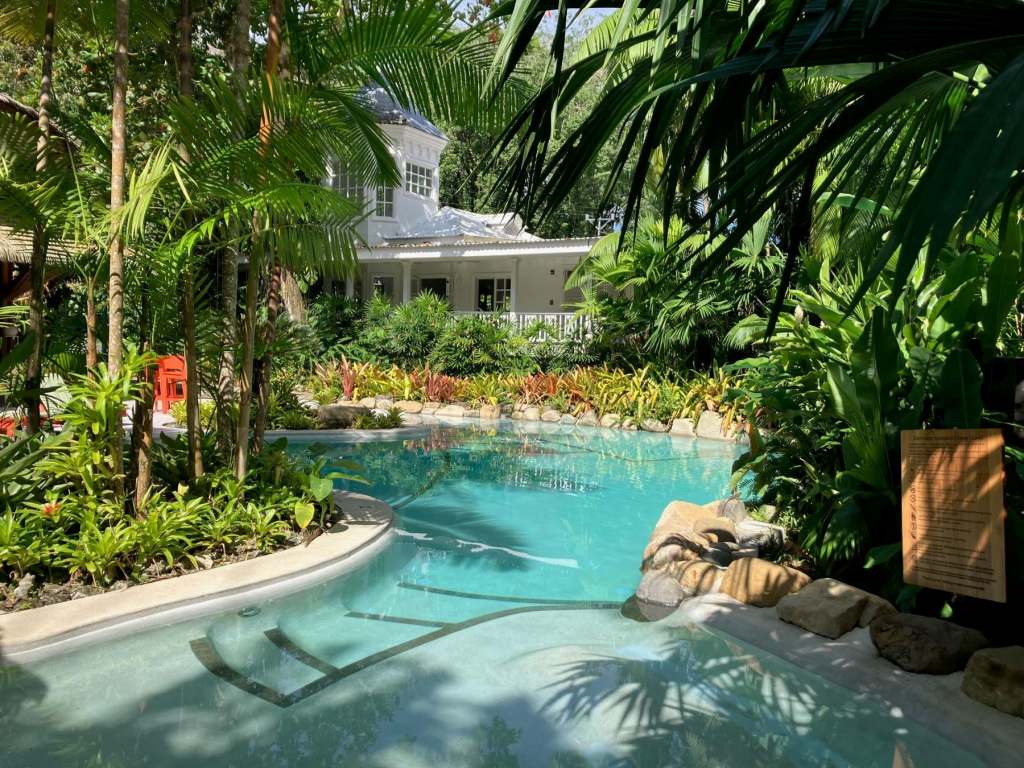
The hotel, an intriguing mixture of Victorian and Caribbean design, is the creation of San Jose artists Elizabeth Steinvorth and her daughter Elena Rohrmoser. Their splendid watercolor paintings, bright mosaics and other artworks enhance nearly every room on the property. Our very comfortable suite, the Belafonte, had the largest walk-in shower we had ever come across.
In the restaurant and pool area the delightful Mabel gave Eileen classes in how to make a top-class cocktail and cook the best tortilla, and we both enjoyed lunches on the hotel’s own private beach. Breakfasts and dinners here were outstanding.
Puerto Viejo Costa Rica’s Caribbean Coast
But we were keen to explore Puerto Viejo, so we chose the most comfortable and scenic way to get into town, in a bright red tuk-tuk, our driver sharing the road with the many bicycles and scooters that are the preferred transport here.
Evidence of the coast’s Jamaican heritage soon emerged with a mural of one of that island’s most famous sons, black nationalist Marcus Garvey, whose political activism was shaped when he worked on a banana plantation here, and several of his famous quotes are commemorated on a wall, including ‘a people without the knowledge of their past history, origin and culture is like a tree without roots’.
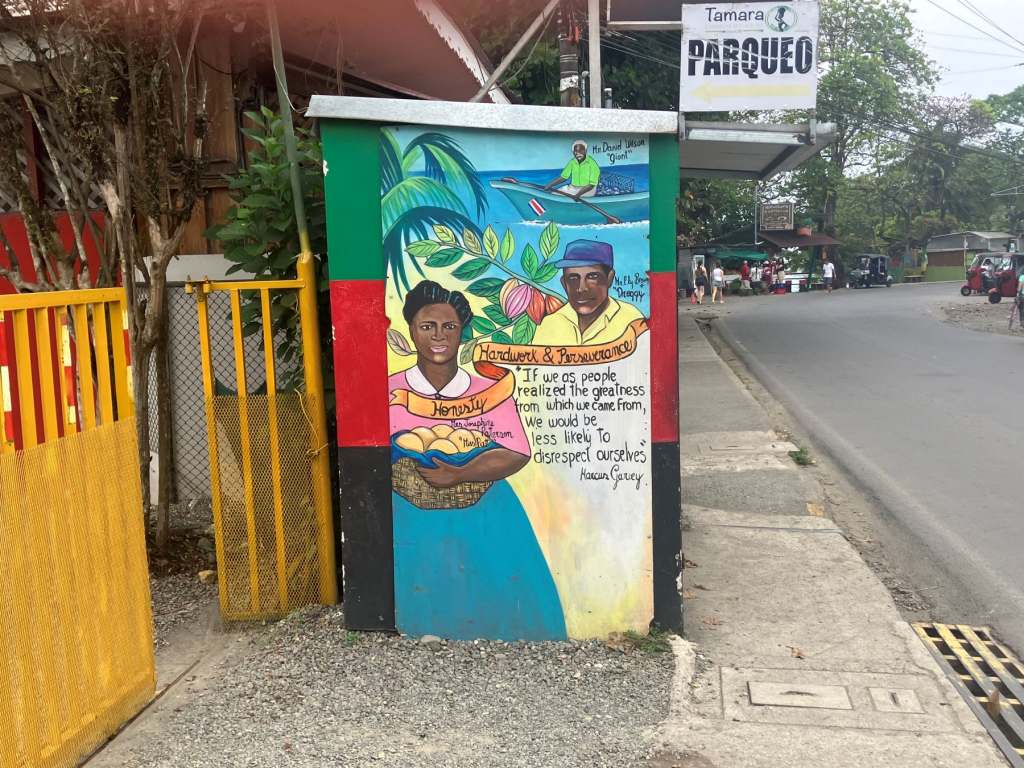
On the town’s main drag the shops and cafés, often characterful wooden, rustic structures with verandas, are painted in a vibrant array of colours, often tropical yellow and lime green, coral, salmon and red. We stopped for a cup of excellent, strong coffee at Café Gustitos, where every table was taken at eleven o’clock on a sleepy Wednesday morning.
At night in season Puerto Viejo’s bars hum to the sound of reggae. By day, one of the town’s main draws is surfing, as it boasts some of the most intimidating waves along the Caribbean coast. We took a walk to the southern end of the town and looked on in admiration as, on a choppy morning, enthusiasts struggled with the town’s most famous wave, ‘La Salsa Brava’.
On our stroll along the seafront we came across a curious ship, or rather boat, wreck, just yards from the shore. Dubbed ‘The Old Shipwreck’ by locals, its history uncertain, the rusting vessel presents a somewhat incongruous sight in the crystalline water. Aside from the obvious photographic opportunity, the side of the boat that lies out of the water has become a canvas for local graffiti artists.
Jaguar Rescue Center
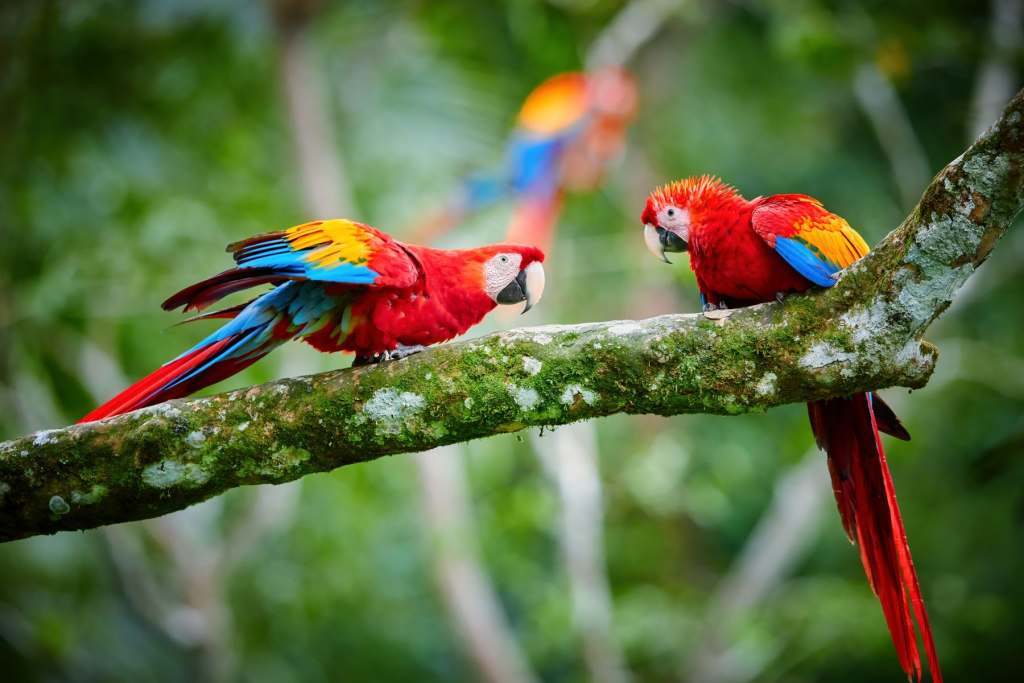
The following day we took the shortest of trips from the hotel (a few hundred yards) to the excellent Jaguar Rescue Center, which aims to rescue, rehabilitate and, if possible, rewild injured or abandoned animals and birds. There are no jaguars here at present as their numbers are sadly in decline, and we heard some sad stories of neglect before a new law kicked into effect in 2017 which made it illegal to own a wild animal.
Paco the spider monkey was a case in point. Tied up at home for 27 years, he had become obese, unable to climb and suffered from severe muscle atrophy. But such had been the efforts of dedicated volunteers here that Paco, now on a proper diet and with greater love and attention, is able to clamber round his enclosure.