Roger Hermiston and Eileen Wise go horseriding and birdwatching in Costa Rica’s Central Valley.
In March 1963 two momentous events in the modern history of Costa Rica collided on the same day. The first was the hugely anticipated first visit of American President John F Kennedy, it would turn out to be his only one as eight months later he was assassinated. A joyous occasion it brought a quarter of a million people onto the streets of the capital San Jose.
Irazu Volcano
But the second would have far greater consequences. Even as the American leader was concluding his visit with a rousing speech to students at the University of Costa Rica, all over the city people were just starting to cover their mouths with handkerchiefs and putting up umbrellas, while storeowners swept their entranceways.
This was no calamitous weather event. Instead, the residents were protecting themselves from a layer of volcanic ash that was beginning to envelop the city, drifting towards them from the Cordillera mountain range twenty miles away. For after decades of quiet, the Irazu (it means ‘hill of tremor and thunder’) volcano, the highest of all Costa Rica’s 100-plus volcanos, had erupted with consequences that would be terrible in the days and months to come.
Kennedy would leave the city before the real damage was wrought. Lava poured down the hillside leading to scores of human deaths, many more of cows and horses, the destruction of hundreds of houses, and the loss of millions of dollars’ worth of crops. These were the grimmest of days but the Irazu eruptions did not finally stop until February 1965.
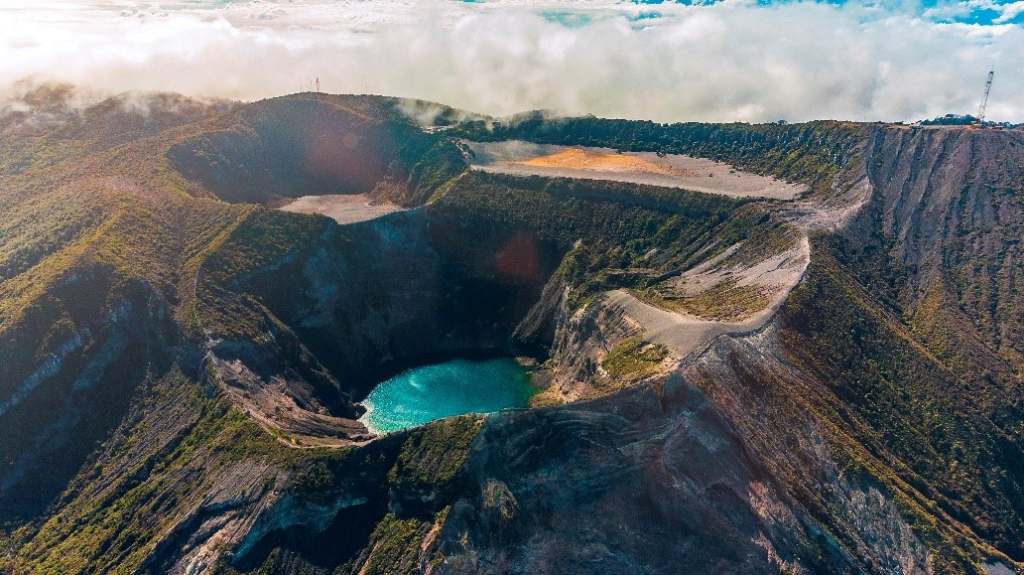
Out of tragedy came opportunity, and today the Irazu volcano is one of Costa Rica’s most popular visitor attractions. It was our first stop after leaving San Jose, and as we started to walk along the paved walkway to the summit, over 11,000 feet above sea level, it was like entering a lunar landscape.
On our left was the Playa Hermosa (meaning, ironically, ‘Beautiful Beach’), a buried old crater, a massive, flat, grey windswept terrace of volcanic ash and sparse vegetation, and a stark contrast to the backdrop of green hills and mountains.
A few hundred yards further on and we were at the top, able to enjoy the stunning view down to the volcano’s Principal crater and its little sister the Diego de la Haya crater. The former is an incredible 1,050 metres wide and 300 metres deep, its walls various colors of grey, black and white from old lava flows. The two crater lakes also contain acidic water, which can dry and reform into stunning colours of turquoise, mustard, red and green.
You’re told that from this summit it’s possible to see both the Caribbean and Pacific oceans, but you have to get here early in the morning to do so. At mid-morning all we could see was only an, admittedly beautiful, blanket of white cloud smothering the valley.
Cartago
Such is its grandeur that visiting Irazu felt like a semi-religious experience. So it was appropriate that after coming down from the mountain we paid a visit to Cartago’s impressive cathedral, the Basilica de Nuestra Senora de Los Angeles.
Cartago was Costa Rica’s capital until San Jose took over in the 1820s. Important churches have been located on this site since the 16th century, but all were destroyed by earthquakes, the last of them in 1926. This current cathedral, a favoured pilgrimage site, was built in the Byzantine style with some Gothic blended in. In the huge antechamber everyone seems to want to touch for luck the cathedral’s founding stone with its tiny statue of La Negrita (‘The Black Virgin’), Costa Rica’s patron saint.
On the same tack, on nearby stone walls, hang hundreds of ex votos (devotional sculptures) of all shapes and sizes, a Latin American tradition in which the faithful deposit representations of parts of the body they need cured. Many here are of hearts, legs or kidneys. In addition, in an adjoining room, there is a big collection of promesas (‘promises’), left as thanks for miracles received, gold and silver charms, photographs, letters, university degrees.
After the exertions of the morning it was time for some relaxation, so we headed southeast from Cartago into the pretty Orosi valley. There we took the waters at the Hacienda Orosi Hot Springs resort, trying out several different pools filled with thermal mineral water, from the cool to the very hot (39 degrees). A cleansing, relaxing experience, with great views of the verdant mountainside.
Hotel Quelitales
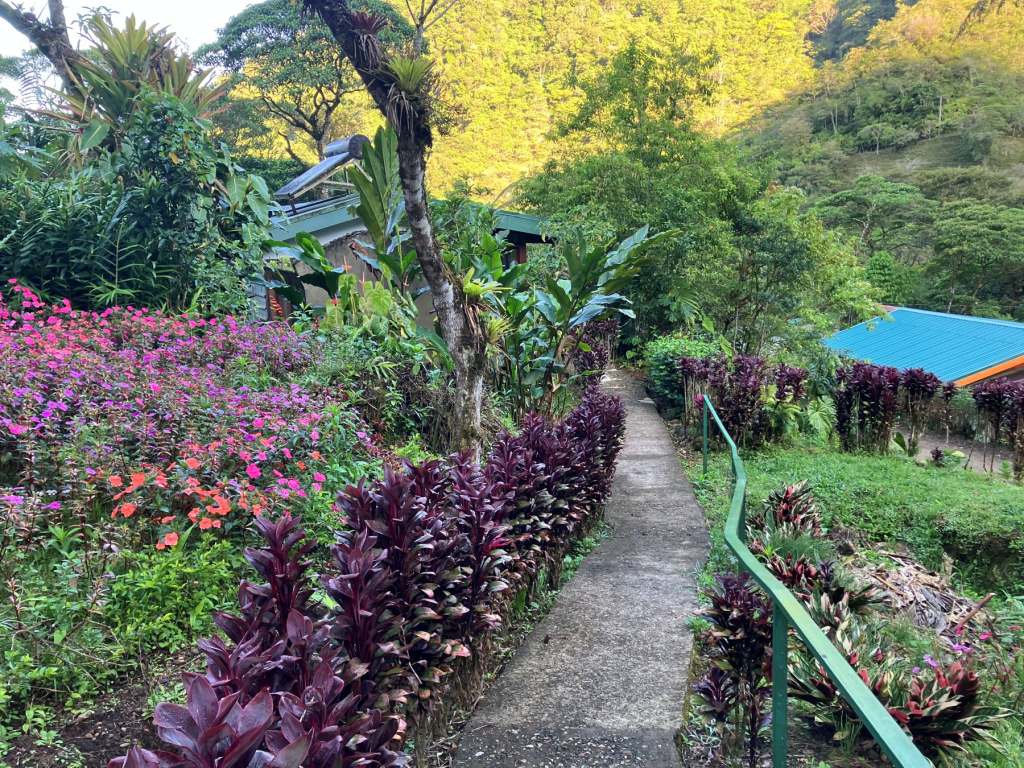
After that diversion we headed to our resting place for the next two nights, Hotel Quelitales, near the village of Cachi in the foothills of the Talamanca mountains above Cartago. Located at the top of a steep road and surrounded by rainforest with lakes and waterfalls, this is a stunningly beautiful, remote ecolodge with eight suites and three bungalows, each named after a bird or insect. We checked into Bungalow Mariquitas (ladybird), which was reached via a path flanked by a wonderful cascade of pink, red, purple, blue and yellow flowers of all varieties.
Our room was stylish and very comfortable, with a king-sized bed and an outdoor shower. Back in the reception and restaurant area we were quickly in conversation with the hotel’s genial and enthusiastic owner, Jose Alvarez, who, aside from his managerial duties, also cooks and takes birdwatching walks.
Jose, who spent much of his career working in the restaurant trade in San Jose, returned to his roots in Cachi and has turned Hotel Quelitales into a veritable birding hotspot. He travels the world evangelising over what he has to offer here. Last year, for example, he was in the UK attending the Global Birdfair held at Oakham near Rutland Water.
Birdwatching and Horse Riding in Costa Rica’s Central Valley
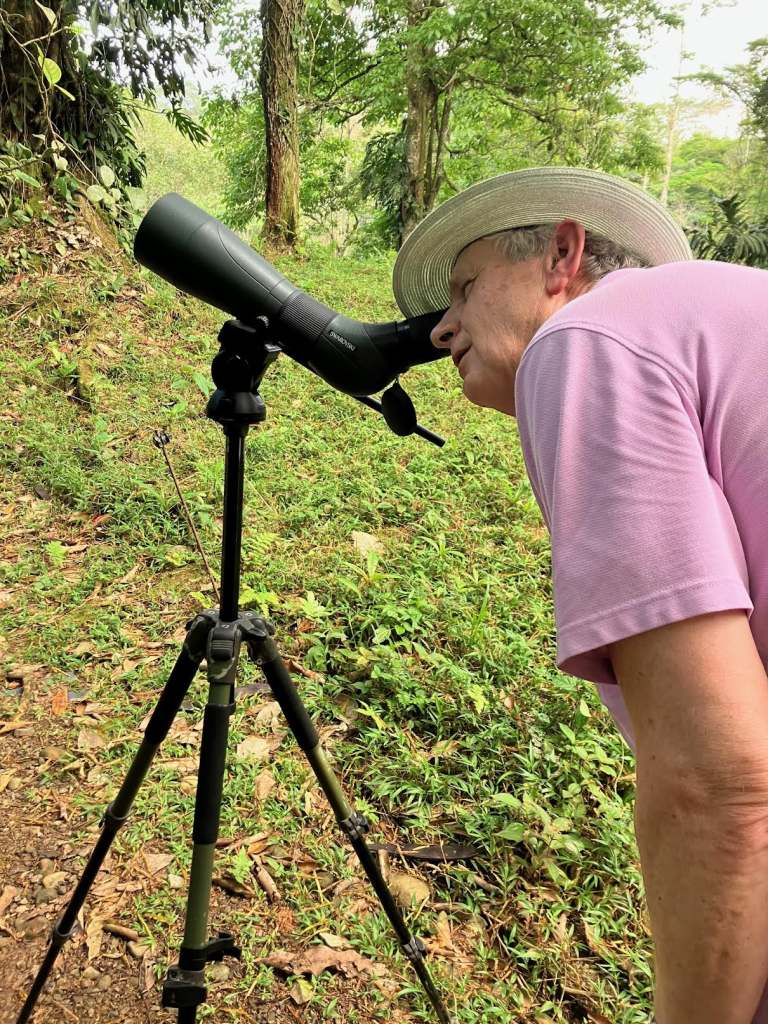
We enjoyed a tasty meal in his Casa Jose restaurant, where the specialty is trout, made with mushrooms, almonds or rosemary. The following morning we rose early for a bird tour with our young, knowledgeable guide Dennison, concentrating our scope in particular on a favourite of these parts, the Montezuma Oropendola. This handsome blackbird of the tropics, with its chestnut-coloured body and yellow tail feathers, has a distinctive, loud gurgling-like cry that is your alarm call in the morning.
This is a prime spot for hummingbirds (there are ten species) and we saw a couple of the black-bellied variety on feeders near the Dona Ana waterfall. Everyone was then excited to see a glossy Black Guan sprint out from the undergrowth. Hotel Quelitales also has a rare bird that enthusiasts come from far and wide to see, the elusive Sunbittern, with its red, yellow and black plumage, which lives down by the lake.
After our bout of birdwatching we headed up high up the Orosi Valley for our next adventure, horse riding at the family-run Finca Queveri farm. On the way we gained some insight into the scale and importance of the prime agricultural land in this area, which massively benefits the country’s economy.
On one side of the road Jersey and Holstein cows grazed contentedly in the lush green fields. On the other, in a timeless scene, horse-drawn ploughs worked the potato fields (too steep for tractors here) with workers handpicking the vegetables. We stopped to talk to a group of men transporting a cartload of huge onions. The minerals from the destructive Irazu volcano (potassium, calcium, magnesium) have helped to make this land even more fertile.
Arriving at Finca Queveri, we were greeted cordially by Roger, Gisella and Adrianna Fernandez-Estrada, enterprising brother and sisters who, in their own words, create a ‘full rural experience’ here. There’s the working farm (founded in the 1930s), with its free-range cattle, pure and mixed breeds of Simmental and Simbrah: there’s the guest house, with four suites and a capacity of 16 guests: there’s biological research with the ‘Conservation Center’, featuring permanent cameras recording the activities of all manner of animals and birds on the estate (totally fascinating, and you can view them all on YouTube and Tik Tok); and then there’s horse riding, for experienced riders and newcomers alike.
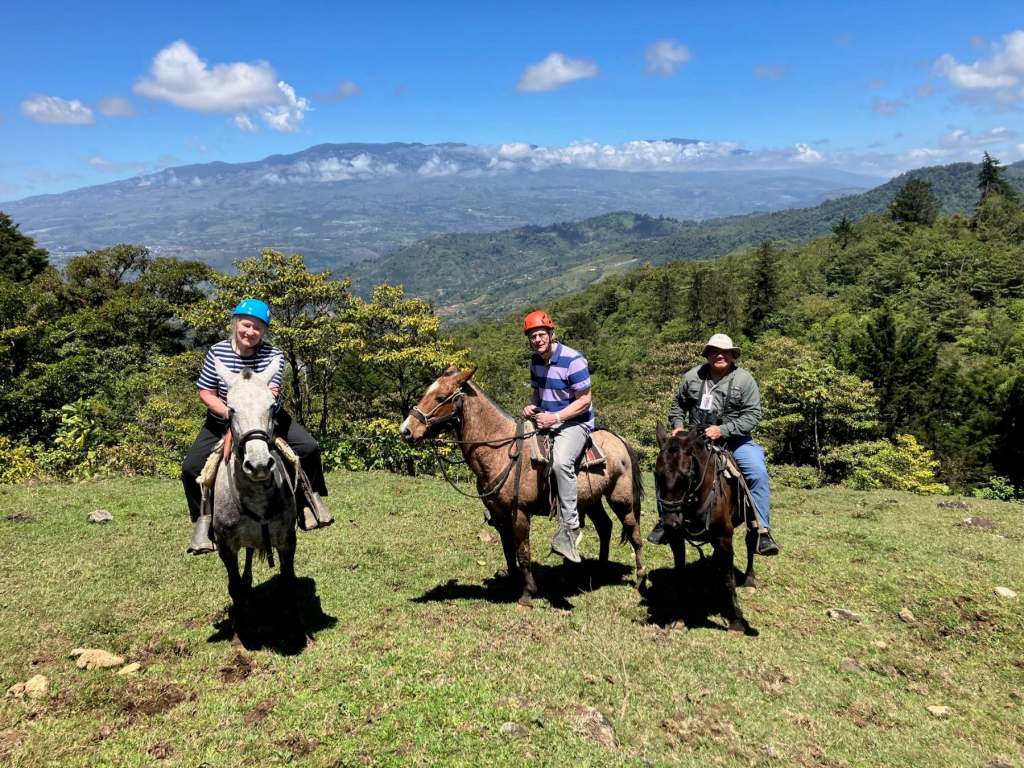
Four of us set out – Eileen, Roberto (our guide), Ramiro (our leader) and a nervous Roger, who was riding a horse for the first time, at the grand old age of 68. For an hour and a half Roger’s mount Cepillo Brush led him over uneven and recently muddy ground to high pastures, and made short work of a tricky descent, navigating stones, rocks and branches. At the highest point on a lovely afternoon, the panoramic views of Tapanati National Park and the volcanic mountain ranges were absolutely stunning. All in all it was an exhilarating experience.
After the ride we sat down in the lodge for a superb four-course meal, most of it made from ingredients derived from the farm. For Roger, Gisella and Adrianna, this farm is clearly a labour of love, and they have created a warm, friendly environment for their guests and visitors. There is so much to learn and enjoy here.
Café Cristina
Before we left the Central Valley and Highlands behind, there was one more visit to make to Café Cristina, a small, organic coffee farm eight kilometres northeast of Orosi. The charismatic owners, Americans Ernie Carman and Linda Moyher, have been running the business since the late 1970s. The 1980s brought an economic downturn, blight outbreak and consequent plummeting prices, but somehow the couple clung on and the business began to flourish.
Linda took us on a tour of the farm, pointing out that it’s more of a natural habitat than a monoculture, and that the coffee plants are just part of an ecosystem of wild flowers, insects and birds. It seems all roads lead back to Irazu, because undoubtedly the volcanic soils, together with moderate temperatures, help towards making an excellent cup of strong coffee, as we discovered in our tasting session at the end of the tour.
