


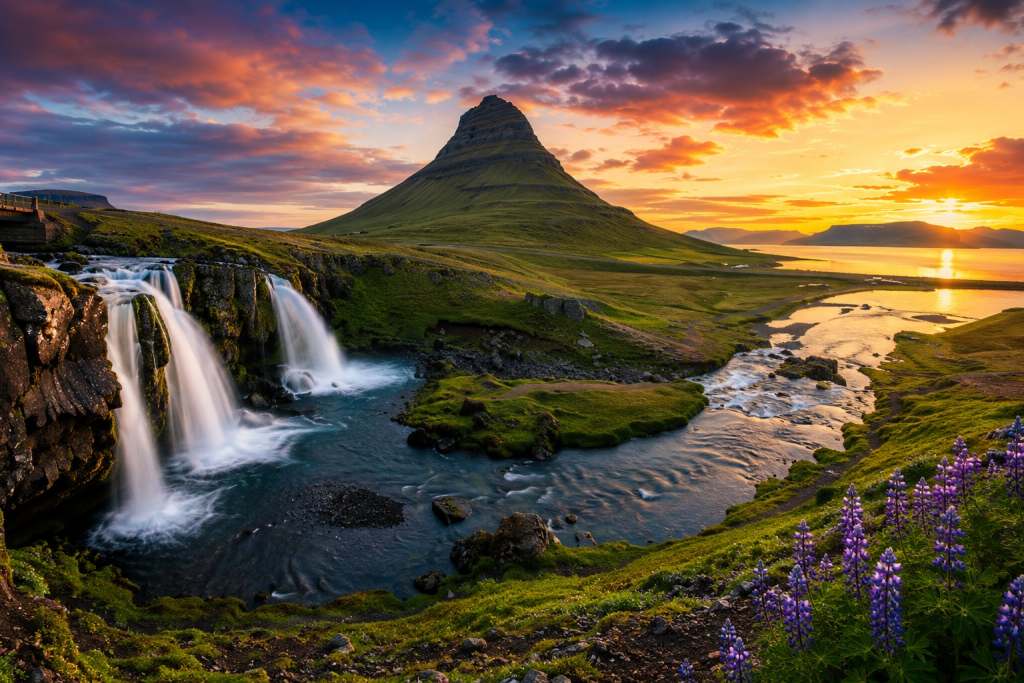
To arrive in Iceland is to encounter a geography that fundamentally alters its identity with the tilting of the earth’s axis. For the traveler, Iceland offers a startlingly dense duality: a land that functions as two entirely different countries depending on the season. Choosing between them is not merely a matter of timing; it is a choice between the expansive freedom of the Midnight Sun and emerald-green mossy valleys, or the intimate, frozen sanctuary of the Northern Lights over a stark, obsidian-and-white volcanic desert.
Many travelers begin their planning by searching for vacations to Iceland to secure a gateway to the vibrant, colorful streets of Reykjavík. While the pursuit of Iceland vacation packages provides a restorative and seamless base for the journey often including handpicked accommodations and guided excursions to the Golden Circle the real reward of a 2026 itinerary is found in the “seasonal rhythm” you adopt. Choosing the summer satisfies the desire for the legendary Ring Road circuit and the accessibility of the remote Highlands, while selecting the winter rewards the curiosity for the “small” details: the glint of blue ice in a hidden cave, the warmth of a geothermal pool against the falling snow, and the unhurried tempo of a world where the sun barely skims the horizon.
Traversing Iceland’s dramatic landscapes, where glaciers meet volcanic fields, demands carefully arranged vacations to Iceland that respect the island’s weather-dependent terrain, ensuring each transition from sunlit glacier walks to aurora-lit evenings feels seamless rather than rushed. Coordinating these shifting conditions becomes far more manageable with the subtle logistical support of Travelodeal, allowing the pressures of unpredictable weather to fade. As structure gives way to the rhythm of the elements, travellers can immerse themselves in experiences often highlighted in solo travel deals, discovering that the island feels most authentic when the natural forces set the pace of the journey.
Summer: The Land of the Midnight Sun
Summer in Iceland (June to August) is an exercise in limitless light. With the sun barely dipping below the horizon, the geography feels expansive and accessible. This is the only time of year when the F-roads into the Highlands are open, revealing a prehistoric interior of rhyolite mountains and hidden hot springs. The landscape bursts into color with purple lupins and vivid green moss, and the cliffs are teeming with nesting puffins. It is a season that teaches the traveler to value the “active” life, where the days are long enough to witness the entire spectrum of the island’s beauty in a single, golden hour.
Winter: The Cathedral of the Aurora
In contrast, winter (November to March) transforms Iceland into a hushed, monochromatic masterpiece. The geography becomes more intimate as the focus shifts to the glaciers and the subterranean worlds of natural blue ice caves, which are only accessible when the temperatures drop enough to stabilize the structures. While the days are short offering as little as four to five hours of light-they are defined by a permanent “golden hour” that is a photographer’s dream. This is prime Northern Lights season, a primary sensory ritual that connects the traveler to the cosmic movement of the solar maximum in 2026.
Planning Your Trip: A Few Essentials
The key to an unhurried Iceland trip lies in the preparation. Book accommodations at least three to four months in advance, particularly for summer, when demand peaks along the Ring Road. Allow a minimum of seven to ten days to avoid the trap of rushing between landmarks, as distances between attractions are deceptively long. Rent a 4×4 vehicle rather than a standard car, as many of Iceland’s most rewarding roads require higher clearance. Finally, build at least one or two completely unscheduled days into your itinerary – Iceland’s weather is unpredictable, and the most memorable moments often arrive when the plan is set aside.
The Ritual of the “Geothermal Soak”
Regardless of the season, the ritual of the hot spring remains the essential Icelandic experience. In summer, a dip in the Blue Lagoon or a remote hillside pool is a refreshing pause during a long day of hiking. In winter, the ritual becomes more profound; the contrast between the sub-zero air and the 40°C water creates a sensory bridge that is uniquely Icelandic. Watching the snowfall while submerged in mineral-rich warmth is a moment of profound peace that reminds the traveler that the most beautiful part of a holiday is the internal stillness it provides.