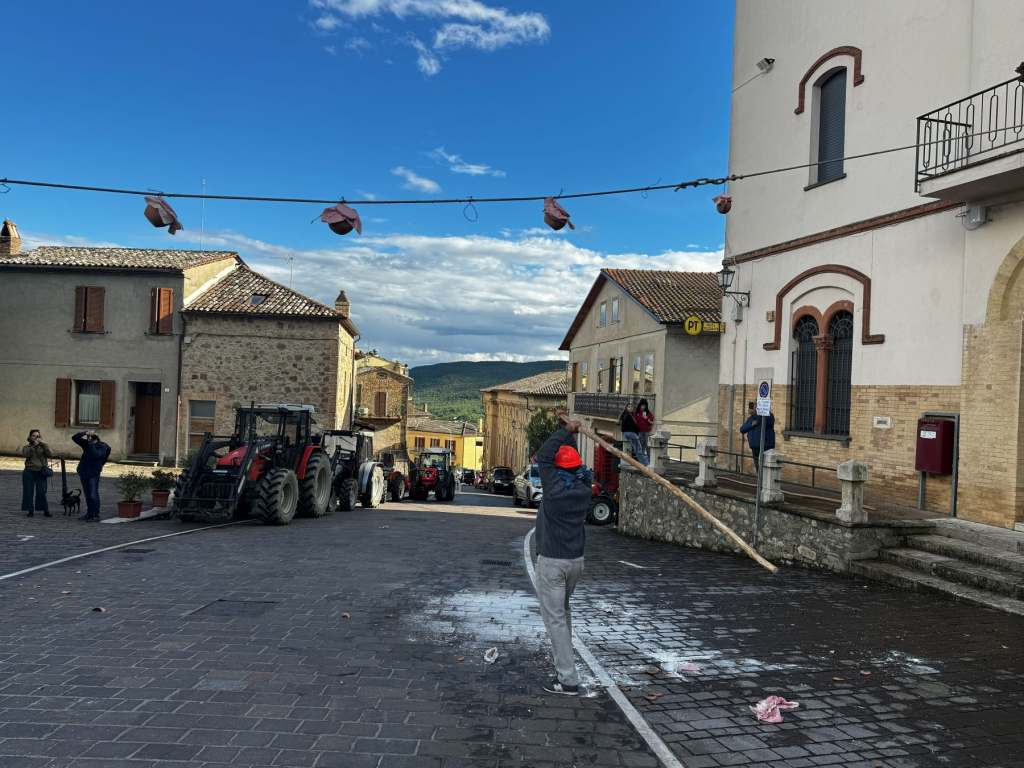
First the man blindfolds me, then he spins me around a few times to ensure I am totally disorientated. He pushes me gently in the right direction before releasing me. Blindly I stagger onwards guided by the crowd. “Avanti!” I move forwards. “Sinistra!” I shuffle left. “Ferma!” I stop. Lifting the long pole high in my hands as instructed beforehand, I strike forwards with all my might.
I hear a loud crashing noise. The crowd cheers. And to my amazement as I remove the blindfold I discover I have managed to hit the porcelain pot hanging from the wire.
Children scurry off towards the debris on the floor in search of sweeties as I am presented with my prize, a €5 note and a lotto ticket which I give to Paolo, who promises to split our winnings “50/50” if we win a million euros. After all my luck is definitely in.
I have just taken part in the Pignatte (literally ‘pots’ in Italian), part of the games held during the Santa Isidoro Agricultural Festival each May in the hilltop village of Allerona in Umbria. According to legend Isidoro was a farmer who grew the best cops despite having to till rocky land. One day the other farmers spied on him, to discover the saintly farmer praying while angels did all the hard work for him.
Blessing the Tractors
Now the angels have been replaced by tractors which stand in proud procession around the town square. My preference is for the beaten up rusty Fiat tractor although others prefer the ‘Lamborghini’ tractor next to it.
A priest blesses both festivities and tractors once the brass band has stopped playing.
The clouds that followed us on the drive from Rome have lifted to reveal the rolling surrounding countryside.
The whole town appears to be here, young and old. There are no recalcitrant teenagers playing on their phones.
Paolo beckons me over and I have a go at the next game. An egg is placed in a small hole in a block of wood. I am passed a wooden ball which I hurl at the egg. I opt for the backhanded technique I learned while playing boules as a kid. My ball hits the log but sadly misses the egg by inches. My beginners luck has evaporated. Perhaps we are not destined for Euro millions?
Later in the evening I bump into Massimiliano Tardiolo, the man who organises the games and had earlier blindfolded me, he calls me ‘Marco’ immediately. For a brief moment I feel as though I have been accepted into the community.
Local Tourism in Allerona Umbria
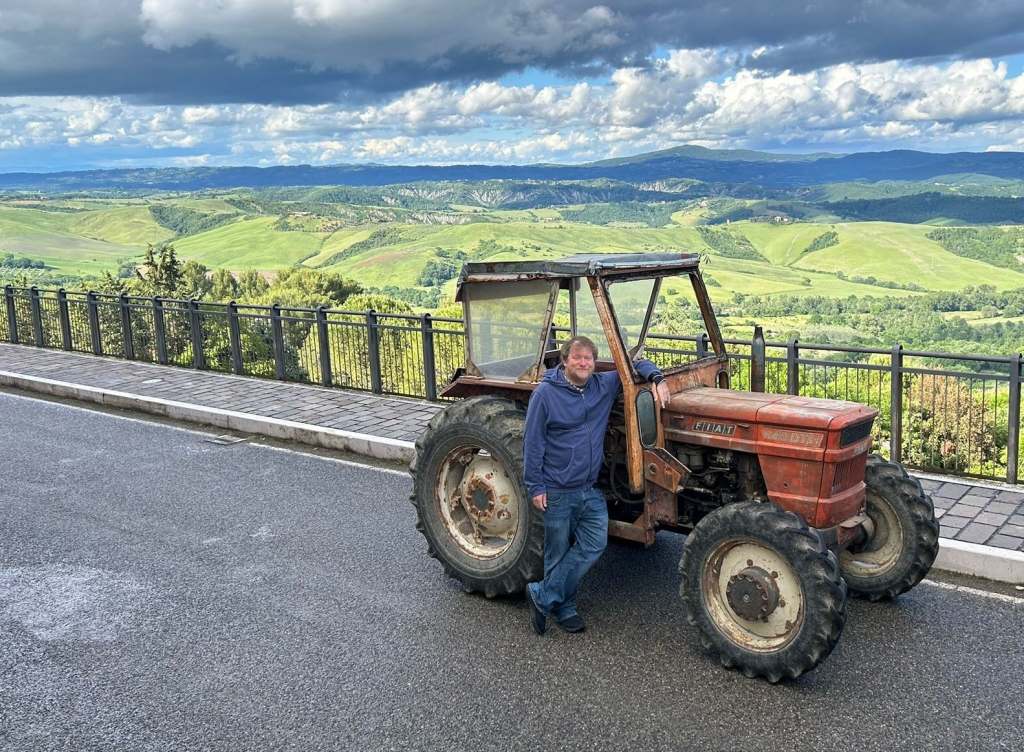
Community is at the heart of the local stays organised by Elizabeth Heath of Villaggio Tours in Allerona. The American travel writer has lived in this small Umbrian village for 17 years.
Later that evening as we enjoy a wonderful meal with local produce and wine at La Panatella for a fraction of the price we would pay in the UK for similar fare, she explains how she fell in love with the village and Paolo while researching for her dissertation many moons ago.
Villages such as Allerona have suffered in recent years from a drain. All around in the small historic centre where a couple of hundred people live, are signs of properties for sale. There is little employment prospects for locals. This may explain why we are embraced by the community rather than vilified as happens in other parts of Europe. Tourism initiatives such as Liz’s bring in much needed income, and the vile plague of Airbnb has not yet infested local life.
Six Keys Guest House
Earlier we checked into Six Keys Guest House, the traditional property Paulo, who is a master stone mason, has turned from ruins into luxurious accommodation in the last couple of years.
Two of our small group have been here before, and marvel at the transformation in recent months. Liz explains the architectural principle was to keep ‘what is old old, while what is new should be new’. Ancient bricks stand next to gleaming metallic stairs. It is a policy of juxtaposition that works.
Upon arrival we are treated to some bread and sharing plates from the local shop. The anchovies, and broad bean tuna and onion dip are especially good. And the local wine is excellent. On the drive to the village, we passed many a vineyard.
Pugnalone Festival
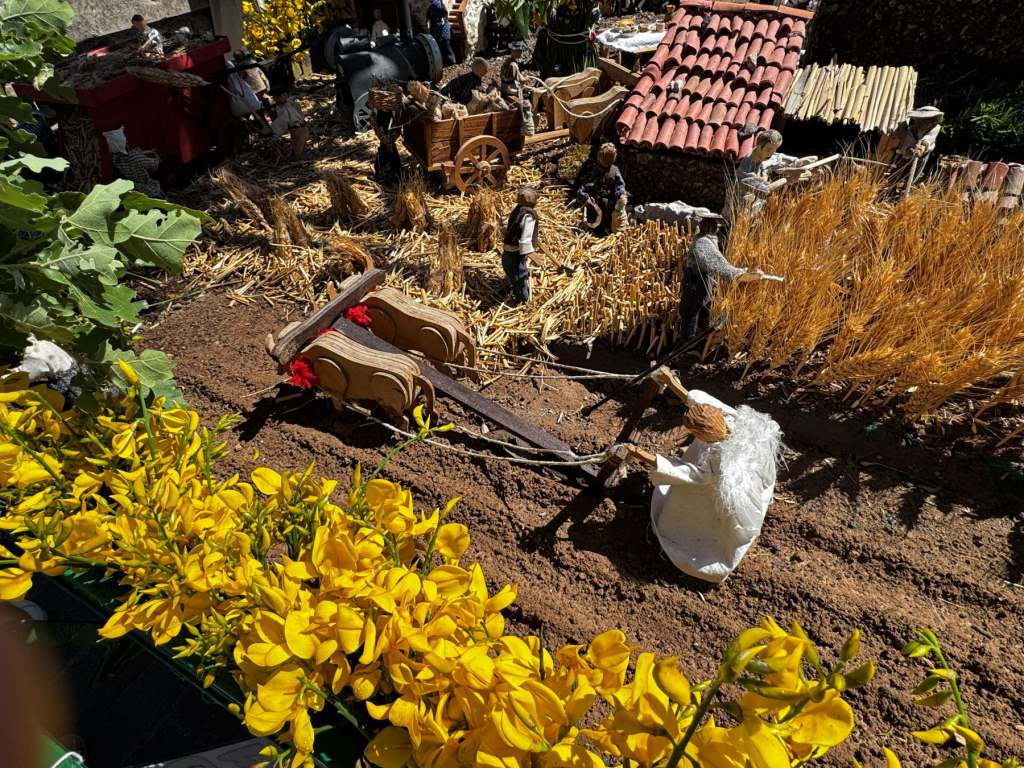
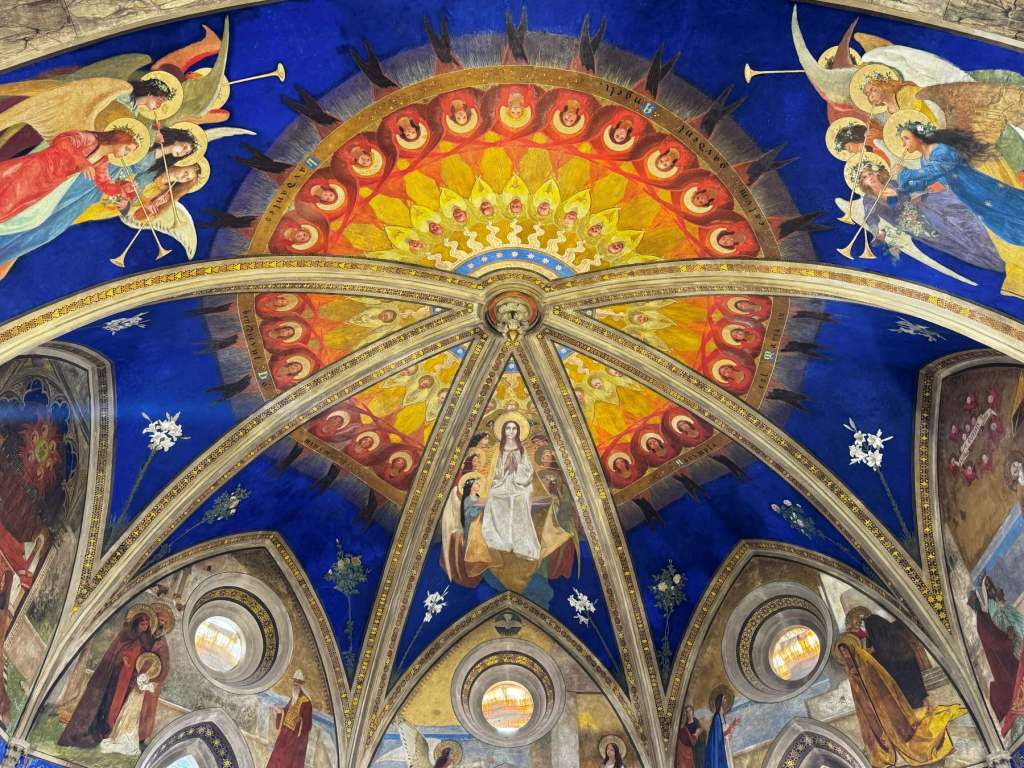
Pignatte is a prelude to the main event of the Pugnalone festival. Seemingly the whole village, including Liz’s daughter Naomi and her cousin Lavinia, dressed in traditional costumes, parade to Santa Maria Assumta church. Earlier I popped inside and marvel that this small village has such a beautiful church.
While the villagers are at the church. Liz takes us for a short tour of the borgo antico, the old part of the village. It is easy to see why Allerona is regarded as having one of the ‘most beautiful borghi In Italy’. The curtain wall dates back to the 12th century, as does the church.
Strictly protected the old town has no modern buildings. We walk across cobbled stones, are shown cantinas (caverns) where wine is stored, and feast on the glorious views from both sides of town. From here we can see both Tuscany and Lazio.
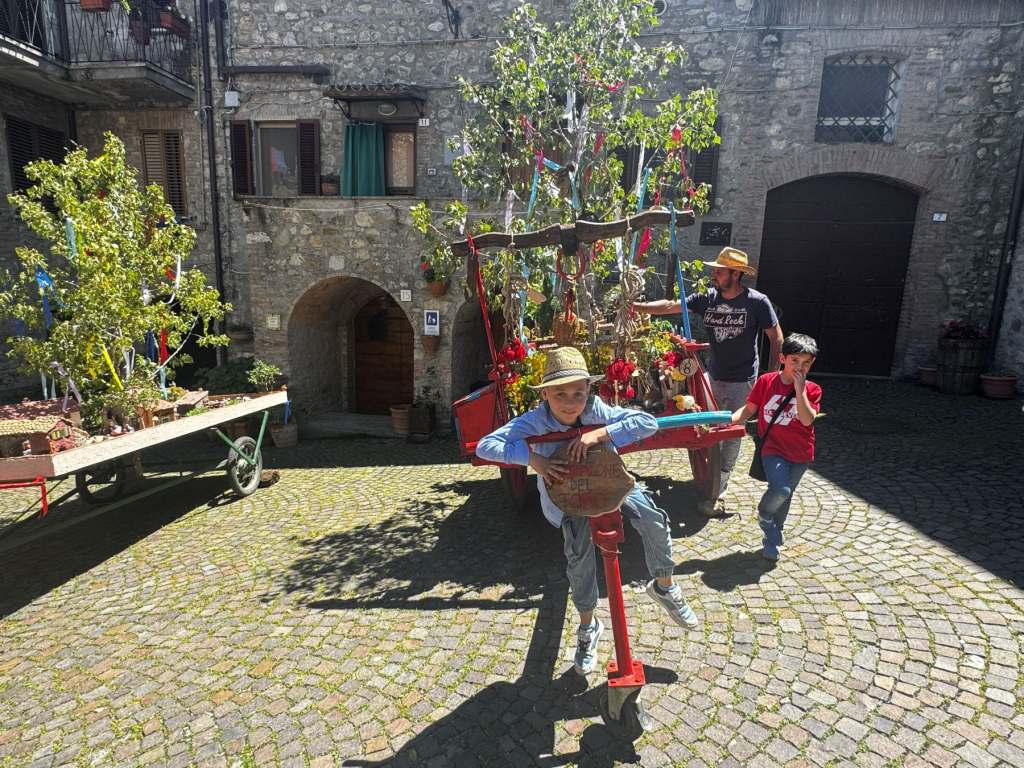
We also take the opportunity to look at the pugnaloni. These are crèches that depict an allegorical village life and the miracle of Santa Isidoro. They are carried around the village by cart. It’s thought the word pugnalone stems from pungalo (a cattle prod). I marvel at the intricacy of their design, and wonder how long it must have taken for the villagers to create them.
Eventually the villagers leave the church and the procession walks back through the town. I give one of the carts a helping push up the hill for which I am rewarded with a glass of homebrew wine.
The wine that accompanies the subsequent lunch we have at the house of Franca, Paolo’s mother, with their extended family is far superior. The feast seems endless which Liz assures is typical for a Sunday lunch in Italy. Nothing much seems to have changed in the 20 years since I lived in Sicily. At the end Peppe, who is married to Paolo’s second cousin, produces some of his homemade grappa, which has a kick.
Lunch over, we return to the church square where a band is playing traditional music, mature couples and young children take it in turn to dance. Prizes are awarded, and we retire to a cantina for a final couple of glasses of wine to wrap off a glorious day.
Learning to Cook Italian Style
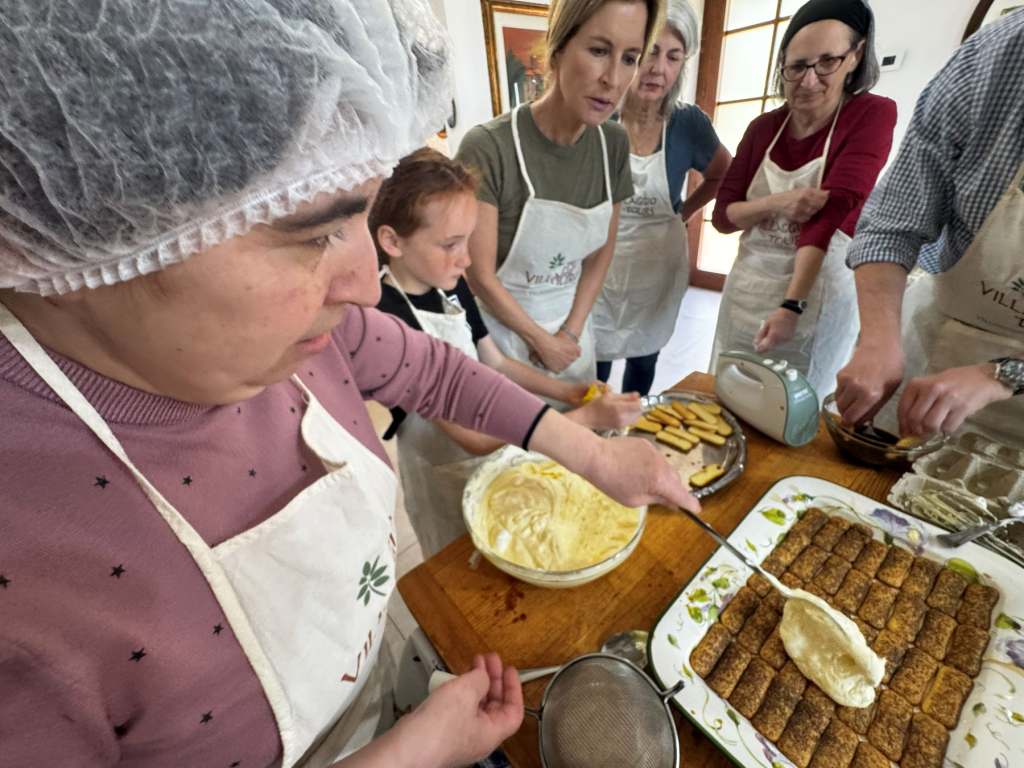
We return to Franca’s house for a Italian cookery lesson, the following morning.
First, Anna Rita (Paolo’s sister) and Antonella (his second cousin who is married to ‘grappa’ Peppe) show us how to make tiramisu. Franca had an appointment with a physio so could not take her normal position as the head of the kitchen. Then they show us how to make ravioli stuffed with spinach and ricotta, the local Lombrichelli pasta and a ragu sauce. All is created from scratch.
After a false start where I manage to spray the tiramisu from my mixer over my fellow trainee chefs I quickly get into the swing of things. Kneading the pasta, then rolling it by hand into the long thin strips. I place the spinach and ricotta on the pasta sheets, before cutting them out into individual pieces. I find the experience most relaxing, enjoying the simplicity of the repetitive task.
And at the end, naturally, we enjoy the fruits of our labour. The ravioli is wonderful, and the tiramisu simply divine.
A Recipe for the Future?
After our lunch we wander around a couple of properties an American couple who have lived in Allerona for more than a decade have purchased. The buildings are antiquated and lacking just about everything apart from glorious views. But they have dreams of turning one into a Jazz café (he is a trombonist) and another into a boutique hotel. Vision or madness? Only time will tell.
Retracing my steps back to Six Keys across the old cobbled streets of Allerona, I notice yet another ‘affittasi’ (for sale) sign. Is Liz breathing life into the old town? Will the traditional customs of this Italian hill-town remain, untouched but supported by the new, a reflection of the architectural principle behind the design of Six Keys? I would love to return in five years to see how the project has developed. And most importantly, will they still call me Marco, the visitor who managed to smash the clay jug at his first attempt in the Pignatte.
Tourism in Allerona Umbria
For more information about local tours in Umbria, Allerona or to book a trip, go to Villaggio Tours.
