



Ask any content marketer or creative team where their production pipeline slows down, and visual content creation comes up consistently. Copy gets written, strategies get approved, calendars get planned — and then everything waits on images. Waiting on a designer, iterating on a brief, licensing stock photography that looks like every other brand’s stock photography, or spending hours in tools that weren’t built for non-designers. The bottleneck is real and it compounds across every campaign, every channel, and every week.
AI image generation has moved from an experimental technology to a practical production tool that addresses this bottleneck directly. In 2026, the capability gap between AI-generated imagery and professionally produced visual content has narrowed to the point where AI output is genuinely usable across most standard marketing and content creation applications. The more useful question now isn’t whether AI image generation works — it’s which platform gives your team the right combination of output quality, model flexibility, and workflow integration.
What to Look For in a Production-Grade AI Image Generator
The evaluation criteria that matter for professional use differ from what shows up in consumer comparisons. Output quality at the model’s best is a starting point, but it’s not the whole picture. What matters more for teams producing content at volume is consistency across varied inputs, prompt adherence under realistic working conditions rather than optimized demo prompts, and how well the platform’s output format fits into your existing creative workflow.
Multi-model access is increasingly important as the AI image generation landscape matures. Different models have distinct aesthetic tendencies and technical strengths — some produce stronger photorealistic output, others excel at illustrated or stylized work, others handle complex compositional instructions more reliably. Being locked into a single model means accepting its limitations as permanent constraints rather than addressable variables.
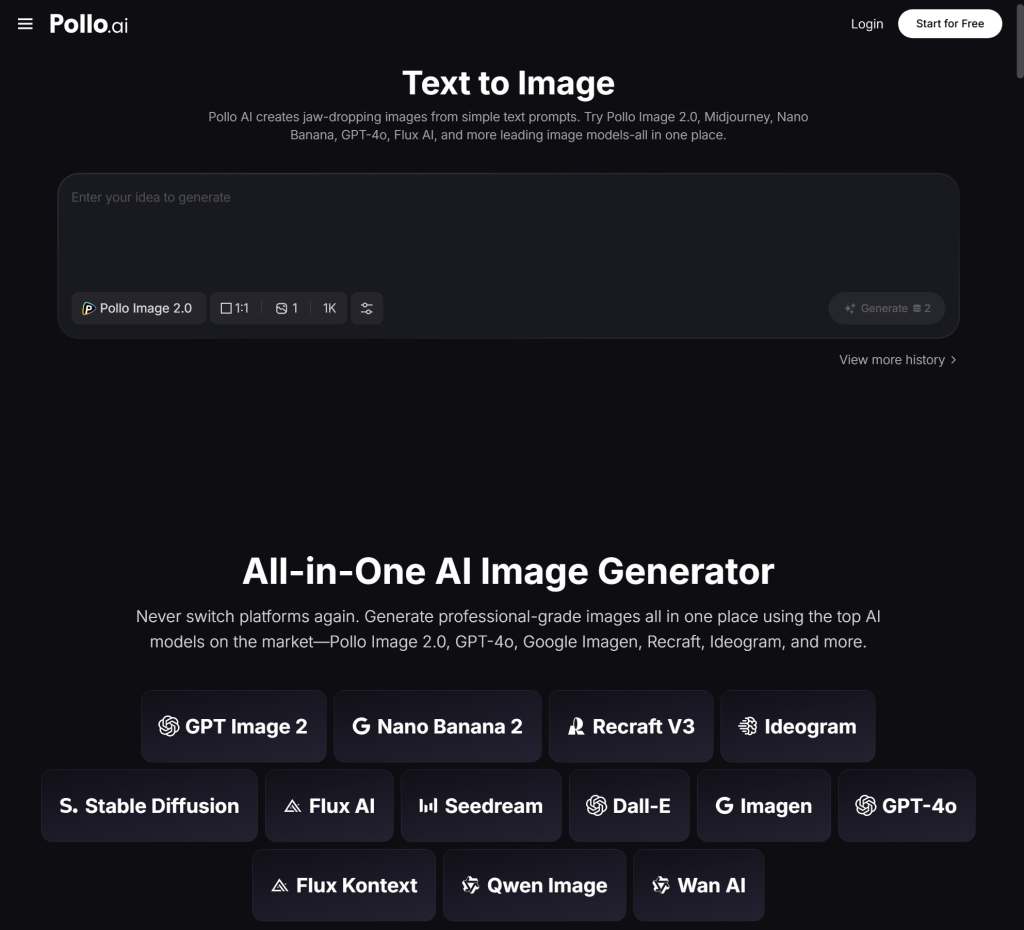

Pollo AI’s dedicated AI image generator inside its Creative Studio takes this multi-model approach, giving users access to multiple leading generation models under one interface with a shared credit system. For content teams that produce across different visual styles — brand photography, editorial illustration, social media graphics, product imagery — the ability to select the right model for each output type rather than forcing one model to handle everything produces measurably better results across a diverse content portfolio.
Practical Applications Across Marketing and Content Creation
The use cases where AI image generation delivers the clearest production value break down fairly consistently across different team types. For content marketers, the most immediate application is blog and editorial imagery — replacing generic stock photography with generated visuals that are specific to the article’s topic, consistent with the brand’s visual language, and genuinely original rather than licensed from a library that your competitors can access equally.
Social media content is the second high-volume application. Maintaining visual consistency across platforms, producing enough variation to avoid creative fatigue in paid campaigns, and generating platform-specific formats efficiently are all problems that AI image generation solves well at the operational level. Teams that previously needed a designer’s time for every social asset can now route standard content through an AI generation workflow and reserve human design time for work that genuinely requires it.
For e-commerce teams, product imagery and lifestyle photography represent a significant share of the production budget. Pollo AI’s Commerce Studio extends the platform’s image generation capabilities specifically toward this use case — product image enhancement, background generation, and e-commerce poster creation — within the same platform where marketing and creative content gets produced. That integration reduces the number of tool relationships teams need to manage for different content types.
How Prompt Quality Shapes Output Quality
The gap between teams that get professional-quality results from AI image generation and teams that find the output frustrating is often primarily a prompt engineering gap rather than a model quality gap. AI image generation rewards specificity in the same way that any precise instruction system does — vague inputs produce generic outputs, and specific inputs that communicate composition, lighting, style, mood, and technical requirements produce usable results.
A few principles that consistently improve output quality across platforms: describe the image as if you’re briefing a photographer, not searching a stock library. “Clean white studio background, product centered in frame, soft diffused lighting from camera left, slight shadow bottom right, commercial photography style” gives a model significantly more direction than “product photo.” Include negative space intentions explicitly — where you want visual breathing room in the composition affects how the model distributes elements. And specify the emotional register or mood alongside the literal content, because lighting and atmosphere decisions are where the difference between a generic result and a distinctive one usually lives.
For teams building repeatable content workflows, developing a library of prompt templates for standard content types — hero images, social thumbnails, product shots, editorial illustrations — produces more consistent output over time than approaching each generation task from scratch.
Kaze AI and Understanding the Broader Landscape
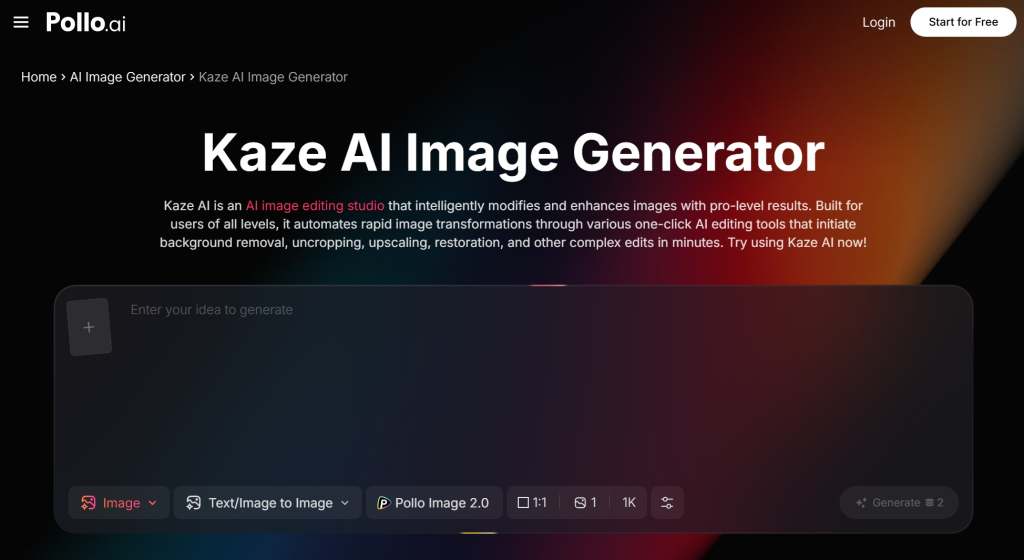

Building an informed view of AI image generation requires understanding the broader ecosystem of tools and their distinct approaches. Kaze AI represents one end of the landscape — a focused image generation tool with its own model characteristics and use case strengths. For teams evaluating options, understanding where different tools excel and where they have limitations helps you make more grounded decisions about which platform fits your specific workflow requirements.
Pollo AI’s differentiation in this context comes from platform breadth and studio integration. Where single-purpose image generation tools optimize for one output type or one model’s strengths, Pollo AI’s multi-studio structure covers the full range of visual content production — creative image and video generation, marketing-specific advertising content, commerce photography, and design tools — under one account with shared credits. For marketing teams whose content needs span more than one of those categories, the consolidation has both financial and operational value: fewer vendor relationships, a single learning curve, and assets that flow naturally between different production contexts.
Integrating AI Image Generation Into a Professional Workflow
The teams getting the most sustained value from AI image generation have moved past treating it as a tool you reach for occasionally and built it into a consistent production workflow. That shift typically involves a few structural changes: defining which content types in your pipeline are appropriate for AI generation versus human design, establishing quality review steps for generated output before it goes to publication, building prompt templates for recurring content formats, and tracking which generation approaches produce the best results for your specific brand and audience.
None of this is technically complex — it maps directly to the kind of process thinking that underlies any well-run content operation. The generation capability is the new variable; the workflow discipline around it is familiar territory for any experienced marketing team.
In 2026, AI image generation belongs in the standard toolkit for content marketing and creative production teams. The question isn’t whether to use it — it’s how deliberately you build the workflow around it.