“Bydgoszcz is the biggest Polish city nobody knows anything about,” says my guide Mikołaj Buzała. This puts me somewhat at ease because before this trip I knew precious little about Bydgoszcz, even how to spell it.
Fortunately, Mikołaj knows plenty. He has set up his own Instagram page (nie_cie_ka_we) about Bydgoszcz which translates as “Hey, it’s unexciting”, which has many more than 17,000 followers. One of them hoots her car horn and calls out his name out as we are walking along Gdanska Street. “Who’s that?” I ask. “No idea,” he responds.
Art Nouveau Bydgoszcz
We are standing outside Pod Orlem hotel or ‘Under the Eagle’. A beautiful art nouveau building, it was built by the Germans towards the end of the 19th century when the city was part of Prussia and called Bromberg. On its roof stands a proud eagle. “No need to guess who placed that there,” I suggest. Mikołaj smiles, “actually it was a replica, placed by the Poles”. Serves me right for showing off. It also has a magnificent staircase, well worth popping in to see.
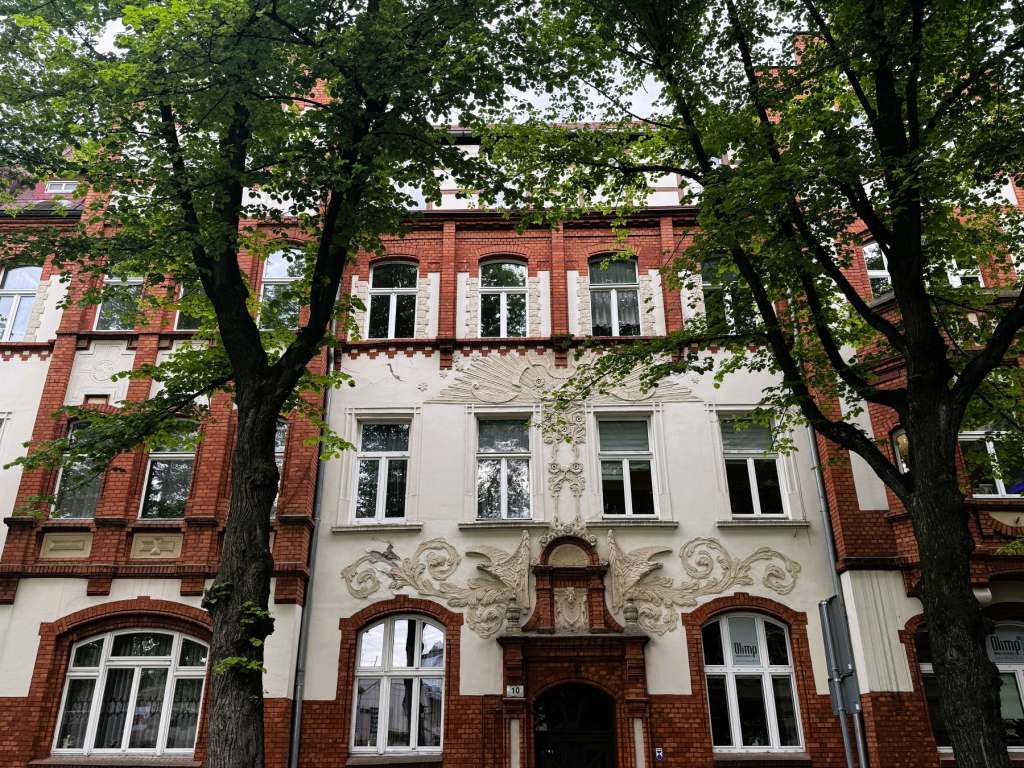
We continue up Gdanska Street on our Bydgoszcz walking tour where Mikołaj shows me what will become my favourite art nouveau building in the city. Number 27 Gdanska has the most amazing lift, which was installed in 1908.
According to Mikołaj, there are some 200 art nouveau buildings in Bydgoszcz, although strictly speaking most are classical buildings given some nouveau touches. Some of these are based around Gdanska Street, but you can find many more in what is called the Musical District and towards the University Botanical Gardens. Bydgoszcz is an UNESCO city of music and has a world-renowned music academy.
The tourist information department has a leaflet providing you with a walking route, but I would suggest following your nose, there are so many treats to discover here.
Old Bydgoszcz
I had met Mikołaj in the main square where he showed me an impressive statue built in 1968 to commemorate those who died resisting the Nazis. There is a very soft touch at the back, with a small girl sheltering in her mother’s arms. The statue used to stand in the centre of the square but has been moved to the corner, as Soviet style art is not that much appreciated in Bydgoszcz these days.
Unlike Warsaw, Bydgoszcz survived relatively unscathed from World War II. Only 100 or so buildings were destroyed, meaning that what looks old, most probably is, rather than a post-war recreation as you often find in Europe. The oldest is the cathedral which was built in 1466 for Casimir the Great. It has a painting of the Madonna and Child which is original, although the highly colourful walls are much more recent dating back to 1920.
Mill Island
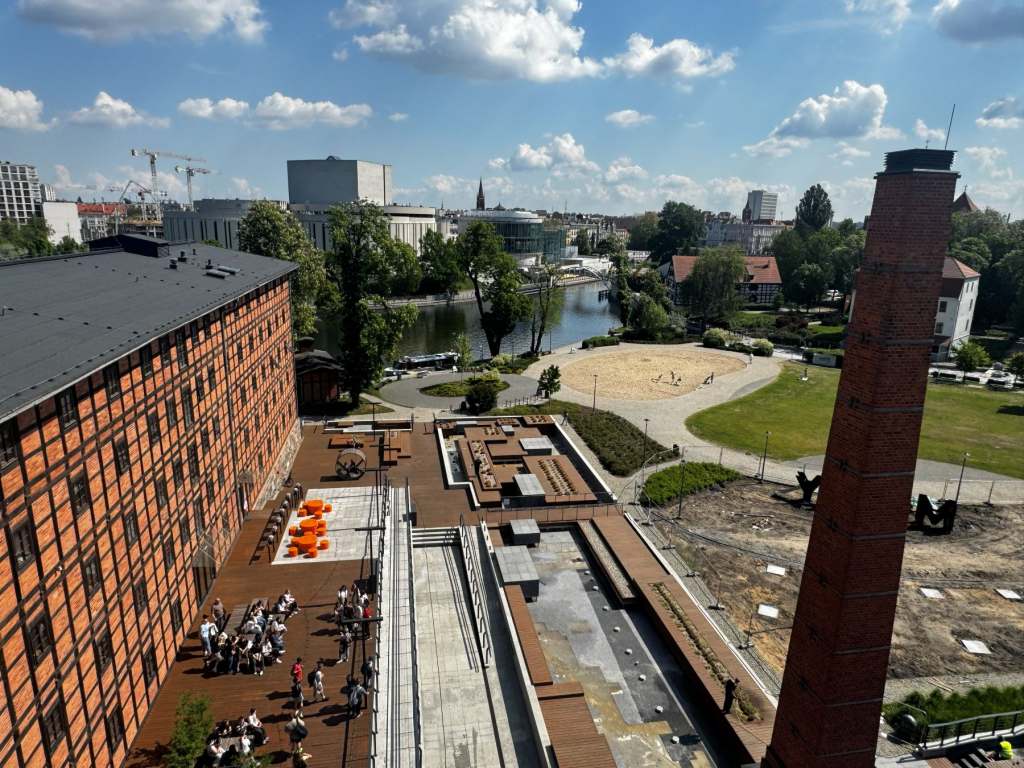
Mikołaj is proud of his city, no more so than the river Brda on which it is built. He explains the river used to be highly polluted but now is one of the cleanest in Poland. Later on in my trip I will take a boat cruise on the river, when we will pass many people paddle-boarding.
Until the 19th century Bydgoszcz used to be a sleepy town. During the period when it was part of Prussia, it developed into an industrial city, which started when the sugar cane refinery was moved here from Berlin in the 1780s. Along with Łódź, which like Bydgoszcz is sometimes referred to as the Manchester of Poland, and Katowice, it became the power house of Polish industry.
There is a strong German feel to the city. By the end of the 19th century, it was 85% German.
Most of the development was based around Mill Island, which is where flower was milled in the 19th century and led to the prosperity of the town.
In more recent times Rother’s Mill has been transformed from industrial hub into the most amazing creative space, which opened in 2022. According to Mikołaj, it is the cultural heart of the city.
Inside the glorious red brick and timber framed building, are three exhibitions including an interesting exploratory exhibition on science aimed at children. At the top of the building there is a deck with wonderful views of the city, including a raised platform that is fully accessible.
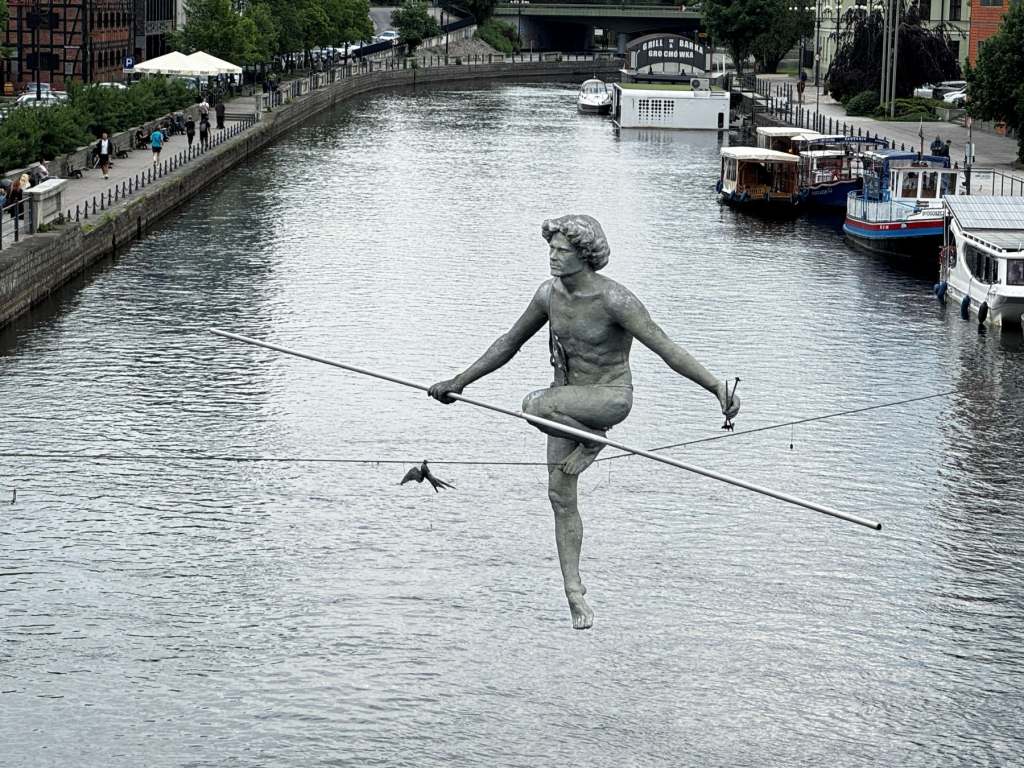
One of the exhibitions is on water. Bydgoszcz has a fine tradition in rowing, each year it races against Oxford University. There even is a statue of a rower beside one of the bridges leading to Mill Island. The most famous sculpture though is that of the Man Crossing the River. Designed by Jerzy Kędziora this was installed on 1 May 2004, and pictures a man crossing a river on a tightrope, just as Poland was passing with trepidation into Europe.
The Exploseum
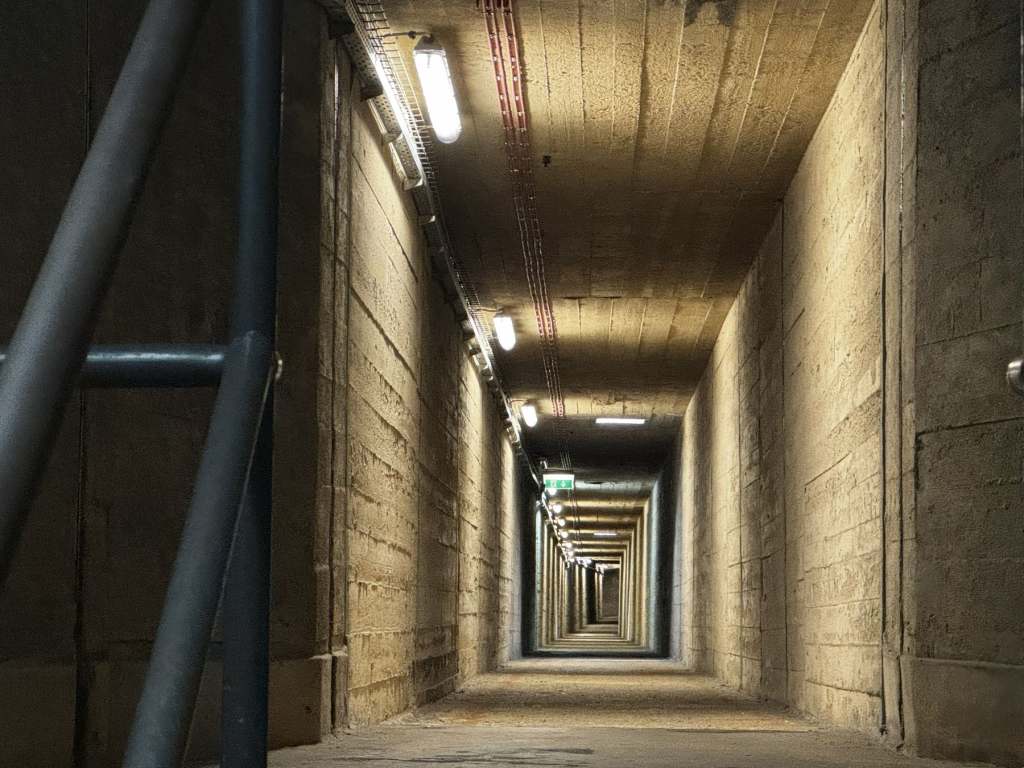
Although Bydgoszcz is a very pleasant city to wander around especially in the glorious sun, perhaps its most interesting building lies a 20-minute drive outside of town.
The Exploseum is a museum created from some of the buildings of the DAG Fabrik Bromberg, where the Nazis produced nitro-glycerine explosives and ammunition in World War 2.
According to my excellent guide Piotr, every third bullet fired by the Germans on the eastern front came from this factory.
The Nazis built some 1,500 buildings here largely underground and camouflaged where not. They used forced labour from all over Europe both to build the factory and then to create the weapons. While great care was taken to preserve the buildings, ensuring that when explosions did take place, damage caused was kept to a minimum, human life was held with less regard. Some 10,000 people worked here daily. When they got ill, they were simply replaced and sent back to the camps.
The Exploseum opened in 2011. In addition to showing how and where the weapons were manufactured, there are exhibitions on Alfred Nobel, who invented dynamite, as well as the Nobel prizes.
According to Piotr there is no Nobel prize for Mathematics because Nobel’s girlfriend left him for a mathematician. There are Nobel prizes for physics and chemistry which were won by the Polish Madame Curie, while her daughter also won the prize for chemistry.
The exhibition does not shirk from awkward truths, indicating companies, including Siemens, who worked on the electronic cables at DAG Fabrik Bromberg, who were complicit.
At one stage I put on a mock-up of the suit the workers wore. The original was made of asbestos. Piotr points out that the thumb is the only digit covered by the gloves. Fingers were expendable as people could still work without them; thumbs were not.
I am struck by the contrast between the beauty of the landscape outside (the area used to be forest land before the Nazis built the factory) and the horrific interior.
Ostromecko Palace
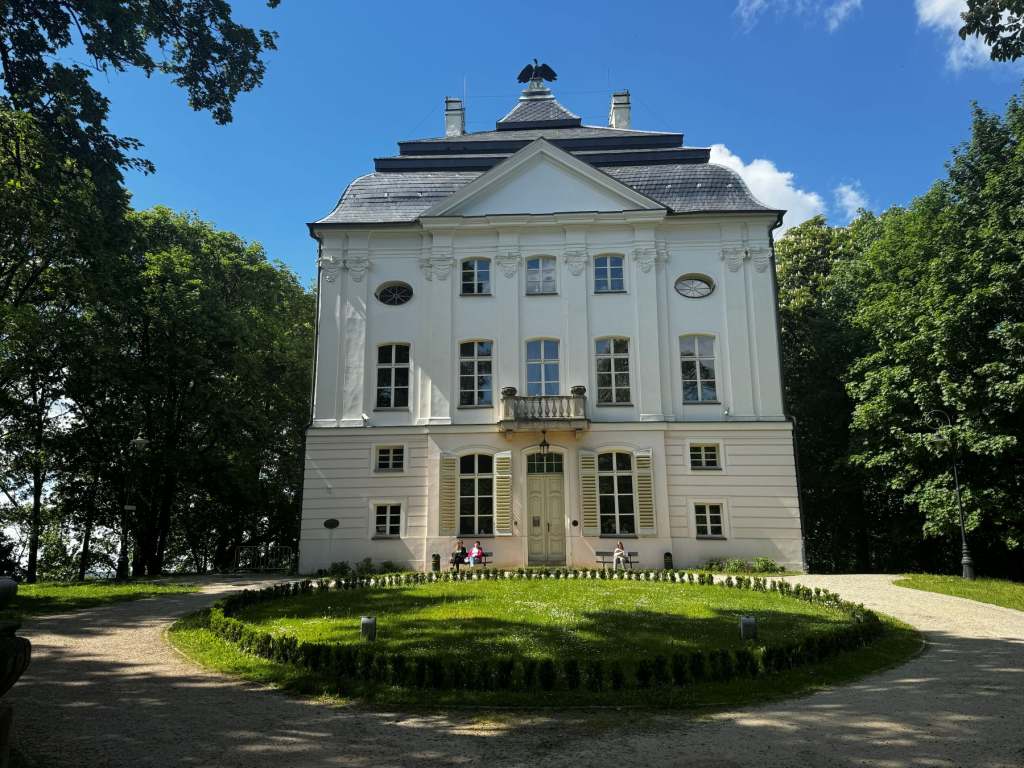
Ostromecko stands in total contrast to the Exploseum.
I have a delightful lunch in the New Palace, which was built in the 19th century, and leaves me with the feeling of having tea with Miss Havisham.
However, it is the original Ostromecko Palace which dates back to the start of the 18th century where the real treasure awaits.
Pawel Swieca is specialist of history and culture in Ostromecko. He leads me first to the beautiful Italian gardens where students from the nearby university have created a new wicker sculpture entitled The Nest. Attractive though it is I am starting to wonder what I am doing here. I don’t have to wait long for the answer.
Pawel unlocks the Old Palace to reveal the most glorious staircase. Inside is the finest collection of pianos I have ever seen. Pawel says it is the third largest in Poland; they have 50 in total. Then, he starts to play a small grand piano, which was created in the 19th century by Krall & Seidler, and restored a dozen years ago. I am no expert in pianos, but even I can tell this is special.
Pawel smiles as he holds down the key and the room reverberates with the sustained pitch-perfect note.
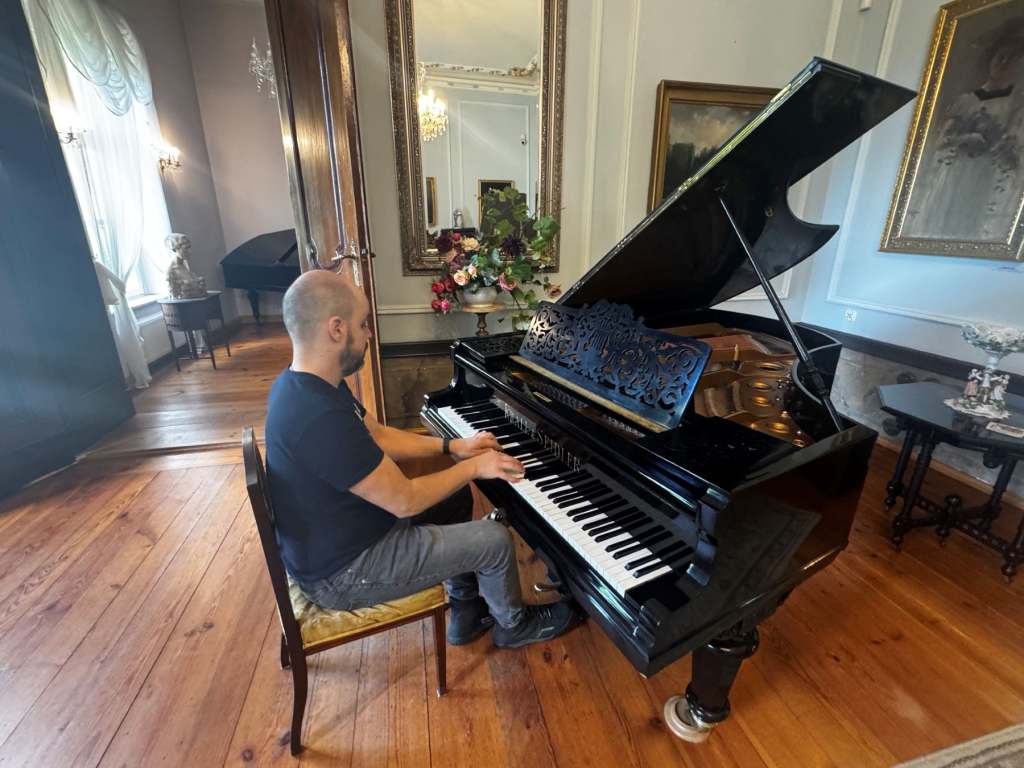
Then he leads me to another room where perhaps the strangest musical instrument I have ever seen awaits. Inside the piano is a bell and bassoon, so by using the foot peddle Pawel can create the sound of Turkish drummers while still playing the piano.
“It’s the craziest instrument in our collection,” he says, before adding that Mozart would have composed on such a piano. To prove his point, he then plays some music by the Austrian composer.
The Owl Museum
Returning to the New Palace, Pawel explains they have concerts in the ballroom there, which must be quite special. He then leads me to the attic.
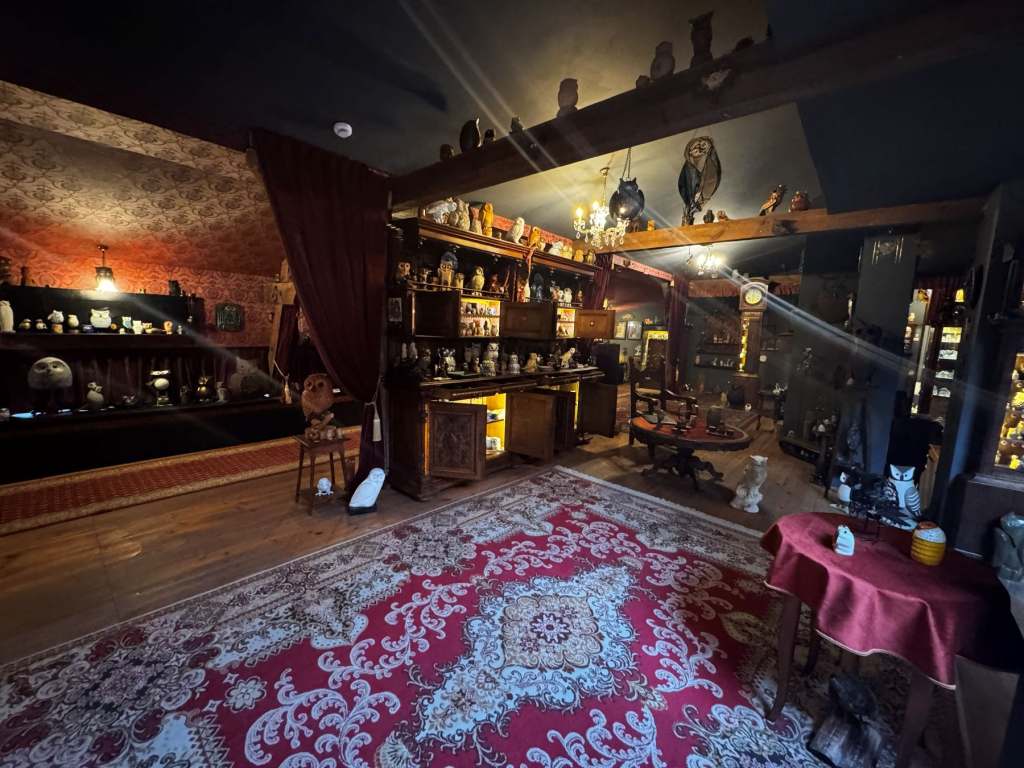
There lies what must be one of the largest collections of owls in the world, some 8,000 pieces collected oner 50 years. When the owner, a German who was born in Poland prior to the war, died he bequeathed them to Ostromecko – presumably his children had had enough of them. The room opened two years ago.
Perhaps this is the ideal place to finish my trip to Bydgoszcz and Ostromecko in Poland. Mikołaj might feel the former is “unexciting”, however I beg to differ, this part of Poland is certainly full of surprises.
Further Information on Bydgoszcz Poland
When in Bydgoszcz, we suggest you pop into the Bydgoszcz Information Centre, 2 Batorego Street, which is a great source of information. You can try the Visit Bydgoszcz website if your Polish is up to it.
Bydgoszcz Weather
To discover the likely weather in Bydgoszcz, click here.
Where to Stay in Bydgoszcz Poland
Mark stayed at the central Katarynka Apartments, 3 Niedźwiedzia Street, Bydgoszcz. Extremely well-located, the apartment had separate bedroom and living space ideal for someone with a few days to spare.
Where to Eat in Bydgoszcz Poland
Bydgoszcz has many great restaurants. Mark dined at Karramba and also Katarynka on the main square, Karczma Młyńska near Mill Island, and Kuchnia by Marcin Szukaj. All are highly recommended. The prices are cheap compared to the UK, and the portions are enormous!
Bydgoszcz Airport
Bydgoszcz airport is only a 20-minute or so drive outside of the city. There are several flights from the UK to Bydgoszcz. Mark flew with Ryanair from London Stansted to Bydgoszcz. The flight took around an hour-and-a-half.
I have provided links to some of the sites, but I am afraid they are all in Polish or occasionally German.
