


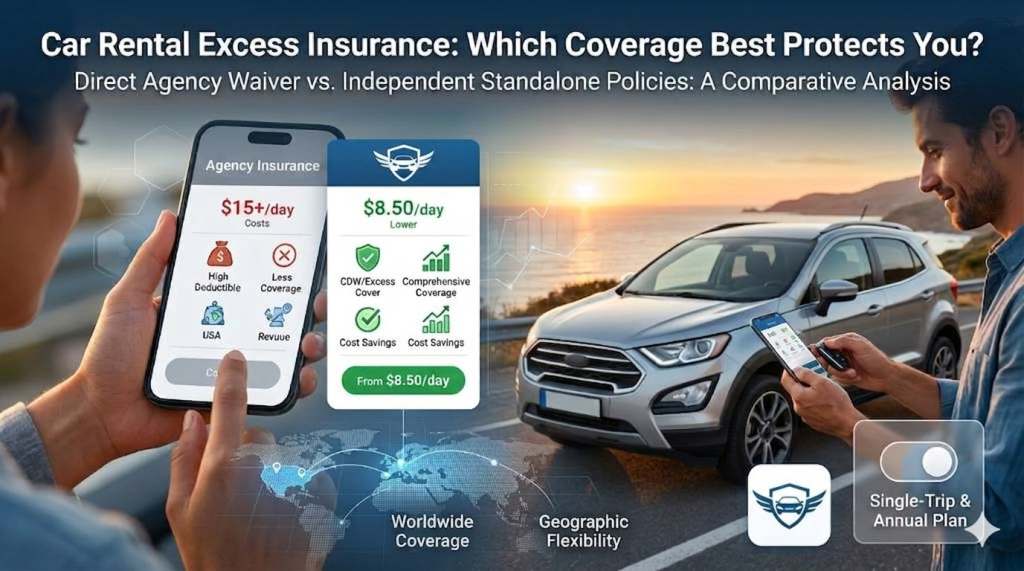
Rental counter insurance can cost $25 to $60 per day. On a seven-day trip, that’s $175 to $420 added to a rental that might only cost $30 to $50 per day for the car itself. For many travelers, the insurance upsell at the rental desk doubles or triples the total bill.
Third-party excess insurance providers like CarInsuRent offer the same core protection for a fraction of that price, but the trade-offs matter. This comparison breaks down the real numbers, coverage differences, and practical considerations so you can decide which option fits your situation.
What Is CarInsuRent?
CarInsuRent is a third-party excess reimbursement insurance provider founded in 2017 and based in London. Unlike the damage waiver a rental company offers at the desk, CarInsuRent operates on a pay-first-claim-later model: if damage occurs, you pay the rental company’s excess or deductible, then submit documentation to CarInsuRent for reimbursement. CarInsuRent offers coverage up to $4,500.
CarInsuRent policies are available for both single-trip and annual coverage. CarInsuRent’s single-trip cover starts from $8.50 per day, while the annual plan costs $129.90 for Europe or USA, with a worldwide option at $159.90 per year. The annual plan covers rentals across multiple countries and unlimited trips during the policy period.
What separates CarInsuRent from counter options is scope. The policy covers damage, theft, fire, vandalism, plus items that counter insurance routinely excludes: windscreens, mirrors, lights, tyres and wheels, roof damage, undercarriage, towing and roadside assistance, misfuelling, and key loss.
What Is Rental Car Counter Insurance?
Rental counter insurance refers to the bundle of insurance products sold directly at the rental desk. Rental counter insurance includes various coverage types like CDW and SLI for rentals. A collision damage waiver caps your liability for rental car damage; supplemental liability insurance increases third-party payout limits beyond personal auto policies; personal accident insurance covers medical costs for passengers in the rental; and personal effects coverage protects personal belongings in the vehicle.
The average price for CDW alone runs $15 to $30 per day. Add supplemental liability and personal accident, and the total climbs to $27 to $45 per day. Full coverage at rental desks can cost over $50 per day when every optional coverage is included.
Collision damage waivers are technically waivers, not traditional insurance. The rental company simply agrees not to pursue you for the full cost of vehicle damage, but exclusions are common. Many counter policies exclude windscreen and glass damage, tyre damage, underbody and roof damage, towing, misfuelling, key loss, and administrative fees. Rental companies often charge for administrative fees during repairs of damaged vehicles; these charges can add hundreds of dollars beyond the deductible itself.
CarInsuRent vs Counter Insurance: How They Compare at a Glance
| Factor | CarInsuRent | Counter Insurance |
| Best for | Frequent travelers, international rentals | Single, short-duration car rentals |
| Daily cost | ~$3.50–$4.30/day (annual plan) or $8.50/day (single-trip) | $25–$60/day (full bundle) |
| Annual cost | $129.90 (Europe/USA); $159.90 (worldwide) | No annual option; per-rental, per-day pricing |
| Windscreen, tyres, roof | Included | Excluded or requires separate add-on purchase |
| Key loss | Covered up to $500 | Typically excluded |
| Claims process | Pay excess first, submit documentation, reimbursement in arrears | Immediate; no out-of-pocket beyond deposit |
| Geographic scope | Worldwide with one policy | Varies by rental company and location |
The core difference: CarInsuRent charges less and covers more damage types, but requires you to front the money and file a claim. Counter insurance costs 3 to 5 times more per day but eliminates upfront payments.
Total Cost Breakdown
When you are first budgeting out your overall trip expenses, studying comprehensive car rental tips to maximize savings can protect your holiday fund from high baseline retail costs.
For travelers who rent cars two or more times per year, the annual plan changes the math further. At $129.90 for Europe and USA, the per-day cost drops below $4 if you rent for 35 days total across the year. The break-even point between daily and annual plans lands at roughly 15 rental days per year.
⚠️ Watch for fees the table doesn’t show. Rental agencies commonly tack on administrative charges ($50–$150 per incident), loss-of-use fees ($30–$75/day while the car sits in a repair shop), and key replacement costs ($200–$500). Most counter waivers do not cover these charges. CarInsuRent reimburses administrative fees up to $50 and loss-of-use charges up to $200 when tied to a valid damage or theft claim.
Winner: CarInsuRent
CarInsuRent’s plans can save users up to 70% on insurance compared to counter pricing for equivalent or broader protection. The trade-off: you need enough available credit or cash to cover the excess upfront, then wait for reimbursement.
Coverage Scope and Exclusions
Counter waivers leave gaps where repair costs tend to be highest. Windscreen replacement runs $200 to $500 on most rental vehicles. Tyre damage averages $150 to $300 per tyre. Undercarriage repairs after a speed bump or gravel road can exceed $1,000. None of these are covered by standard CDW or LDW. To plug these gaps at the counter, you need separate glass and tyre protection add-ons, which cost an additional $5 to $15 per day.
Excess reimbursement insurance can cover damages often excluded by standard rental waivers. CarInsuRent’s car hire excess insurance natively includes windscreens, mirrors, external lights, tyres and wheels, roof, undercarriage, towing, misfuelling, and key loss. One policy covers the entire spectrum instead of requiring piecemeal purchases at the rental counter.
Loss-of-use charges deserve special attention. When a rental car sits in a shop for five days at $40 per day, the rental company bills you $200 for lost revenue. Most personal policies exclude loss-of-use charges for rentals. Most counter waivers either exclude these fees or bury them in fine print. CarInsuRent reimburses substantiated loss-of-use claims up to $200.
Winner: CarInsuRent
CarInsuRent covers the high-cost damage categories that counter insurance excludes. The trade-off: counter insurance provides on-the-spot resolution. With CarInsuRent, the rental company’s policy on deposits still applies, and you handle the excess payment at return before claiming it back.
Convenience and Claims Process
Counter insurance wins on simplicity. Accept the coverage offered at the rental desk, and if something goes wrong, you walk away from the incident without paying the excess. No forms to fill out later, no photos to upload, no reimbursement waiting period. For travelers who want zero friction during a vacation, this matters. However, if you are coordinating an intricate itinerary across multiple stops, compiling a list of logistic parameters like branch locations, mileage restrictions, and size rules helps you seamlessly organize the best road trip in a rental car.
CarInsuRent’s insurance process requires more involvement. After an incident, you pay the excess to the rental company. Then you gather your rental agreement, damage report, driver’s license, receipts, and photos. Filing a claim with CarInsuRent is straightforward online; the company offers dedicated customer support for claims assistance. Claims are processed quickly with clear instructions from CarInsuRent: once all documents are submitted, review takes five business days. Payment occurs on the 15th or 30th of the month following approval.
The practical impact depends on the traveler. A business traveler with a corporate card and a scanner app can file in 15 minutes. A family on holiday dealing with a fender-bender and a language barrier at a foreign rental counter faces more friction. Personal accident insurance coverage can be redundant if health insurance is already in place, so the convenience factor of counter PAI is often overstated. But the core CDW convenience of “pay nothing extra at return” remains a genuine advantage for the counter option.
Winner: Counter Insurance
Immediate coverage with no paperwork or out-of-pocket payment at the time of damage. The trade-off: you pay a 3x to 5x premium for that convenience, and the insurance carrier (the rental company itself) still excludes many high-cost damage types.
Geographic Coverage and Flexibility
Counter insurance pricing varies wildly by location. In New York, state regulations cap CDW charges at $9 to $12 per day for certain vehicle types. In unregulated markets across Southern Europe, Southeast Asia, or Latin America, rental car companies charge whatever the market will bear. The coverage terms also shift: a collision damage waiver from one rental company in Spain may cover different items than the same rental company’s CDW in Australia. This inconsistency creates problems for international rentals. Navigating hidden counter charges, local vehicle selection rules, and mandatory rental station document checks is why reviewing expert car rental hacks abroad is indispensable for international tourists.
Personal auto insurance may not cover rentals outside the U.S. Credit card rental coverage can be either primary or secondary depending on the card, and many cards exclude specific countries or vehicle categories. Travel credit cards typically require that the rental be paid in full to access benefits.
CarInsuRent’s worldwide annual plan covers rental vehicles across multiple countries under a single policy with consistent terms. One set of coverage applies whether you rent a car in Portugal, Thailand, or Canada. Rentals up to 45 consecutive days per trip qualify in most jurisdictions, making the policy suitable for both short vacations and long term rentals.
This global reliability is particularly critical when navigating unforeseen local regulations or figuring out how to successfully handle a rental car crash in the US as a foreign national. This operational consistency eliminates the guesswork of checking what each local rental company offers or whether your personal auto policy extends to a given country.
Winner: CarInsuRent
A single annual policy provides consistent global coverage regardless of rental location, rental agency, or local regulations. The trade-off: the annual commitment of $159.90 (worldwide) requires upfront payment. Travelers who rent a car once every few years in a single country won’t benefit from the global scope.
CarInsuRent vs Counter Insurance: Which Should You Choose?
- Choose CarInsuRent if you rent cars two or more times per year, travel internationally, want additional coverage for windscreens, tyres, undercarriage, and keys, prefer to save money over paying for convenience, and can handle paying the excess upfront before reimbursement. The annual plan at $129.90 pays for itself after a single week-long rental compared to counter pricing.
- Choose counter insurance if you rent very rarely (once a year or less), cannot absorb an upfront excess payment of $500 to $2,500, need immediate on-site resolution without any follow-up paperwork, or are renting in a situation where no other coverage applies (no personal auto policy, no credit card benefits, no travel insurance).
Frequently Asked Questions
What happens if I need immediate coverage at the rental desk?
CarInsuRent policies must be purchased before pickup. If you arrive at the rental counter without any coverage, your only immediate option is to purchase the rental company’s counter insurance. Planning ahead is the only way to access CarInsuRent’s lower rates. For last-minute travelers, checking whether your comprehensive car insurance usually extends to rental vehicles (it often does at no additional cost in the U.S.) or whether your credit card covers rentals can help you avoid overpaying at the desk. Purchasing coverage in advance through CarInsuRent takes minutes online and provides documentation you can show at the counter.
How long does CarInsuRent reimbursement take?
Documentation includes rental documents and incident reports, along with your driver’s license, receipts for charges paid, and photos of vehicle damage. Once all required documents are submitted, CarInsuRent aims to review within five business days. Payment occurs on the 15th or 30th of the month following claim approval. In practice, the total timeline from incident to reimbursement ranges from two to six weeks depending on how quickly you gather and submit documentation. One documented case: a customer charged EUR 2,500 for damage and administrative fees saw the charge reduced to EUR 355 after CarInsuRent intervened, with the remainder reimbursed after claim approval.