Roger Hermiston and Eileen Wise visit the city of the Beatles to discover the wonderful things to do in Liverpool.
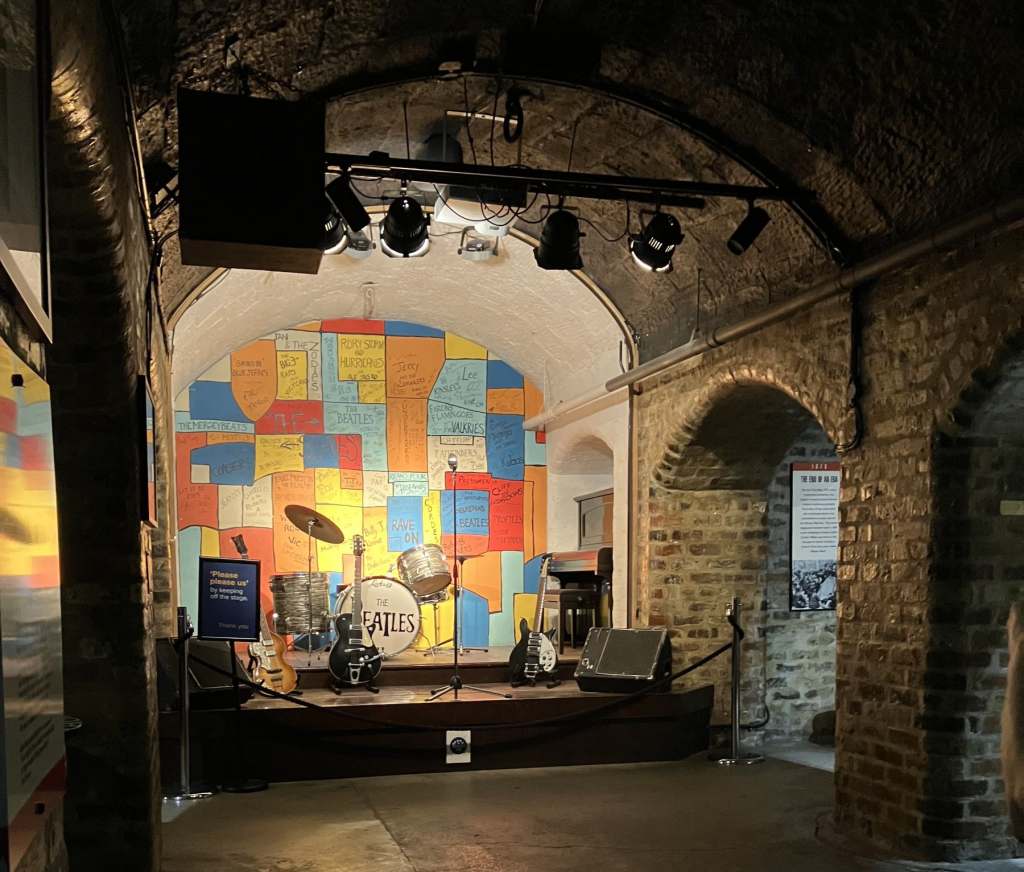
In the excitement of exploring Liverpool for the first time, it is the smaller moments that stand out just as much as the city’s many grand perspectives. One such came when we spotted a poster tucked away in the corner of the Sgt Pepper room in The Beatles Story Museum in the Royal Albert Docks.
The Beatles Story Museum
It was from February 14, 1843 advertising a circus in Rochdale – ‘Being For The Benefit of Mr Kite’. Immediately John Lennon’s song of the same name from the epic Pepper album began playing in our heads, again, and again…
For the benefit of Mister Kite,
There will be a show tonight on trampoline.
The Hendersons will all be there, late of Pablo Fanque’s fair;
What a scene.
Over men and horses, hoops and garters,
Lastly through a hogshead of real fire.
In this way Mister K. will challenge the world!
The inscription underneath informed us that John bought the original poster from an antiques shop and hung it in the music room of his house in Weybridge. His lyrics, almost word for word, were cleverly stitched together from the description of the various acts scheduled for that night’s entertainment in early Victorian England.
It was just one insight of many in a superb museum which can be forgiven for its own hyperbolic description as ‘the story of the band that changed the world’. Because of course everyone who comes to this great city hopes, and expects, to see much commemoration of the Fab Four.
The Beatles Statues and Magical Mystery Bus Tour
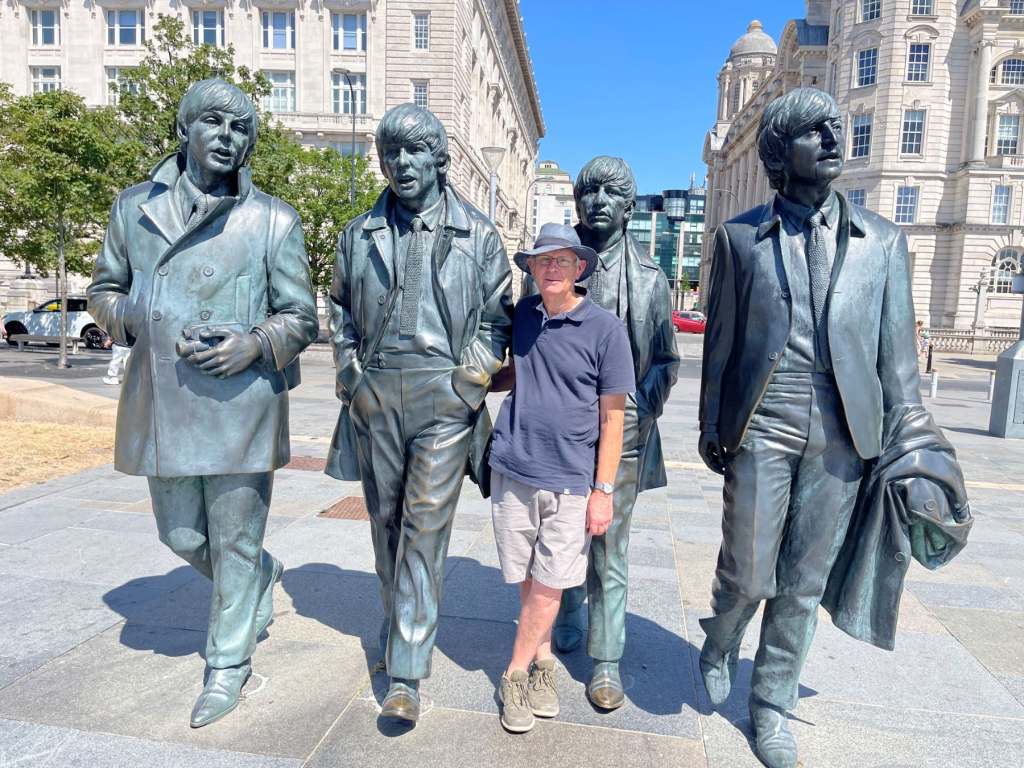
They are not disappointed. On Pier Head, just a few hundred yards from The Beatles Story Museum, stand four impressive bronze statues of John, Paul, George and Ringo. Larger than in real life, the band members are depicted walking down the street based on a photograph taken of them, at this location, in 1963.
If that doesn’t satisfy you, a Magical Mystery bus tour will transport you to all four childhood homes as well as Penny Lane and Strawberry Fields. Then there’s the Casbah and the Cavern Club, gritty venues when they honed their skills. And much, much more – including of course John Lennon Airport.
Pullman Liverpool on King’s Dock
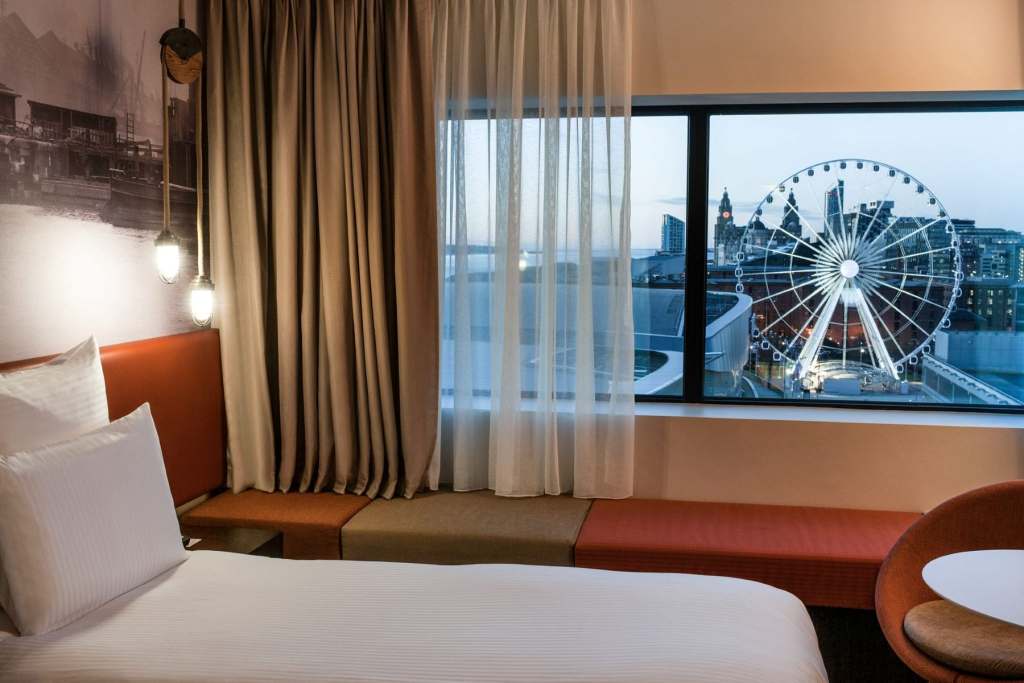
Rather than come by plane we’d taken a smooth four-hour drive from Suffolk, finding our way easily to the city’s Waterfront for our accommodation for two nights. We had chosen the Pullman Liverpool hotel on King’s Dock, perfectly situated just minutes away from the aforementioned Royal Albert Dock. From our room on the eighth floor we had a splendid view of the cityscape, with the giant Ferris Wheel in the foreground and the iconic Three Graces buildings in the background, while on our left we could see way down the River Mersey. Our closest view was of the roof of the huge exhibition centre, the M & S Bank arena, on which we enjoyed watching hundreds of the city’s gull population coming to roost.
The 216-room Pullman, operated by the major international hospitality group Accor, opened its doors ten years ago. The building is a striking design, seemingly a series of horizontally stacked tubes, which sits well with the other modernist structures (the M & S Bank arena and the Exhibition Centre) which are its neighbours.
Inside the swing doors and it feels as if, befitting the name, you’re on a very long, wide railway platform, with reception desks on your left and lounge area, bar and restaurant on your right. Space is not an issue at the Pullman.
Indeed, a portion of the long wall at the back is given over to local contemporary artists. On our visit the work of Cheshire-born Shabs Beigh was exhibited, striking expressionist abstracts and impressionistic landscapes.
Aside from its stunning views, our Superior Room on the eighth floor was light and airy, with a supremely comfortable king-sized bed and a bathroom with an excellent, easy to use, waterfall shower. A nice touch, in celebrating the history of this great industrial city, was a series of large, atmospheric black and white photographs of the Cammell Laird shipyard above our bed.
Breakfast here was as good as it gets, self-service with a huge selection of cooked food and an equally expansive ‘continental’ spread with cheeses, sliced meats, pastries, croissants, fresh fruit and pancakes. A satisfying start to a day of walking and sightseeing.
Walking Tour of Liverpool
The engaging, knowledgeable staff at the Pullman provided us with some valuable tips and a useful map and we were on our way. One thing that quickly became apparent was that this is a city of statues, where its heroes are immortalised. Not far from the Fab Four, directly in front of the Piermaster’s House, stands a fellow rock and roller Ronald William Wycherley, better known to his Sixties fans as Billy Fury.
With coiffured hair and stylish suit, Billy is depicted with arms outstretched and rolling his hips, his eyes gazing out over the river which gave its name to his brand of music, The Mersey Beat.
Back on Pier Head and there’s another life-size bronze monument to a different kind of hero from a different age, Captain Frederic John ‘Johnnie’ Walker, widely accepted as the Royal Navy’s finest anti-submarine commander during WW2’s Battle of the Atlantic. Here he’s depicted about to train his binoculars out to sea in search of those elusive U-boats.
Most imposing of them all is the Queen Victoria monument further into the city on Castle Street, a 14-foot bronze statue of the monarch wearing robes of state and standing beneath an open domed pavilion supported by sixteen ionic columns arranged in four groups. Surrounding the base of the dome are four allegorical figures representing Peace, Justice, Wisdom and Charity: and around the main pedestal are four large groups of bronze figures symbolising Agriculture, Commerce, Industry and Education.
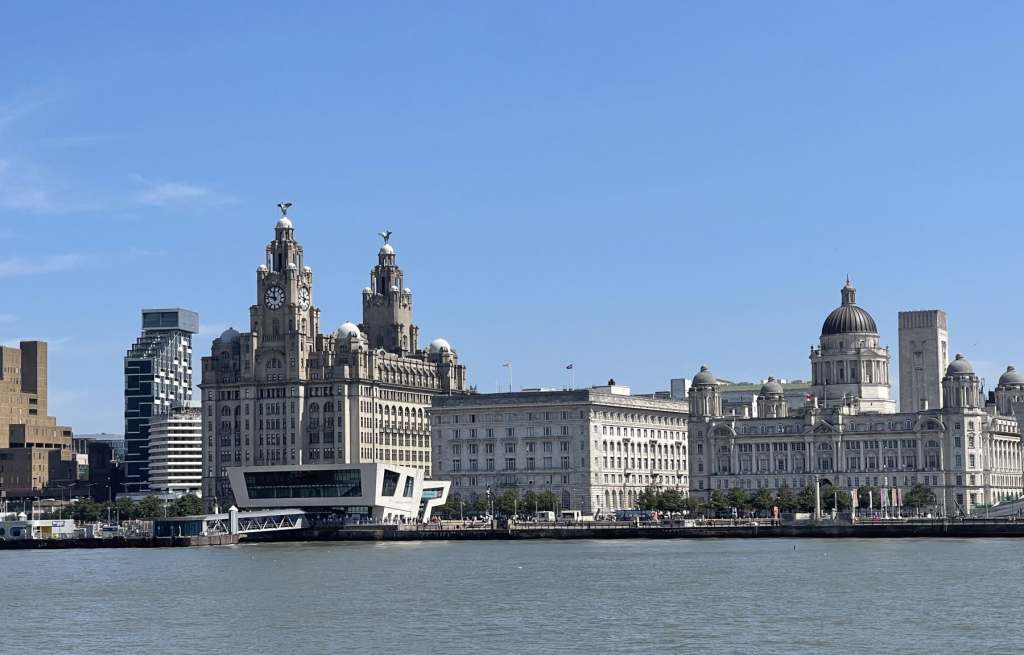
There is a grandeur about the heart of Liverpool that few other British cities can match, the architecture a vibrant mix of Georgian and Victorian excellence blended in with the modernist, futuristic structures which are found mainly on the Waterfront. This, remember, was a commercial and industrial city that once ruled the world. In the 19th century at least 40% of the world’s trade passed through Liverpool.
Liverpool Cathedral
It’s a city with a rich Catholic heritage, driven by the influx of Irish immigrants in the 19th century. On this visit however we elected to walk up Duke Street, passing Chinatown the first of its kind in the whole of Europe, and visit the Anglican cathedral, which advertises itself as Britain’s largest.
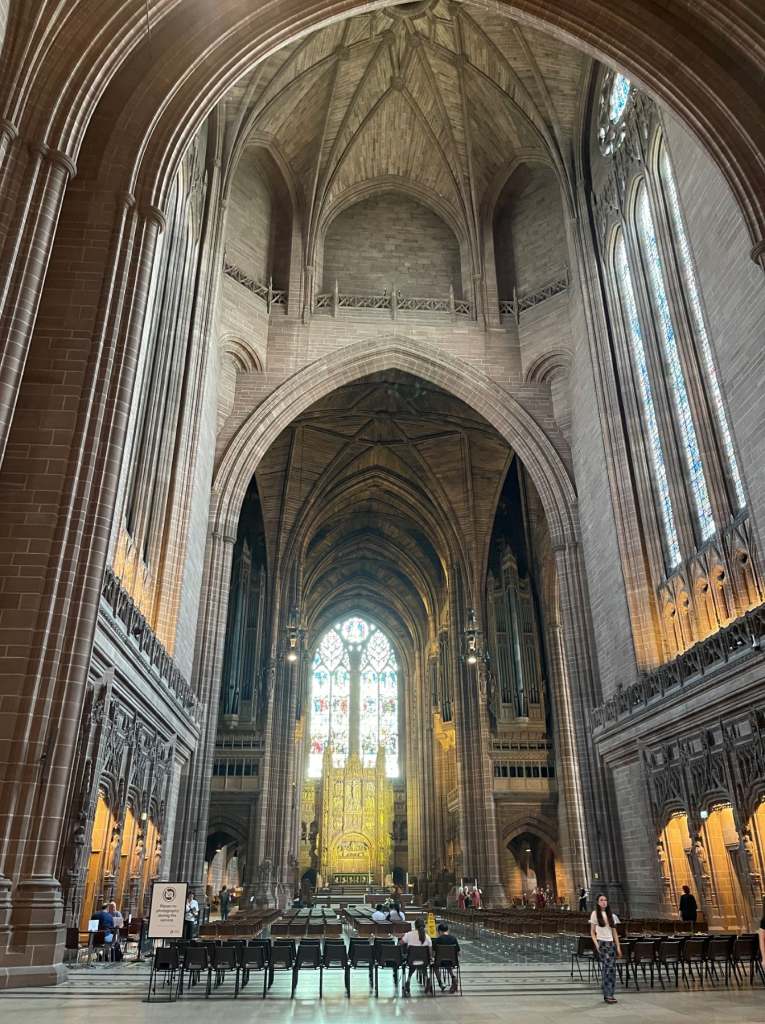
It’s a modern building as churches go, taking 74 years to complete (1904-78). Inside is a massive, awe-inspiring space, the highlight of which is the Great West Window, known as the Benedicte window, spanning 1,600 feet with over 200,000 pieces of coloured glass, brilliant blues, yellows and greens. The scenes show all of nature (men, animals, stars, waters, winds) united in praising God. Just below the window, above the Great West Doors, is a pink neon installation ‘For You’ by Tracey Emin, with the words in her handwriting ‘I Felt You and I Knew You Loved Me’.
A church helper guided us towards one of the building’s curiosities, which we certainly would otherwise have missed. In the transept lies the tomb of prominent Conservative politician Frederick Arthur Stanley, the 16th Earl of Derby, an impressive one, befitting a generous benefactor to the church in its early days. If you look very closely, tucked behind a decorative tassel on the Earl’s left shoulder is a tiny bronze mouse, which has earned the sobriquet ‘Scouse Mouse’. Was it to prove that all creatures, however humble, are welcome in this house of God?
Liverpool’s International Slavery Museum acknowledges the city’s unsavoury role in the 18th century transatlantic slave trade. We didn’t have time to visit this time, but heading back from the Anglican Cathedral, on Strand Street, we bumped into a magnificent sculpture on that theme.
‘The Great Escape’ by Lancastrian sculptor Edward Cronshaw features a 15ft bronze horse, depicted as being formed entirely from rope fashioned together like spaghetti. At the animal’s tail a piece of rope extends to the ground where a life-size figure of a man steps on it, forcing the horse to rear. Cronshaw apparently intended his work to symbolise man’s attempt to free himself from slavery.
Ferry Across the Mersey
It was time to take to the water. There’s been a ferry across the Mersey for more than 800 years, providing a link between Liverpool and the Wirral. So we bought our ticket from, where else, the Gerry Marsden Ferry Terminal (The Beatles contemporaries Gerry and the Pacemakers’ had a Top Ten hit with ‘Ferry Across the Mersey’) and prepared to board the Dazzle Ferry for an hour-long cruise on the vast waterway, whose eastern bank stretches for nearly 12 miles and includes 7.5 miles of docks.
On a beautiful summer’s day with a refreshing breeze, we took our seats at the very front of the upper deck on the multicoloured boat. Once in the middle of the river we were presented with a superb panorama of an evolving city, with more of the traditional buildings to our left contrasting with the sharp designs of recent years on the right.
Of particular interest on our journey was Everton Football Club’s new home, the Hill Dickinson Stadium at Bramley-Moore Dock. An extraordinary bowl-like structure of steel and glass, it cost a mere £800 million to build with the existing dock filled in with reclaimed sand from the Mersey.
On the opposite bank, from another age but equally striking, we marvelled at the neo-Grecian Wallasey Town Hall, uniquely built back to front so that it could face the river. We also got a great view of the six-faced Victoria Clock, the ‘Dockers’ Clock’, by which ships would synchronise their chronometers as they sailed out into Liverpool Bay.
Disembarking, we strolled back towards Royal Albert Dock, which is ringed by a profusion of restaurants and bars with the occasional gift shop, often with Liverpool Football Club memorabilia (we spotted a Mo Salah doll/stature, the great striker’s arm raised in familiar goal salute). We dined that evening at Rosa’s Thai restaurant, a friendly establishment where we enjoyed starters of summer rolls and calamari, followed by delicious red and green curries.
Another fortifying Pullman breakfast the following morning and we were on the road back to Suffolk. We had been mightily impressed by our first full visit to this vibrant city, and there’s no doubt we will be back again.
Things to Do in Liverpool
For more inspiration on the things to do in Liverpool, go to the official Visit Liverpool website.
