Leaving Hurghada before the resort day has properly begun creates one of the most striking transitions in Egyptian travel. The coast gradually disappears, the Eastern Desert takes over, and then, after hours of rock, open sky, and mountain silhouettes—the landscape begins to soften as the Nile Valley comes into view. Green fields, palms, villages, irrigation channels, and ancient monuments suddenly replace the dry horizons of the Red Sea. Luxor is memorable not only because of its temples and tombs, but because the journey there reveals how dramatically Egypt changes when the desert finally meets the river.
The Journey to Luxor Is Part of the Experience
Most travelers think of the road between Hurghada and Luxor simply as transportation, yet the changing landscape tells an important part of Egypt’s story. The Red Sea coast is framed by mountains and dry valleys, while Luxor sits within a fertile ribbon of cultivated land created by the Nile. Moving between the two makes the relationship between geography and civilization easier to understand long before the first archaeological site appears.
That contrast is what gives a Luxor day trip from Hurghada a character very different from another beach or marine excursion. The value is not limited to reaching famous monuments; it comes from crossing from one environmental world into another and seeing how ancient Egyptian life developed around the river. By the time the road enters the Nile Valley, the green fields and palms feel almost as dramatic as the temples waiting ahead.
The shift also helps visitors understand why ancient settlements developed where they did. Water, agricultural land, transportation, and religious geography all shaped the ancient landscape, and Luxor still preserves that relationship more clearly than many other destinations.
The Nile Valley Changes the Meaning of the Landscape
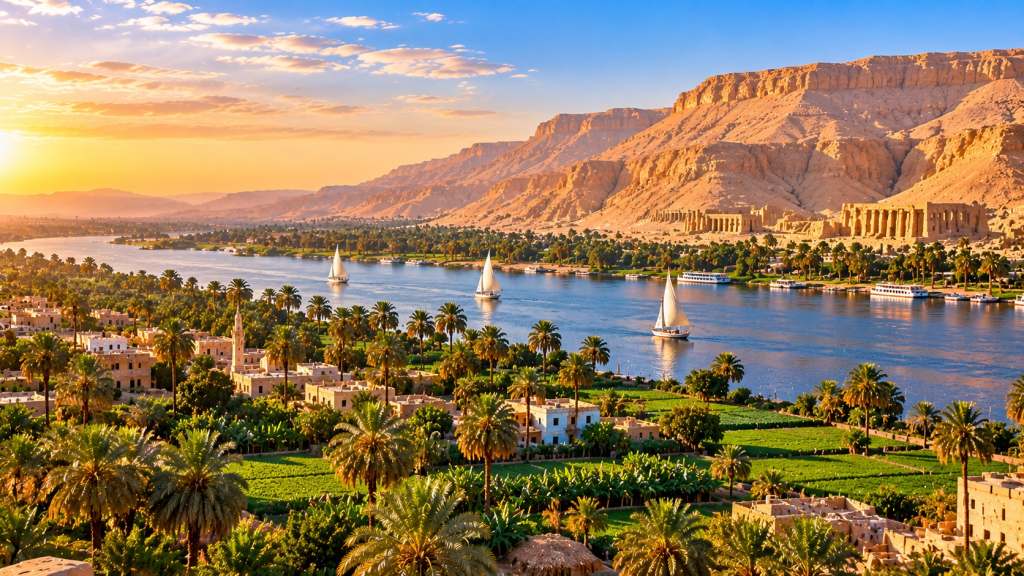
Luxor is often described through individual attractions, but the wider environment is just as important. The Nile runs between fertile land and desert edges, while ancient temples, necropolises, villages, and fields occupy a surprisingly compact area around it. Looking across the valley makes it possible to understand why the ancient city of Thebes developed into such an important political and religious center.
The contrast between cultivated land and desert is especially visible on the West Bank. Green fields can end abruptly, giving way to dry cliffs and valleys where royal tombs were carved into the landscape. That physical transition reinforces one of the most important visual ideas in ancient Thebes: life concentrated along the Nile, while the western desert became associated with royal burial and eternity.
Read Luxor as a Landscape, Not a Checklist
A rushed itinerary can reduce Luxor to a list of names: Valley of the Kings, Hatshepsut Temple, Colossi of Memnon, Karnak. Seeing the sites in isolation, however, misses the relationship between them.
A better way to experience the day is to ask what each place contributes to the wider story.
The West Bank introduces:
- Royal burial traditions
- The relationship between desert and cultivated land
- Mortuary temples and royal memory
- Monumental sculpture
- Ancient beliefs about death and renewal
The East Bank introduces:
- Temple ritual
- Religious processions
- Monumental architecture
- Royal building programs
- The relationship between temples and the living city
Seen together, the two sides of Luxor reveal a much more complete picture of ancient Thebes.
Enter the West Bank Through the Valley of the Kings
The Setting Matters Before You Enter a Tomb
The Valley of the Kings feels intentionally separated from the fertile Nile Valley. Its dry limestone cliffs, narrow valleys, and hidden tomb entrances create an atmosphere completely different from the temples encountered elsewhere in Luxor.
That setting matters because the location was not chosen randomly. Ancient Egyptian royal burial traditions were closely connected with ideas of protection, regeneration, and the western horizon. Even before entering a tomb, the landscape helps explain why the necropolis developed in this area.
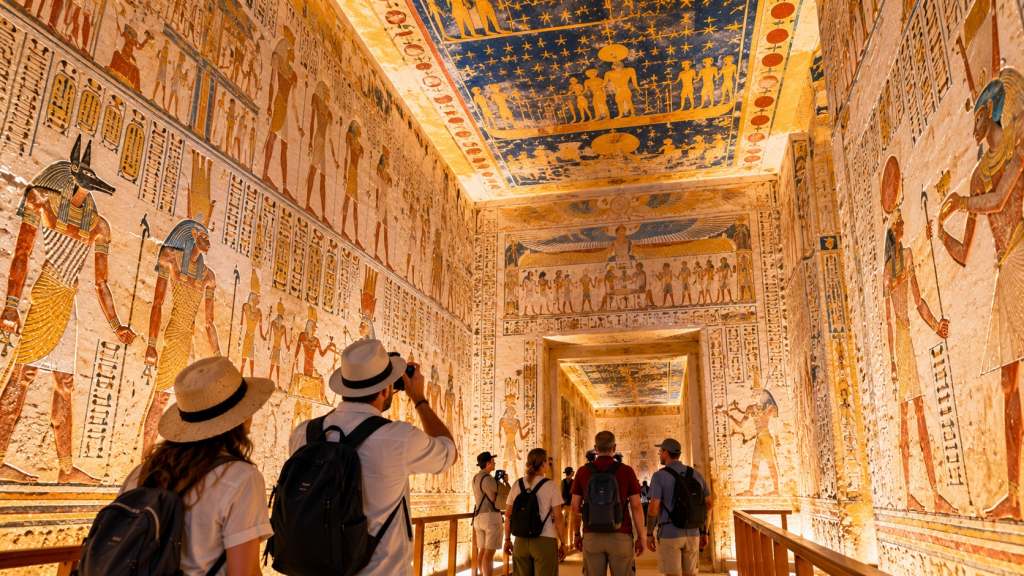
Inside, the experience changes again. Painted walls, religious texts, stars, divine figures, and funerary imagery turn the underground spaces into symbolic journeys designed for the afterlife.
Rather than entering as many tombs as possible, compare a smaller number carefully. Differences in scale, decoration, preservation, and architectural design become much easier to notice when the visit is not rushed.
Tombs Reward Attention to Detail
Royal tombs can overwhelm visitors because nearly every wall contains imagery. Instead of attempting to interpret every scene, focus on recurring elements: gods, boats, stars, protective figures, royal representations, and passages connected with the journey through the afterlife.
A guide can provide context before entry, allowing the visual details to become more meaningful once inside. This is usually more effective than trying to absorb a long historical explanation while standing in a narrow decorated corridor.
Hatshepsut’s Temple Shows Another Relationship With the Mountain
The Temple of Hatshepsut at Deir el-Bahari creates one of the strongest architectural compositions in Upper Egypt because the structure and cliffs appear almost inseparable. Its terraces, ramps, colonnades, and surrounding mountain face give the monument a visual rhythm very different from the enclosed tombs nearby.
The site also adds another historical perspective. Hatshepsut’s reign opens questions about kingship, legitimacy, religious authority, and the ways rulers used architecture to shape how they were remembered.
Moving from the Valley of the Kings to Hatshepsut’s temple therefore does more than add another famous monument. It shifts the day from hidden burial spaces to public royal architecture, making the West Bank feel more varied and historically layered.
The Colossi of Memnon Reveal What Has Been Lost
The Colossi of Memnon are powerful partly because they stand in a landscape where much of their original architectural context has disappeared. The two enormous seated statues once formed part of the entrance to the mortuary temple of Amenhotep III, a complex that was vastly larger than what remains visible today.
That absence encourages visitors to imagine scale rather than simply observe what survives. Archaeology is not only about preserved buildings; it is also about reconstructing lost spaces from fragments, statues, foundations, and historical evidence.
A short stop works best when the colossi are understood as part of this wider story rather than simply treated as another photograph.
The Nile Is the Thread Holding Luxor Together
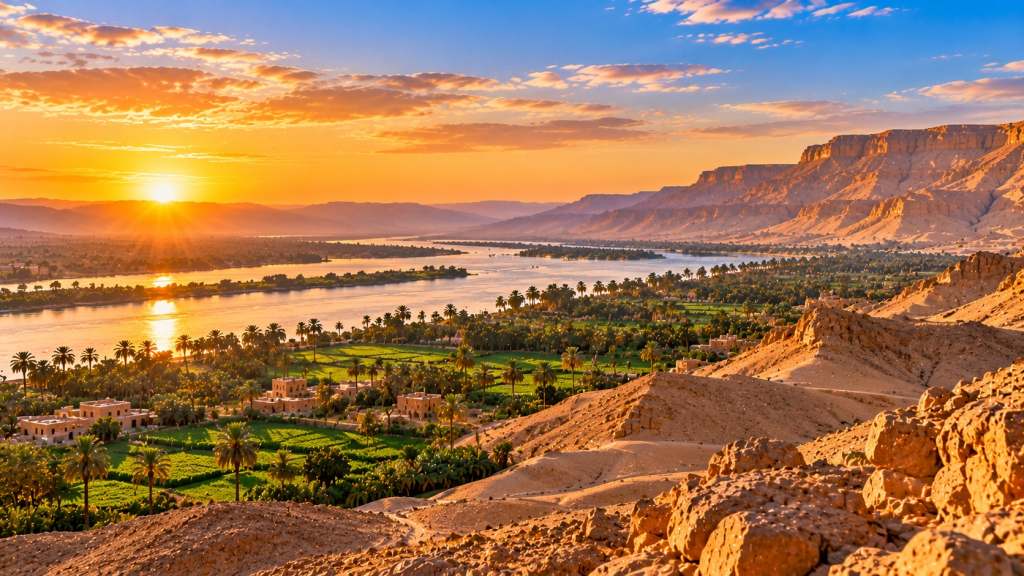
After several hours among tombs and temples, the river becomes easier to notice. It separates Luxor geographically, but it also connects the city historically, visually, and practically. Fields spread outward from its banks, boats cross between both sides, palms follow the water, and the desert begins where irrigation ends.
That perspective helps explain why a future Nile River Cruise can feel like a natural continuation of the Luxor experience rather than a completely separate activity. Once visitors have seen how temples, settlements, farmland, and desert landscapes all developed around the river, traveling along the Nile becomes a way of following the same geography rather than merely moving between destinations.
Even on a single-day excursion, pausing beside the river can change the pace of the itinerary. The Nile provides visual continuity after the intensity of tombs, cliffs, and monumental architecture, reminding visitors that ancient Thebes was shaped not only by its rulers but by the river that sustained the entire region.
Use the Middle of the Day as a Reset
Luxor can be demanding because many of its most important places involve outdoor walking, exposed stone, stairs, uneven surfaces, and concentrated historical interpretation. A proper midday break therefore contributes directly to the quality of the afternoon.
Lunch should provide enough time to sit, cool down, drink water, and let the morning experiences settle. Moving immediately from the West Bank into another major temple complex without a pause often makes the later sites feel less distinct.
Useful pacing principles include:
- Carry water throughout the day.
- Use sun protection consistently.
- Wear supportive walking shoes.
- Avoid an oversized day bag.
- Leave enough time for lunch.
- Alternate intense sightseeing with quieter moments.
- Do not treat every photo stop as mandatory.
The more comfortable the traveler remains, the easier it is to notice historical detail rather than simply wait for the next rest break.
Karnak Reveals the Scale of Religious Power
Walk Into Architecture Built Across Generations
Karnak is not a single temple constructed at one moment. Its enormous scale reflects centuries of building, expansion, modification, and royal patronage. That long history is visible in its pylons, courts, obelisks, sanctuaries, statues, and monumental columns.
The Great Hypostyle Hall naturally attracts much of the attention. Walking between its towering columns produces a sense of enclosure and scale that is almost the opposite of the open desert landscapes of the West Bank.
This contrast is valuable. Earlier in the day, visitors descend into hidden royal tombs; at Karnak, they move through monumental public spaces designed for religious ceremony and divine presence.
Look Up as Much as You Look Forward
Karnak rewards visitors who slow down enough to notice vertical detail. Column capitals, carved walls, obelisks, surviving pigment, and inscriptions become easier to appreciate when the visit is not reduced to walking quickly toward the next courtyard.
Human scale is also important. Seeing other visitors beside the columns makes the architecture feel even more immense, offering a sense of proportion that photographs often struggle to communicate.
A thoughtful visit therefore needs moments of stillness. Stand between the columns, look upward, then step back and observe how the architecture controls light, movement, and space.
Do Not Try to Make Luxor Feel Small
One day in Luxor can be deeply rewarding, but only when expectations are realistic. The city contains enough archaeology for several days, and the purpose of a day trip should never be to “complete” it.
Instead, allow a limited number of major sites to represent larger themes:
- The Valley of the Kings represents royal burial and the afterlife.
- Hatshepsut’s temple represents royal memory and legitimacy.
- The Colossi of Memnon reveal monumental scale and archaeological loss.
- Karnak represents religious power and centuries of architectural development.
- The Nile connects every part of the landscape.
This thematic approach helps the day feel complete without pretending that every important site has been seen.
Look Beyond the Monuments During the Return Journey
The road back to Hurghada offers another opportunity to understand the contrast that shaped the entire day. Luxor’s green fields gradually give way to dry land, mountain landscapes return, and the Nile Valley disappears behind the vehicle.
That transition can feel more meaningful after spending the day studying ancient Thebes. The importance of water, fertile land, and river transportation becomes almost impossible to miss when the traveler has just moved between such different environments.
The Eastern Desert no longer looks like empty space between two destinations. It becomes the boundary between two remarkably different Egyptian landscapes.
What to Bring for the Day
A compact day bag is enough for most visitors. The excursion requires movement rather than extensive luggage, and carrying less makes temple walks and tomb entrances easier.
Useful items include:
- Comfortable walking shoes
- Sunglasses
- Hat or cap
- Sunscreen
- Lightweight, breathable clothing
- Portable charger
- Essential medication
- Small amount of cash
- Camera or phone
- Reusable water bottle where appropriate
- Light extra layer when needed
The most important consideration is comfort across several different environments: vehicle travel, outdoor archaeological sites, tomb interiors, restaurants, and temple complexes.
Let Luxor Change the Meaning of the Red Sea
Returning to Hurghada after Luxor can make the coastline feel different. The Red Sea is still calm, blue, and restorative, but the day has added another layer to the journey. Only hours earlier, the traveler was walking beneath desert cliffs associated with royal tombs, standing between enormous temple columns, and looking across fields sustained by the Nile.
The two experiences strengthen each other because they are so different.
Hurghada offers water, reefs, mountains, and leisure. Luxor offers archaeology, river landscapes, royal history, and monumental architecture. Traveling between them makes Egypt’s geographical and cultural variety impossible to ignore.
A successful day therefore does not depend on how many ancient sites can be squeezed into the schedule. It succeeds when the changing landscapes remain clear in memory: the dry Eastern Desert, the first green fields of the Nile Valley, the silent cliffs above the royal tombs, the river crossing Luxor, and finally the Red Sea appearing again at the end of the road.
That is what makes the journey more than a day trip. It becomes a lesson in how geography, history, and travel can reshape one another within a single day.
