Tilda Swinton makes a welcome return to the London stage in Man to Man, Manfred Karge’s extraordinary play about a woman who assumes the identity of her dead husband to survive in Nazi Germany. First performed in the UK at Edinburgh’s Traverse Theatre in 1987, before transferring to the Royal Court the following year, this revival feels as relevant today as it did nearly four decades ago.
A Woman’s Fight for Survival in Nazi Germany
At its heart, Man to Man is a tragedy of the absurd. Through the eyes of Ella Gericke, who becomes Max after her husband dies, Karge charts the turbulent history of Germany from the rise of Nazism through the Second World War and the subsequent decades of political upheaval, culminating in the fall of the Berlin Wall and its aftermath.
Ella has little interest in politics. Her overriding concern is survival. In a society where women have few economic opportunities, she puts on her dead husband’s clothes, takes his job and assumes his identity. What begins as an act of necessity becomes a life in which the distinction between Ella and Max grows increasingly blurred.
Is she still herself, or has she become her husband, at least in part? It is a question that resonates well beyond the historical setting of the play. Identity is rarely as straightforward as we might like to believe, particularly when the world around us insists that we conform to its expectations.
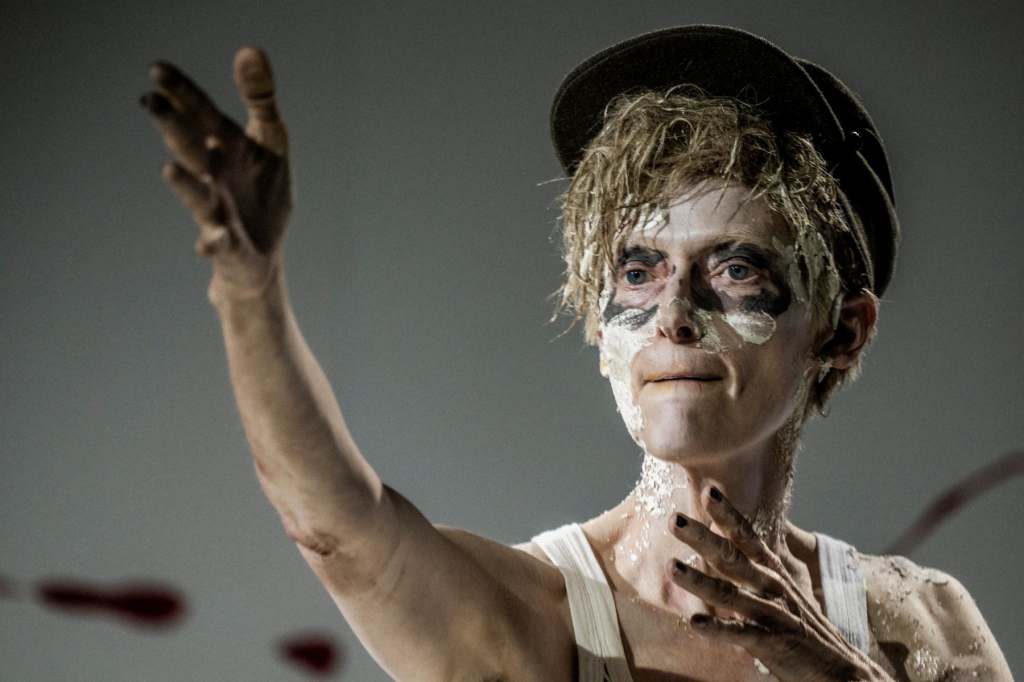
Initially, I find Ella difficult to warm to. It is not simply her appearance, with her stained vest and Y-fronts, but her apparent contempt for those she regards as scroungers or shirkers. There is something disconcerting about her insistence on hard work and self-reliance, given the circumstances in which she finds herself. Yet gradually, as we witness the humiliations and hardships she endures, my response changes. Her apparent harshness begins to make sense. She has had to fight for every scrap of security in a world where simply being a woman puts her at a disadvantage.
The play’s power lies in this uneasy mixture of the grotesque, the comic and the tragic. Ella is not an obvious heroine, nor does Karge invite us to view her as one. Instead, we see someone who adapts, compromises and sometimes behaves in ways we might find repellent because she has little choice if she is to remain alive.
Tilda Swinton’s Extraordinary Performance
Inevitably, much depends on the performance of the central character. Tilda Swinton is made for this role. Her androgynous physicality lends itself perfectly to the ambiguity of Ella/Max, while her extraordinary stage presence sustains a character who is at once vulnerable, aggressive, absurd and strangely compelling.
Swinton first played the role when she was in her twenties. Her return, alongside director Stephen Unwin, designer Bunny Christie and lighting designer Ben Ormerod, reunites much of the original creative team. The production forms part of the Royal Court’s 70th anniversary season, but this is more than a nostalgic return to a landmark performance. Karge’s play has been revised for the new production, bringing its historical journey into the present.
At times, I find Man to Man difficult to watch. This is not an easy play, and its fragmented narrative, strange shifts in tone and frequent silences demand patience. There are more pauses than in Pinter, and the awkwardness can be unsettling. Yet this is part of the point. Ella’s life is a constant struggle to keep going, and the gaps, hesitations and disjointed recollections seem to reflect the precariousness of her existence. We are not offered a comfortable, linear account of history, but fragments of a life lived under relentless pressure.
Stark Staging and Evocative Sound
The staging is remarkable. Despite its starkness, the set is filled with objects that Swinton uses to punctuate the silences and give physical shape to Ella’s memories. An old television, worn furniture and the ever-present fridge create a world that feels simultaneously domestic and alien. The fridge, in particular, becomes central to Ella’s existence, with its seemingly inexhaustible supply of beer. Drinking offers a means of escaping the tedium and hardship of everyday life, even as it becomes an obsession in its own right.
The use of television footage from the period is evocative, grounding Ella’s personal history in the wider political events unfolding around her. Music also plays an important part in establishing the atmosphere, while the accumulation of familiar and decaying objects suggests a life in which the past can never quite be discarded.
The Return of the Far Right
But it is the play’s final movement that proves most sobering. The dead have risen, just as Ella has, in a sense, resurrected her husband by taking on his identity. Here, however, the resurrection has a darker meaning. The return of the dead becomes a metaphor for the resurgence of neo-Nazism and the far right. “Hitler has found his lost ball captures the play’s disturbing mixture of dark humour and political warning.
The warning feels particularly pertinent following the far-right AfD’s victory in Saxony-Anhalt in September 2026, where it secured 43.8%, underlining that the spectre of Germany’s past has not been laid to rest.
The history that Ella has endured is not safely confined to the past. The old hatreds and ideologies can return, often dressed up in new language and presented as a response to contemporary anxieties. Karge’s play reminds us how easily the lessons of history can be forgotten, and how fragile the apparent security of the present may be.
This is a bravura performance from one of our most distinctive and adventurous actors. Swinton brings an extraordinary physicality to the role, but also a sensitivity that gradually reveals the human cost of Ella’s transformation. Her return to the London stage is most welcome, and the production offers a timely reminder of why this strange, challenging play deserves to be seen again.
Man to Man Tour
London venue: Jerwood Theatre Downstairs, Royal Court Theatre, Sloane Square, London until 24 October 2026
Forthcoming performances: Traverse Theatre, Edinburgh, 29 October to 7 November 2026; Berliner Ensemble from 9 February 2027; New York in spring 2027.
The original UK production premiered at the Traverse Theatre in Edinburgh in 1987 and subsequently transferred to the Royal Court in London in 1988. The 2026 revival reunites Tilda Swinton with key members of the original creative team.
