


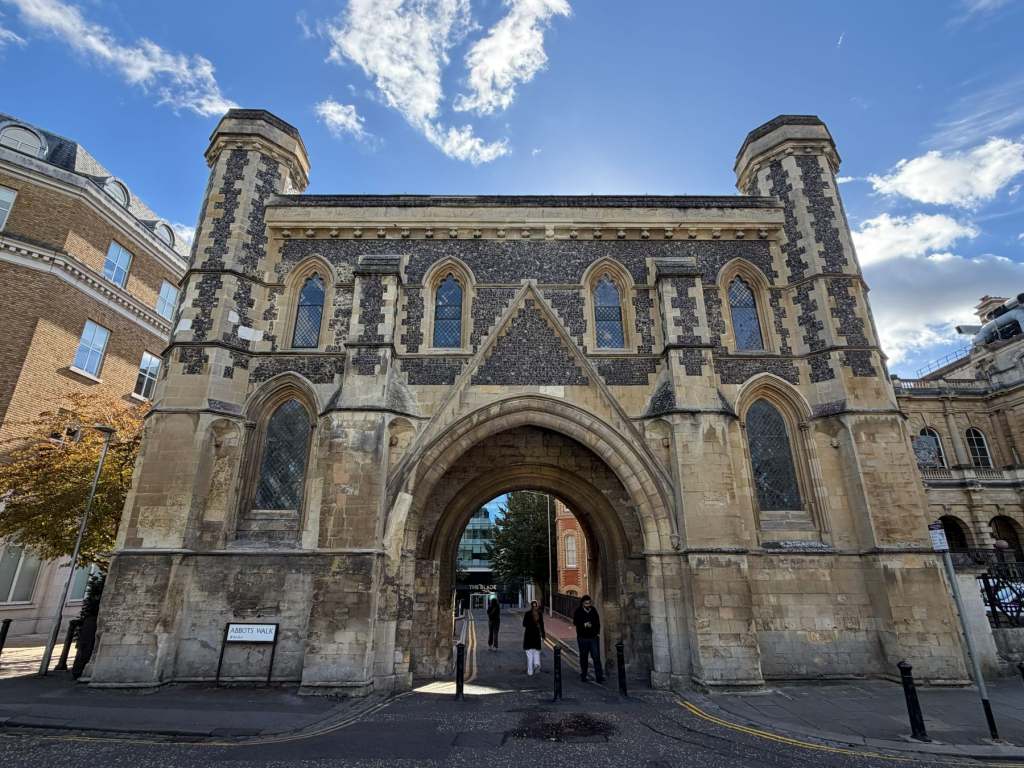
The Bayeux Tapestry British Museum exhibition may be generating almost as mush media coverage as a certain American President, but what you may not know is that another Bayeux Tapestry has been on display in the UK for the past century. It might not be the original tapestry, but it has an interesting story in itself.
As I had already seen the original Bayeux Tapestry in Normandy on a recent visit, I thought I would make the trip to Reading to see Britain’s Bayeux Tapestry.
Britain’s Bayeux Tapestry
“The original Bayeux Tapestry was thought to be made in Canterbury,” our eagle-eyed guide Rosy Aquilano says at the start of our tour of Britain’s Bayeux Tapestry in Reading Museum. Rosy is an incredible guide. Impeccably informed, she injects so much enthusiasm into the subject.
According to her, the Bayeux Tapestry was a propaganda tool to explain to the populace that William was the rightful king. As they were largely illiterate the story was told in a pictorial form and displayed as a tapestry, although technically as it is embroidered not woven it isn’t really a tapestry.
So, neither a tapestry nor from Bayeux, what’s in a name anyway?

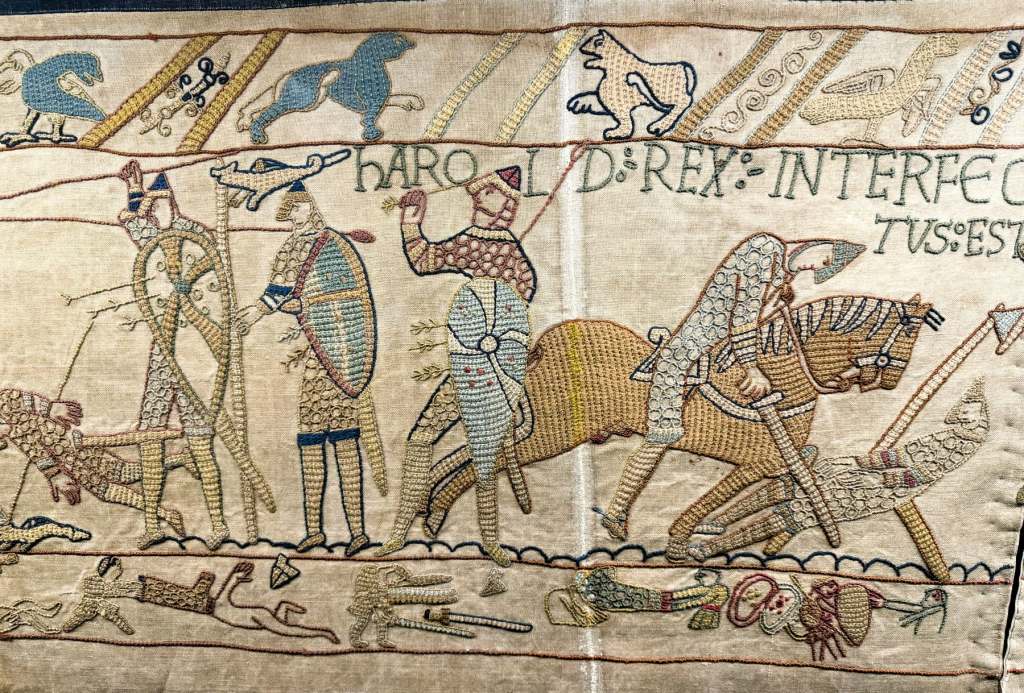
The Bayeux Tapestry was commissioned in the 1070s by Bishop Odo, who in addition to being William’s half-brother was the Bishop of Bayeux. This is why the non-tapestry made its way across the channel to Bayeux just like Harold did in the opening scenes of the tapestry.
Odo is to play an important part in the latter scenes, even appearing taller than his half-brother and taking centre stage – he who pays the piper.
The copy is a painstaking replica of the original commissioned by Elizabeth Wardle in 1886. There are minor alterations, such as the blue borders that have been added, and the occasional covering up of nudity to reflect Victorian values, but by and large this is an accurate copy of the original, which took thirty five women a year to produce.
In 1895, it came to Reading where it was bought by the philanthropist Arthur Hill, and in Reading it has remained.
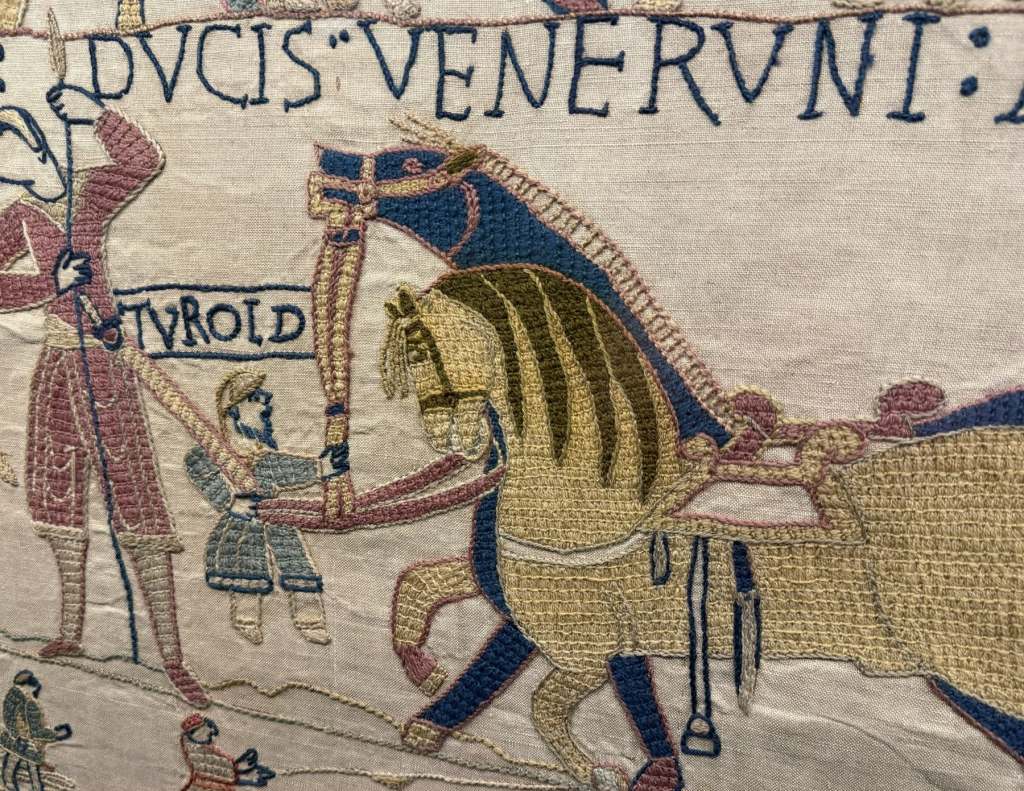
I gleaned far more information about the tapestry from Rosy’s tour than I did in Bayeux, such as who is the character Tyrold who appears near the start of the story for no apparent reason, and the non-linear storytelling technique, like the flashback in a film.

The Final Scene
The original tapestry went missing in the middle ages for a few centuries. As it was rediscovered still in Bayeux, it was probably rolled up and put in a cupboard somewhere. After all it is not that easy to find a place to hang a 70-metre long wall carpet. Or at least it is 70 metres long now. The original was damaged, presumably when it was stored, and the final scene of the Bayeux Tapestry was lost for ever.
It is assumed this depicted the coronation of William in Westminster Abbey on Christmas Day 1066. In 2019, the embroiderer Jan Messent created what she imagined the final piece would have looked like, a smaller version of which is also on display in the Bayeux Gallery at Reading Museum.
In 2027, a new tapestry based on a cartoon designed by Hélène Delprat and currently being woven – it is an actual tapestry – by the family Guillot family will be displayed at Château de Falaise, where William was born, and subsequently the medieval Chapter House Westminster Abbey, from 1 May – 30 July 2027. It is part of MILLENIUM – 2027, European Year of the Normans, an initiative led by the Normandy Region in partnership with several European territories.
I was fortunate enough to see the Guillot family weaving the tapestry on my recent visit to the Cité Internationale de la Tapisserie in Aubusson. It was an amazing site to see history in the making, some 1,000 years later. Some 25sqm in size it will be an amazing, and very contemporary, piece of work.
Reading Abbey
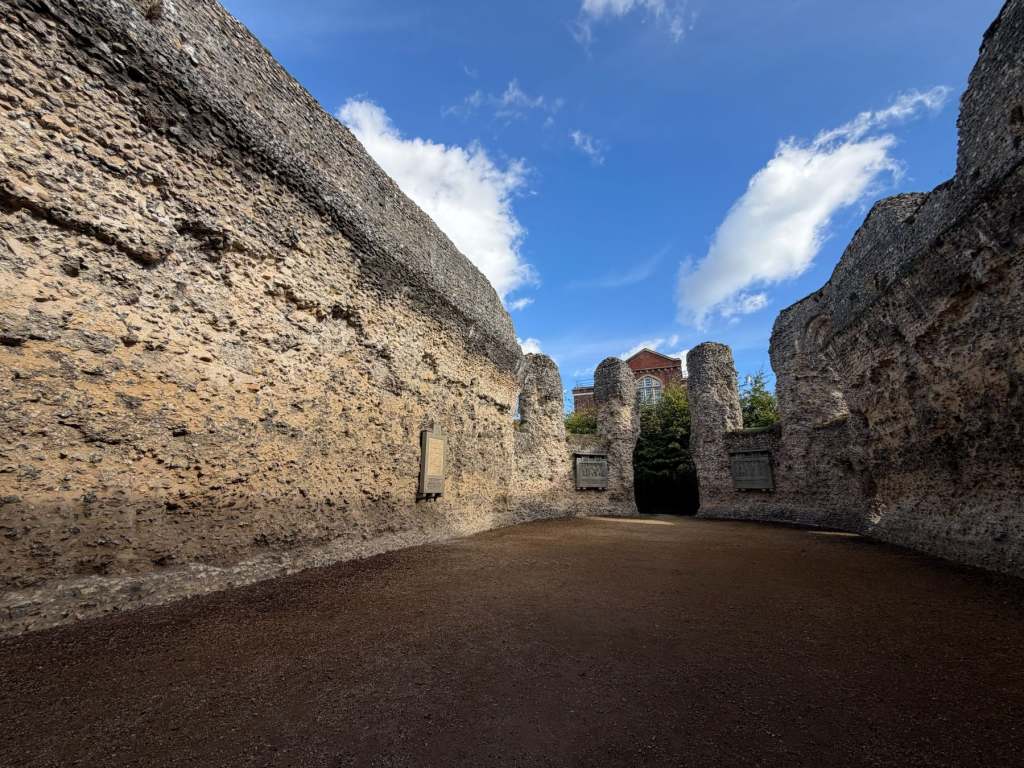
William is not the only Norman king with an association with Reading.
His son and heir, Henry I, is thought to be buried somewhere beneath Reading Abbey. Although the exact location of his remains is unknown, Henry had the abbey built as his mausoleum and he was brought here after his death.
Philippa Langley, the woman who drove the campaign to discover the bones of Richard III in Leicester, is said to be very interested in discovering Henry’s bones too. It is unlikely, that his bones like Richard’s will be found underneath a car park, but if it is then it would be that of Reading Jail where Oscar Wilde was famously imprisoned in 1895-7.
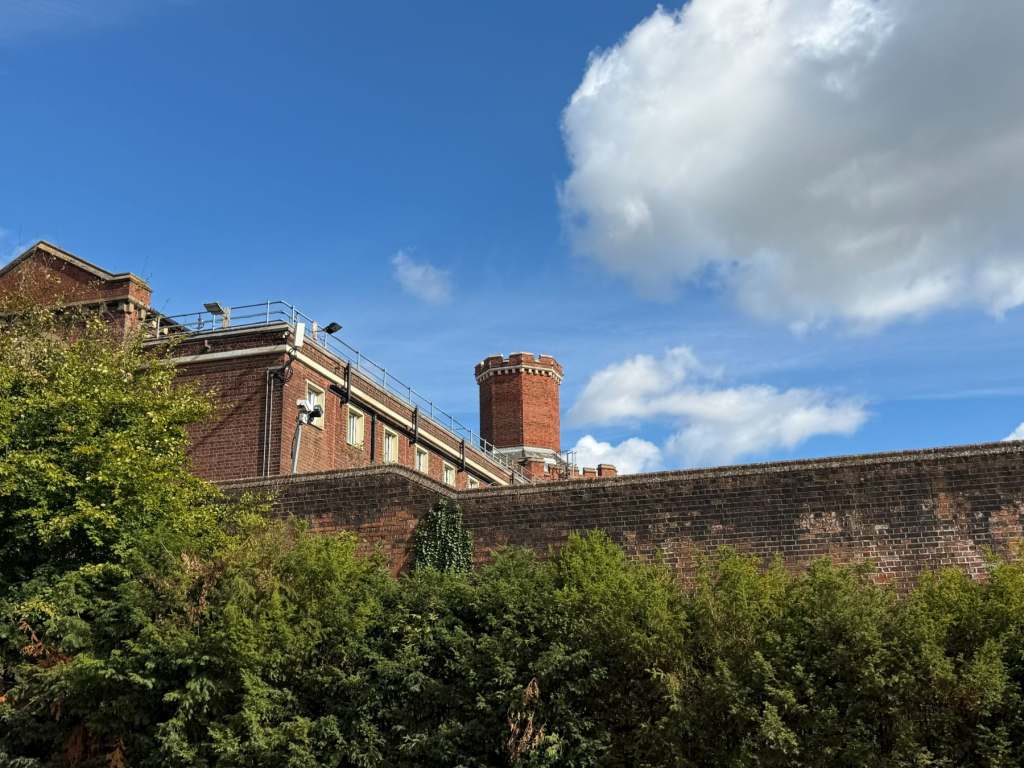
The jail lies next to the remains of the abbey and forms part of Reading Abbey Quarter.
Wilde enthusiasts will be disappointed to discover the jail is currently closed, although you can just see the window to cell 3CC (sixth from the right on the top row) from the abbey ruins.
Create Escape is a mural on the outside of the jail walls. It depicts a man, possibly Wilde, dressed as a convict, attempting to escape from the prison. Sadly, Create Escape was created by Banksy not Steve McQueen.
The abbey itself is open all year round for free to the public. Part of it was converted into a Pleasure Gardens by the Victorians, and is still a park.
The Start of a Pilgrimage
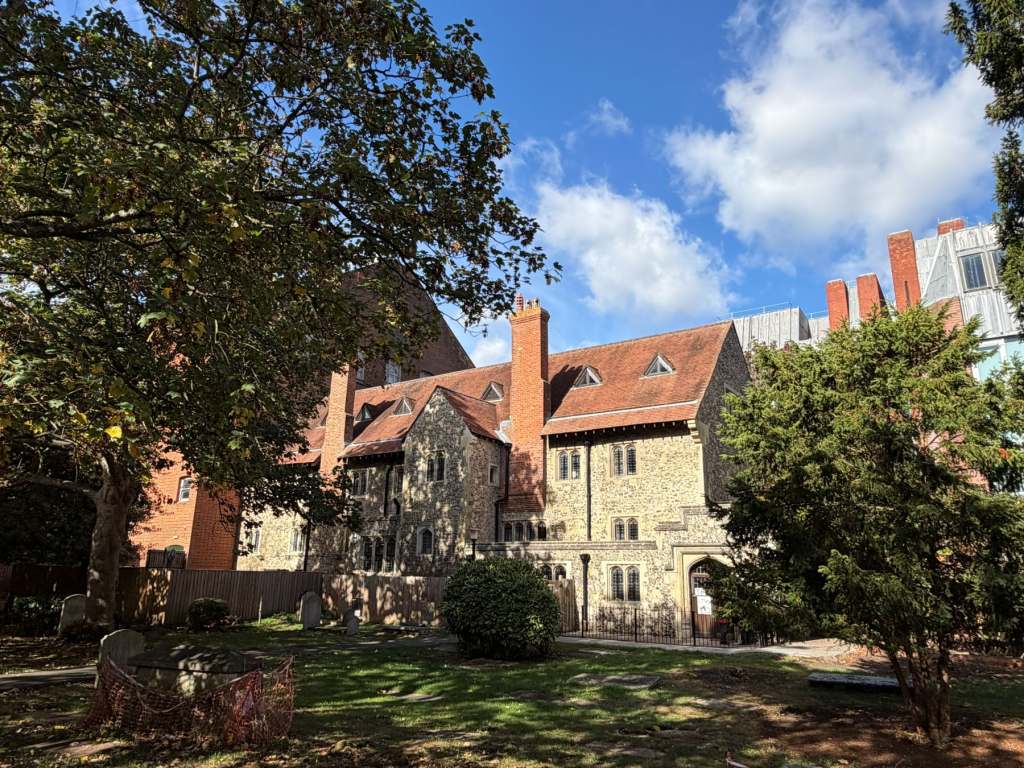
Reading Abbey was popular with pilgrims, who believed it contained the hand of St James the Apostle. It forms the starting point for the St James’ Way which is part of the Camino de Santiago (Saint James in Spanish).
Pilgrims would stay at the 12th century hospitium, which is now a nursery school, before commencing their walk to Southampton via Winchester, and then take a ship to Spain and continue their pilgrimage the Cathedral of Santiago de Compostela, where it was believed St James’ body lay.
The way has now been reopened so you can walk it (just follow the scallops) from Reading to Santiago de Compostela. The walk takes about ten days in total, although it involves a long swim as there are no direct ships from Southampton to Spain at the moment.
Reading Station
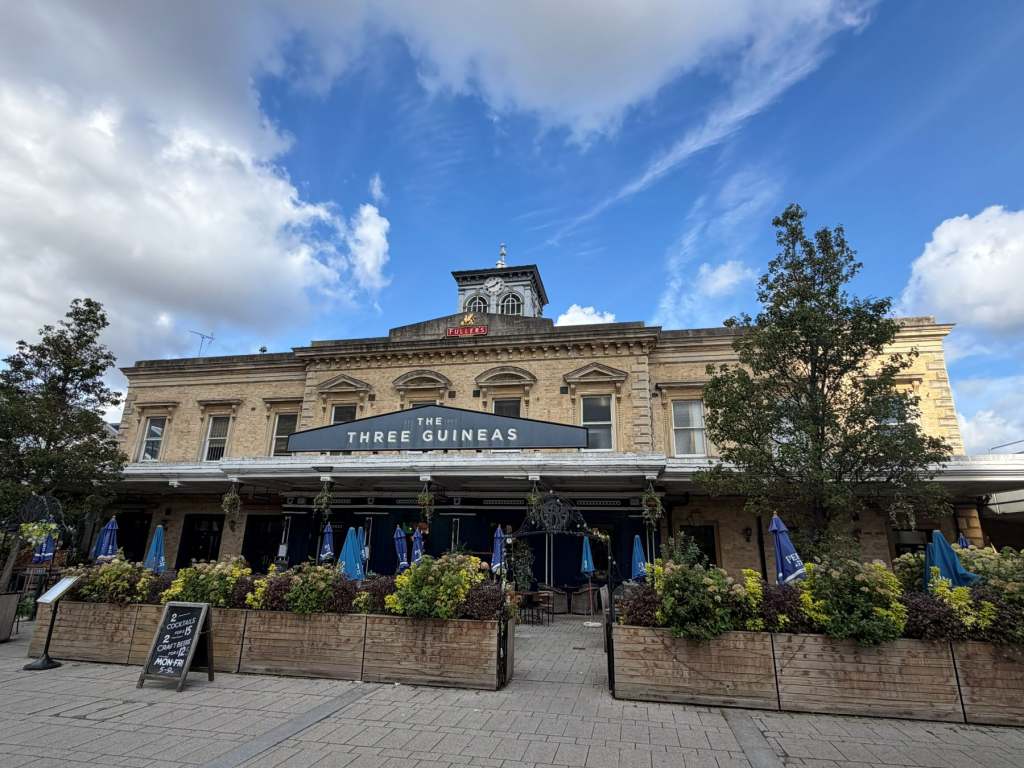
Most people choose to visit Reading by train, especially now the Elizabeth Line runs there. The original 1840 Brunel station has been turned into a Fuller’s pub, the Three Guineas. This is an excellent place to await your inevitably delayed train.
Day-trippers are not the only people to have arrived at Reading Station. During World War 2, author Michael Bond lived here. He was struck by the stream of refugees arriving here from London. Apparently, this inspired him to create his most famous character, a refugee whose name is based on the London station from which the refugees departed – Paddington.
Bond himself became displaced during the war. His building was a casualty of the only major bomb that struck Reading in the war. The town was known for making biscuits not munitions. His building was situated just around the corner from the Victorian Town Hall where Reading Museum is located, and which now displays Britain’s Bayeux Tapestry.
Britain’s Bayeux Tapestry Tickets
Guided tours of Britain’s Bayeux tapestry are held each Tuesday and Thursday (2.30pm to 3.30pm) and Saturday (2pm to 3pm). You can buy Britain’s Bayeux Tapestry Tickets (£15) here.
Things To Do in Reading
For more inspiration on what to do in Reading go to the local tourism website.
Where to Stay in Reading
Reading can easily be visited as a day-trip from London, but if you wish to stay a night, then I recommend you do so at the Malmaison Reading, which is situated in the old listed Great Western Hotel, built in 1844. Make sure you book the breakfast, which is excellent.