Tegan Pivard returns to Norway to visit the UNESCO listed Geirangerfjord and contemplate not just its beauty but its importance
My last visit to the Norwegian fjords was so long ago that I’m slightly horrified to admit we’re talking decades rather than years. I visited Bergen and Flåm back then, but all these years later I still remembered just how beautiful this part of Norway was.
I knew the fjords were beautiful, but I’d never been to Geiranger, and arriving into Geirangerfjord on an unbelievably sunny morning it felt a little like discovering them all over again.
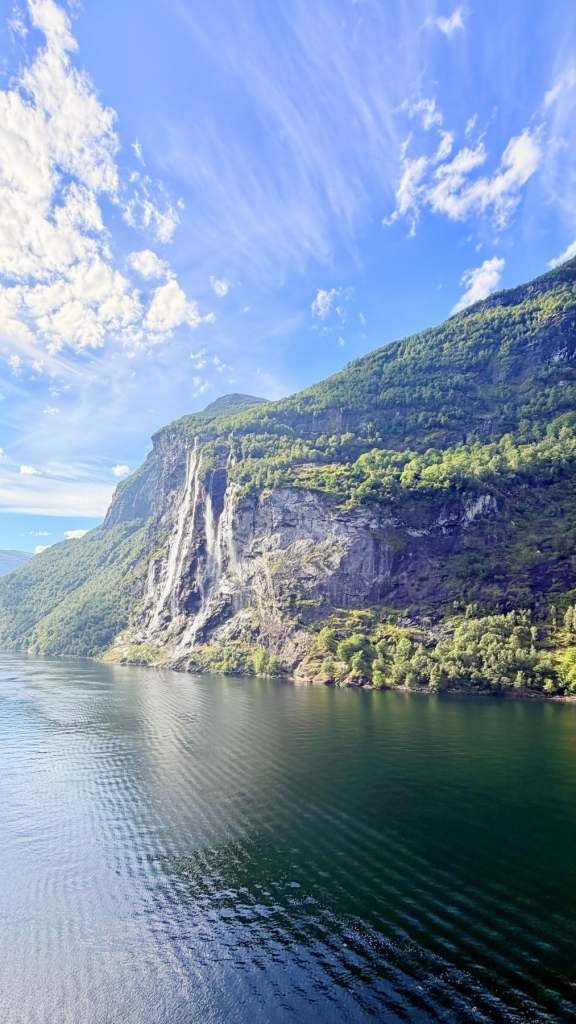
The mountains rise almost vertically from the water, waterfalls tumble down their sides and around every bend there seems to be another view demanding your attention. We were incredibly lucky with the weather too. Norway isn’t exactly famous for guaranteeing blue skies, but the sun shone all day, the water sparkled and Geiranger looked every bit as spectacular as the photographs would have you believe.
What I hadn’t appreciated before visiting was that there is much more to Geirangerfjord than an exceptionally pretty landscape.
Together with Nærøyfjord, Geirangerfjord forms the West Norwegian Fjords UNESCO World Heritage Site. The two areas were added to the World Heritage List in 2005, recognised for both their extraordinary natural beauty and the geology that created them.
In a country that is hardly short of spectacular fjords, I wanted to know what made this one quite so special. UNESCO status tells you that Geirangerfjord is important, but it also raises a more complicated question. How do you protect a landscape judged to have Outstanding Universal Value while still allowing around a million people a year to experience it?
Geirangerfjord : More Than a Pretty View
UNESCO considers the Geirangerfjord and Nærøyfjord areas to be among the most scenically outstanding fjord landscapes on the planet, which is quite an accolade when you consider the competition.
The World Heritage designation isn’t simply about the view, however. The landscape provides an extraordinary example of how fjords develop, shaped by glaciation and the geological processes that continued after the ice retreated.
It is also about recognising a landscape UNESCO believes has significance far beyond Norway itself. World Heritage status is reserved for places considered important to humanity as a whole, which means the responsibility extends beyond attracting visitors. It includes ensuring that future generations inherit the same landscape rather than a diminished version of it.
Today, the steep rock walls surrounding the World Heritage fjords rise as much as 1,400 metres above sea level and extend as far as 500 metres beneath it. Waterfalls tumble from the cliffs, while rivers run through forests towards glacial lakes, glaciers and mountains.
Those are impressive numbers on paper, but they make much more sense when you’re actually there.
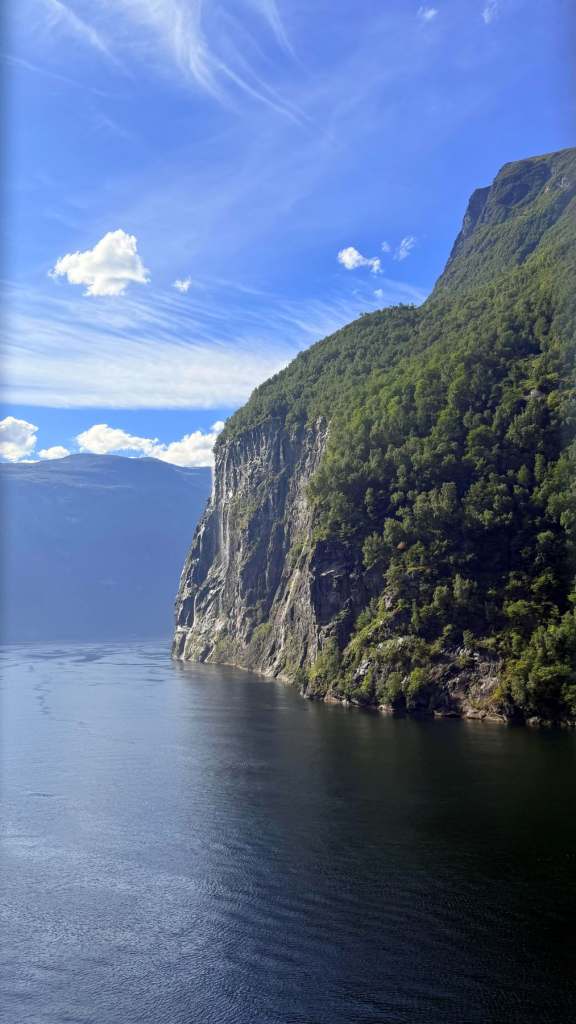
From the water, the scale is difficult to comprehend. The mountains seem to rise straight out of the fjord and everything human suddenly looks very small in comparison.
And then there are the waterfalls.
The Seven Sisters
The Seven Sisters are probably the most famous of Geirangerfjord’s waterfalls, and seeing them was one of the highlights of my visit.
The seven waterfalls plunge from high on the mountainside towards the fjord below. While I’d seen plenty of photographs beforehand, there is something completely different about experiencing them as part of the landscape itself.
They are also only part of the story. Water seems to find its way down the mountains everywhere you look, with waterfalls and rivers forming part of a landscape that feels almost impossibly dramatic when you’re surrounded by it.
It is easy to understand why people come here simply for the scenery, but Geirangerfjord isn’t an untouched wilderness. Humans have somehow found ways to live amongst these mountains for generations.
Life on the Fjord
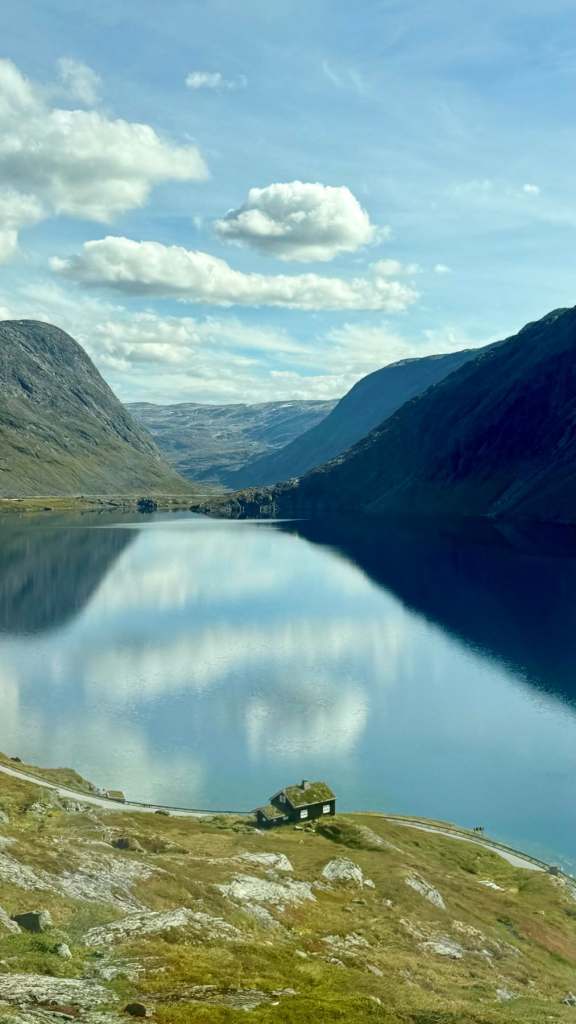
Look carefully at the mountainsides and you can still see remnants of old farms perched high above the water, some in locations that make you question the judgement of whoever first looked at an almost vertical mountainside and decided it seemed like a reasonable place to build a home.
Many are now abandoned, but they tell another part of Geirangerfjord’s story and add a human element to a landscape otherwise dominated by nature.
People farmed here, raised families here and travelled across the fjord long before anyone arrived simply to admire the view. The landscape wasn’t an attraction to them. It was home.
UNESCO recognises these largely abandoned mountain farms as part of the cultural history that adds another dimension to the area’s significance.
Seeing Geiranger from the water gives you one perspective, but later that day we headed in completely the opposite direction, climbing high into the mountains towards Dalsnibba.
From the Fjord to Dalsnibba
The journey to Dalsnibba is one of those occasions when getting there is at least half the fun. As the road climbs away from Geiranger, the landscape gradually changes and the fjord becomes increasingly distant below.
Dalsnibba sits 1,500 metres above sea level and, on a clear day, the views back towards Geiranger are extraordinary. Fortunately, our frankly ridiculous luck with the Norwegian weather continued. With blue skies above us, we could see across the mountains and back towards the fjord we’d travelled through earlier that morning.
Standing up there gave me a completely different sense of the landscape. From the water, I’d been looking upwards at mountains that seemed enormous, but from Dalsnibba I could look back down and see how the fjord sits amongst them.
Looking down from 1,500 metres above sea level also helped me understand why UNESCO considers this more than simply an attractive viewpoint. From above, you can see the wider system of mountains, rivers, valleys and glacial landscapes that together form the World Heritage Site.
The official Geiranger Skywalk describes Dalsnibba as Europe’s highest fjord view accessible by road, and the journey from Geiranger takes you 21 kilometres into the mountains. It is difficult to think of many places where you can experience the same landscape from such completely different perspectives within the space of a few hours.
Protecting Geirangerfjord
Home to only around 200 permanent residents, Geiranger welcomes more than one million visitors a year. Tourism is nothing new here, travellers have been visiting the Norwegian fjords for generations, but modern tourism inevitably raises questions about carrying capacity. Cruise ships, coaches, cars and sightseeing boats all enable people to experience the landscape, yet they also place pressure on the very environment visitors have come to enjoy.
UNESCO has identified tourism pressures in Geirangerfjord and Nærøyfjord as intense and highlights effective visitor management as important to the site’s long-term conservation.
It is a particularly interesting question here because Geiranger isn’t something that can simply be preserved behind a rope. It is a living community as well as a natural landscape, and tourism is an important part of local life and the economy.
In response, Norway has introduced increasingly ambitious environmental measures for its UNESCO fjords, including a long-term transition towards zero-emission passenger shipping within World Heritage fjord areas. The aim is to reduce pollution and ensure tourism remains compatible with protecting these internationally significant landscapes.
The World Heritage designation encompasses the geology and natural processes that created the fjords, along with the waterfalls, rivers, forests, glacial lakes, glaciers and mountains that make up the landscape today. Much of the World Heritage property is protected under Norwegian environmental legislation, with management designed to preserve the qualities for which it was granted World Heritage status.
For travellers, sustainability can sometimes feel like a list of things we’re being told not to do, but I don’t think that is particularly helpful. Most of us aren’t going to stop travelling, nor do destinations that benefit from tourism necessarily want us to.
Perhaps the more useful question is how we behave once we’re there. Supporting local businesses, respecting protected areas, choosing lower-impact ways to explore where possible and simply remembering that the places we visit aren’t there solely for our benefit are all relatively small things. None will save a fjord on its own, but collectively they matter.
Visiting somewhere with UNESCO status also made me think differently about what that designation actually means. It isn’t simply an endorsement telling travellers that this is somewhere they really ought to see. It means that what is here has been judged to have Outstanding Universal Value, something considered important enough to humanity that preserving it for future generations matters.
After spending a day in Geiranger Norway, it was difficult to disagree.
