In the Bolivian Andes, the world’s largest salt flat sprawls across an area of more than 4,000 square miles; about half the size of Wales. Julia Hammond finds the Salar de Uyuni at its most surreal when rain turns the salt flats into a giant mirror.
Salar de Uyuni in the Low Season
I should have brought flip-flops, I muttered, chastising myself for overlooking an instruction that had seemed unimportant but was now having major consequences. Our jeep had come to halt way out in the middle of the Salar de Uyuni. It was wet season and floodwater still covered large areas of this vast salt flat. I had a choice: leave on my no-longer-waterproof hiking boots and suffer with wet feet all day or unlace them and step on the sharp salt crystals with only a thin pair of socks to protect the soles of my feet. I opted for the latter, and every step was agony.
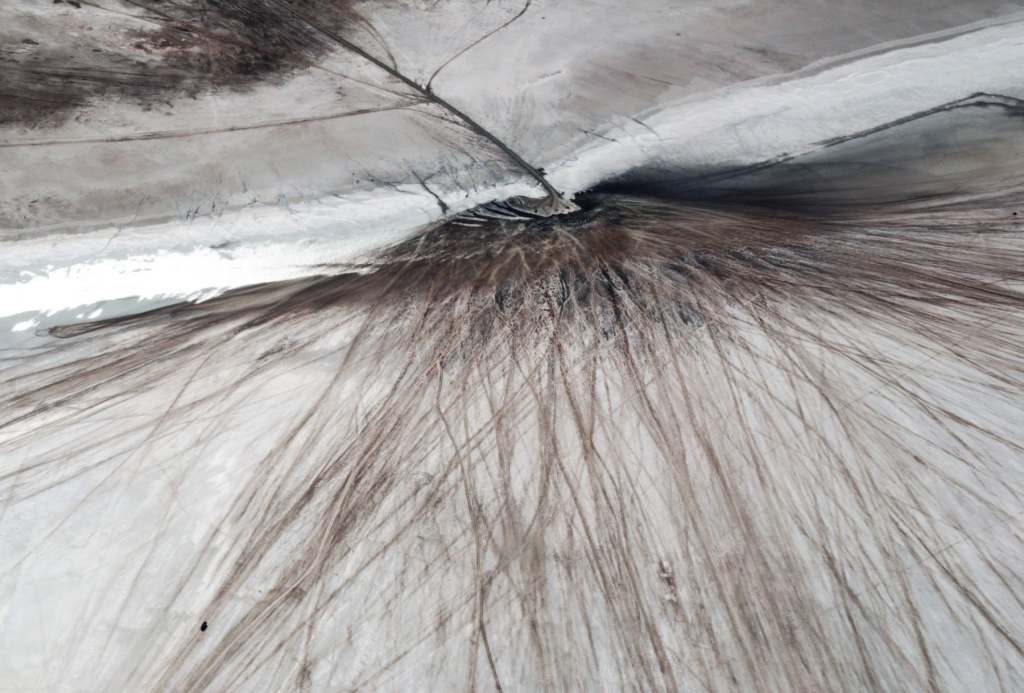
Amazing landscapeFortunately, I didn’t need to stray far to appreciate the area’s extraordinary characteristics. One of the benefits of coming at the tail end of low season was that showery weather was now far less common, but the huge pools of water dumped by rain clouds over the previous couple of months had yet to evaporate. It was calm, and on days like this when the air was still and the sky a deep cobalt blue, the reflections in those puddles were something quite extraordinary. The shallow film of water had turned the Salar de Uyuni into a mirror, and it was jaw-droppingly beautiful.
Exploring Bolivia’s Vast Salt Flats
The salt flat wasn’t as homogeneous as it first appeared. In fact, the surface was anything but uniform. After a brief stop in Colchani to learn about salt production, our 4×4 sped out onto the salt flat following the tyre prints left by other tour vehicles. I wound down the window. The rutted ground, interspersed with standing water, consisted of banks of salt that had the consistency of slushy snow. Such tracks were unmarked: one of the reasons why independent travellers weren’t allowed to forge their own path out here. With so few landmarks to navigate by, anyone without local knowledge could easily become lost, with disastrous consequences. So access to the Salar de Uyuni is permitted by organised tour only.
We headed further and further out onto the salt flat, eventually finding dry ground. Beside us, the pristine surface glistened like ice in the sunshine. Tessellated crystals had created a seamed quilt with endless bumps, mounds and ridges. On the far horizon, a smudge of charcoal grey was all we could see of distant mountains and volcanoes.
A Surreal Photography Playground
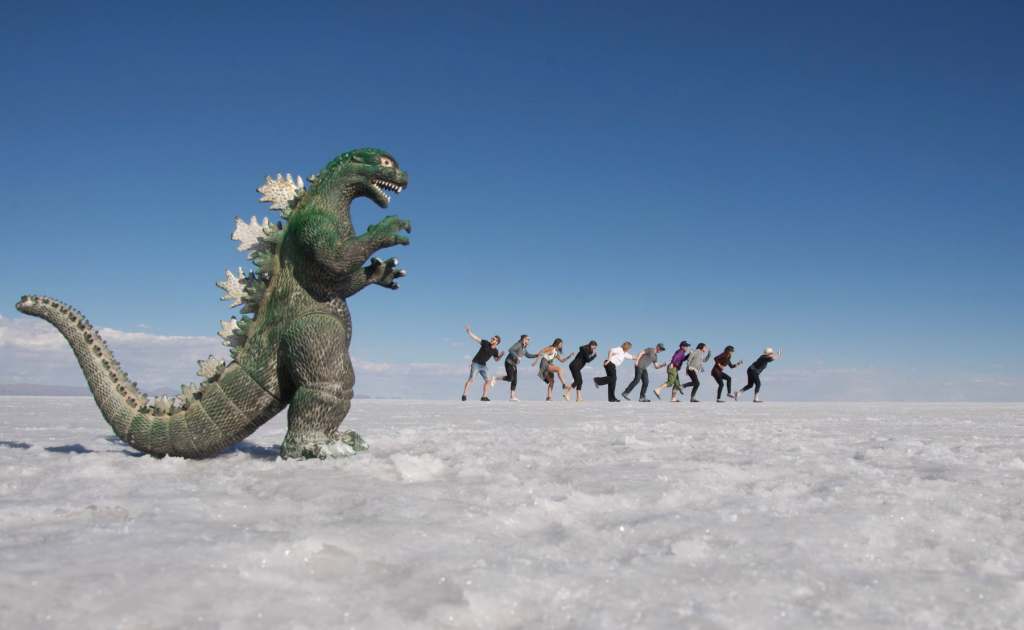
Parking up again, it was time to have some fun. Our photography stop took a surreal turn in this featureless white landscape thanks to carefully placed props and people. When I flick back through my photo album, I see an image of myself peering down like a demented Gulliver at a group of cowardly Lilliputians whose mouths gape open in fear. As they prepare to flee, I raise my boot to stamp on them. Of course, it never happened; it was just a trick of perspective. It’s the cheesiest (and most eagerly anticipated) part of any tour to the Salar de Uyuni and the reason guides carry an array of household items in the boot. Ours presented a box of cooking pots, empty beer bottles, used Pringles tubes and more; we wound up surfing on a wine bottle and running away from a very scary plastic toy dinosaur.
Why Isla Incahuasi Is Off Limits in Wet Season
One place we couldn’t visit was Isla Incahuasi. This marooned outcrop of rock is the visible remains of an ancient volcano; 40,000 years ago, it was submerged in water as evidenced by the coral-like deposits formed from fossils and algae. The main draw is the island’s giant cacti, some of which stand ten metres tall despite growing at a snail’s pace. In peak season, it’s a must-see, but until the ground dries out the trails in this part of the Salar de Uyuni can be treacherous so tours give it a wide berth until the rainy season has passed.
The Curious History of Uyuni’s Train Cemetery
Instead, we spent time at another curious visitor attraction: Uyuni’s train cemetery. Once, this highland town had been a rail hub, a boom town that thrived while the area’s minerals were plundered. Ore was piled high onto wagons and transported from landlocked Bolivia to the Pacific coastal ports. As reserves ran low, the mines closed. It was cheaper to abandon the trains than to relocate them and so they were left to the mercy of salt-laden winds and harsh sunlight. The result was a tourists’ playground of rusting engines and graffitied carriages that formed the pre-show to the salt flat tours.
Sunset on the Salar de Uyuni
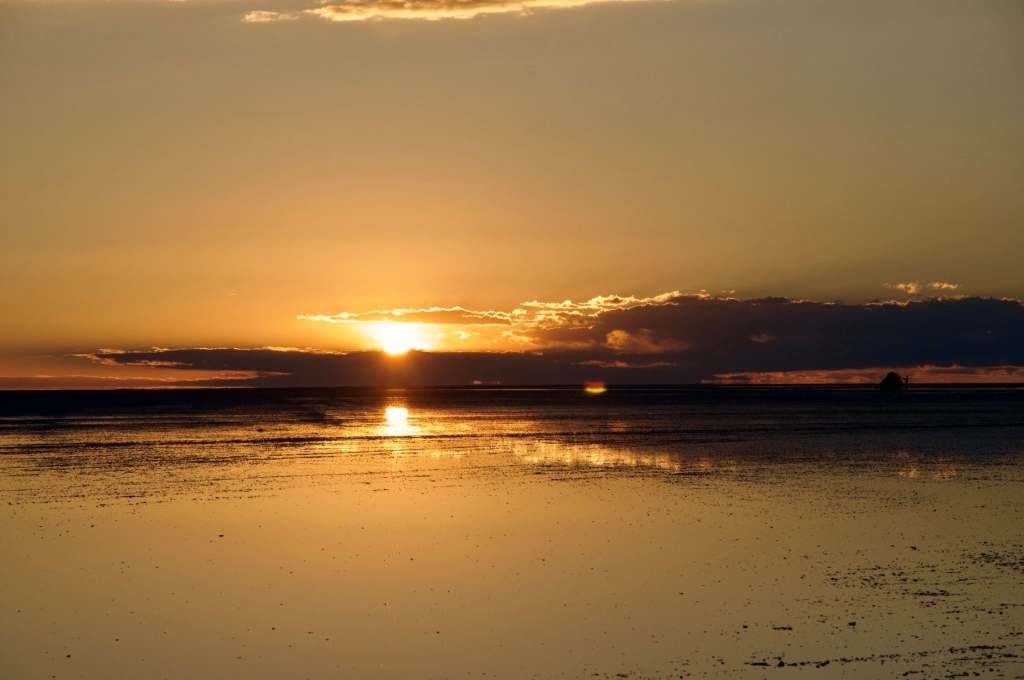
By the time the sun began to set, we’d seen so much that the train cemetery felt like a distant memory. A group of jeeps formed a crescent-shaped huddle on the edge of the salt flat. We scrambled out to stake our place to watch and photograph the flame-orange sky. It could easily have been a view out over a millpond-calm sea, were it not for the tyre tracks etched into the salt. We stood, transfixed, until the light faded completely.
Sleeping in a Hotel Made of Salt
The Salar de Uyuni had one last treat in store: a hotel built entirely of salt. Similar to an ice hotel, the structure is fashioned from blocks. Everything (from the walls to the bed bases) was made of salt. Here, brightly coloured soft furnishings injected Latin American flair into what otherwise would have been a bland and neutral palette. Yet those pesky crystals somehow managed to pierce the underside of the rug, as I found out when stepping onto it barefoot. For the second time that day, I wished I’d packed a pair of flip-flops.
Getting to the Salar de Uyuni
Travellers approach Uyuni from different directions; direct flights from La Paz typically arrive in the morning – bag a window seat for aerial views over the salt flat. Bus in from La Paz, Sucre and Potosi or, if coming from Argentina, the border town of Villazón, from where there’s also a train service to Uyuni a few times a week. Cross-border tours are another option, especially if you’re keen to see the Chilean Andes and Atacama Desert. Upon reaching Uyuni, arrange a guided tour with one of the many local operators; check reviews carefully before making a reservation.
