


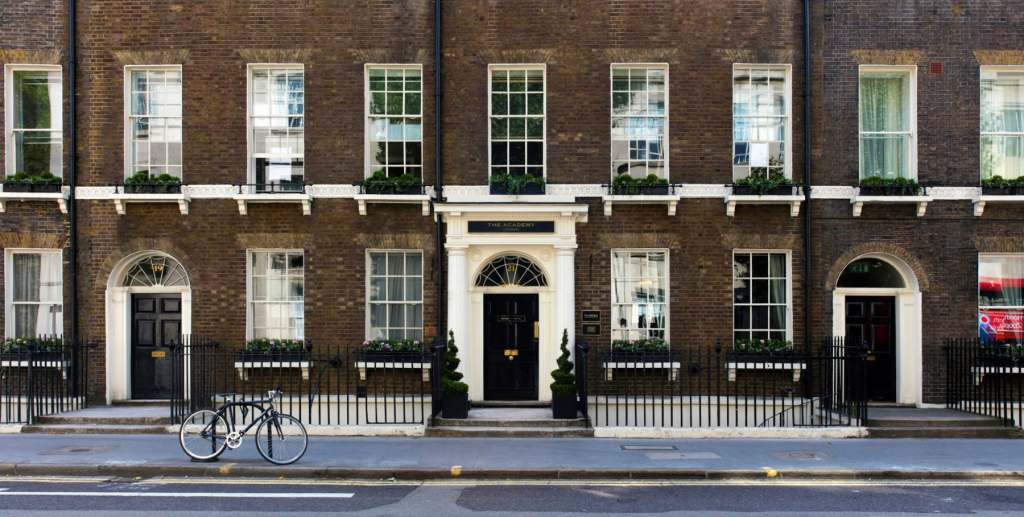
Roger Hermiston and Eileen Wise stay at The Academy Hotel Bloomsbury in London
A century on and the fascination about the Bloomsbury Set shows no sign of waning. That collection of British writers, artists and intellectuals who rejected Victorian values and blazed a new trail of personal freedom, aesthetic pleasure and open relationships, now feature in a sparkling new West End play, while the work of two of their number is under the spotlight in a Tate Britain exhibition.
So, we headed to London for a weekday trip – and an immersion in all things Bloomsbury. We would stay in the area of central London immortalised by the free-thinking group, and then in the evening head out into the West End to catch the drama based around the life of one of their number.
The Academy Hotel

We checked into The Academy Hotel in Gower Street, situated just across the street from the former home of Lady Ottoline Morrell, the society hostess at whose salon the likes of group members Virginia Woolf, her sister Vanessa Bell, Lytton Strachey and T. S. Eliot would gather.
The Academy opened in 2000, and in 2018 its owners YTL Hotels (which has a string of luxury hotels in the UK and abroad) gave it a multi-million-pound interior makeover. It’s spread over a row of five conjoined Grade II listed Georgian townhouses and has fifty bedrooms and suites, seeming a bit higgledy-piggledy at first until you become familiar with the layout.
Acclaimed New York designer Alexandra Champalimaud was commissioned to design the interior, and her stylish public rooms feature bohemian colours of dark blue and green on solid wood, with the whole atmosphere warm and informal.
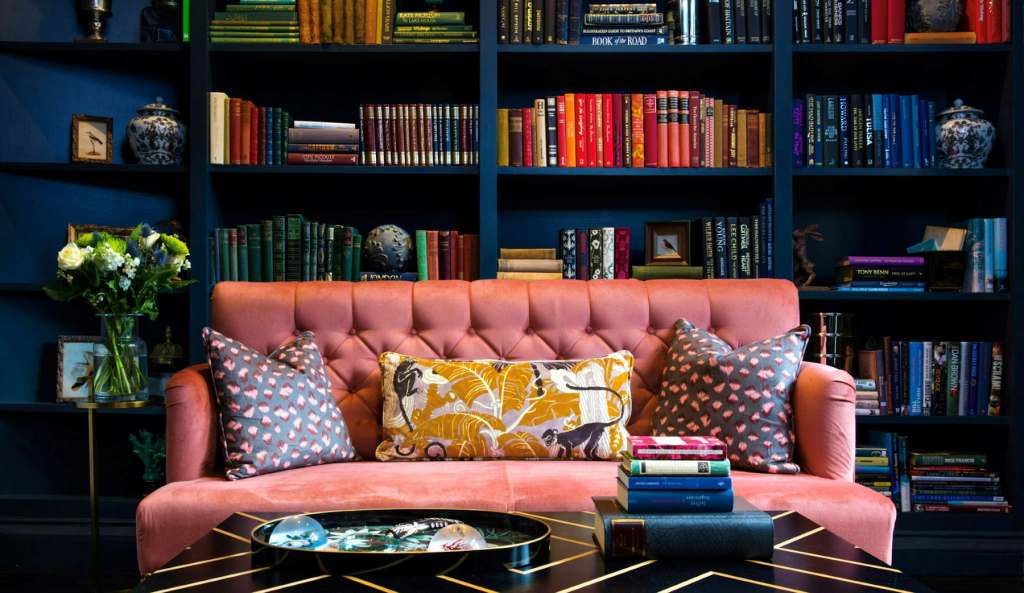
A nod to the Bloomsbury Set comes in the hotel’s library, an elegantly furnished room lined with quirky monkey-themed wallpaper, featuring distinctive Chinese porcelain vases, and decked out with bookcases featuring the works of Woolf, Eliot and E. M. Forster, as well as more modern literature. This room – whose doors open on to a lovely courtyard garden – is also the home of the London chapter of an international women’s book club called The Gloss, which meets monthly.
Mr Ma’s Afternoon Tea

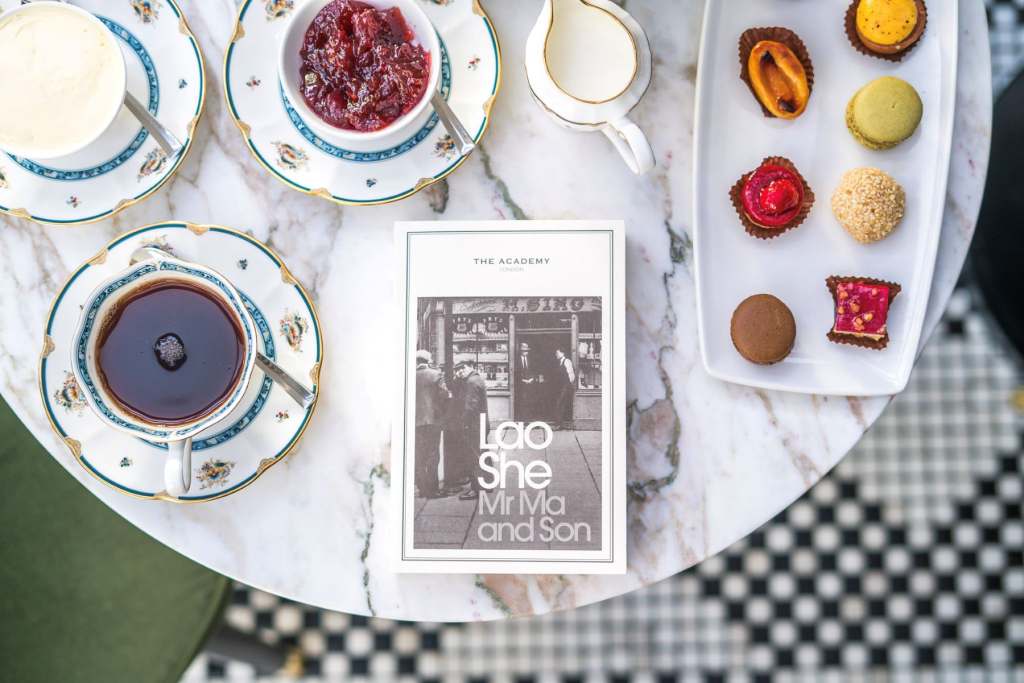
But the literary connections do not end there. The Academy is a bed and breakfast establishment, but does offer the excellent Mr Ma’s Afternoon Tea. This meal – which we took in the library – pays homage to the famous satirical novel of the 1920s, Mr Ma and Son by Lao She, which is set in the streets around here and follows a Chinese father and son as they attempt to navigate life and culture in London.
So, the tea is quintessentially English with a Chinese twist – the three-tiered tower featuring finger sandwiches, scones and cakes supplemented by sweet Asian egg tarts and sesame mochi. It was delivered to us with aplomb by the charming and efficient reception manager Felix Okyere, who looked after us very well during our stay.
Still, on the subject of food we took breakfast in the basement, in The Refectory, another striking-looking room of blue cabinetry. We enjoyed an expansive continental spread, which included artisan breads, croissants, a selection of chesses and cold cuts, granola and fresh fruit.
Our suite on the first floor looked out over Gower Street towards the renowned London School of Hygiene and Tropical Medicine. It was an attractive, well-furnished room, with its original fireplace, a distinctive chequerboard table, sofa and two leather armchairs. There was plenty of wardrobe space, the large bed was exceptionally comfortable and the marbled bathroom had everything you could want.
Exploring Bloomsbury
Blue plaques abound on lengthy Gower Street – women’s suffrage leader Millicent Fawcett is at No 2, while Charles Darwin is at 110. The British Museum is just a few minutes’ walk away, but a stroll towards a revitalised Tottenham Court Road (to our eyes, having left London 16 years ago) brings other incidental discoveries.
We passed by the domed Eisenhower Centre, the World War Two air-raid shelter named after the US President (who, contrary to myth, never had a meeting with Churchill here) now used for document storage. Then, close by Goodge Street station, is the giant Fitzrovia Mural, painted in 1980 by street artists Simon Barber and Mick Jones and featuring colourful scenes of everyday life in this area. It fell into a parlous state, faded and besmirched by graffiti, but was thankfully rescued and restored in 2010.
The Standard of Living
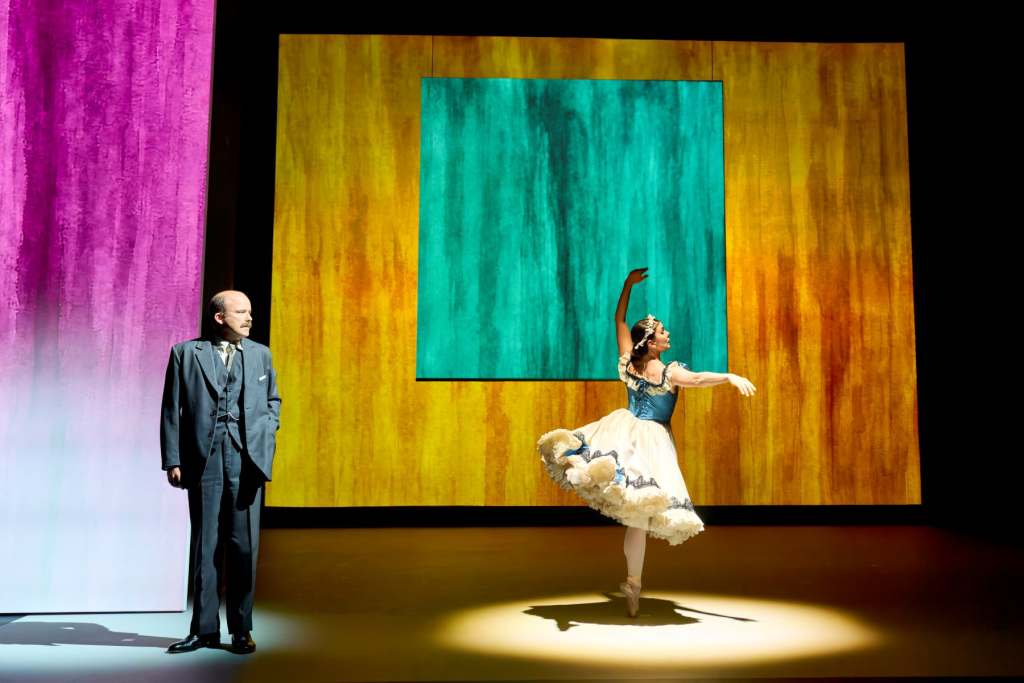
After Mr. Ma’s tea it was time to set off on the 20-minute walk to the Haymarket Theatre for the evening performance of ‘The Standard of Living’, the new play about the life of economist John Maynard Keynes, written by James Graham (of ‘Dear England’ fame) and directed by Nicholas Hytner.
It’s a clever title, a play on economics terminology and the more philosophical side of Keynes’s character, his constant questioning of what makes a good life. Wearing the three-piece suit and bowler hat of the Whitehall mandarin, Keynes cut an unlikely figure among the Bloomsbury Set. But as the play demonstrates, with his busy sex life and valuing of art and beauty, he fitted in well with the likes of Strachey and Woolf.
It’s not a whole life story, concentrating mainly on the period 1917 to 1946 when Keynes was so influential in the world of global economics. This is a man who has given his name to a whole theory of economics – Keynesian – which still resonates today.
The action switches between the corridors of power in Westminster and the gardens at the Charleston farmhouse, where the Bloomsbury Set often hung out. The economics explainers are crisply done, the dialogue is witty, and the characters in the group – Virginia Woolf and Duncan Grant in particular – all excellently drawn. The sets – large colour blocks and panels, maybe a reference to the work of the Bloomsbury Set artists – are visually striking, and live dance and ballet adds to the lively mix.
The ballet is a nod to one of the play’s main characters, Keynes’s wife Lydia Lopokova, whom – surprisingly to his Bloomsbury friends, given his rampant homosexuality – he married in 1925. The role has been taken by renowned Royal Ballet principal Natalia Ospara, but on the night we went her understudy Dannie Norman produced a splendid performance.
Bestriding the vastly entertaining two and a half hours is Rory Kinnear as Keynes, who superbly captured the self-assurance, likeability and generosity of this extraordinarily gifted intellectual. A patron of the arts, amongst many other things Keynes established the Cambridge Arts Theatre back in 1936.
We had spent a splendid couple of days in the capital – very good living, for sure, on the Keynesian index.
The Academy Hotel
To book a room at The Academy Hotel, click here.